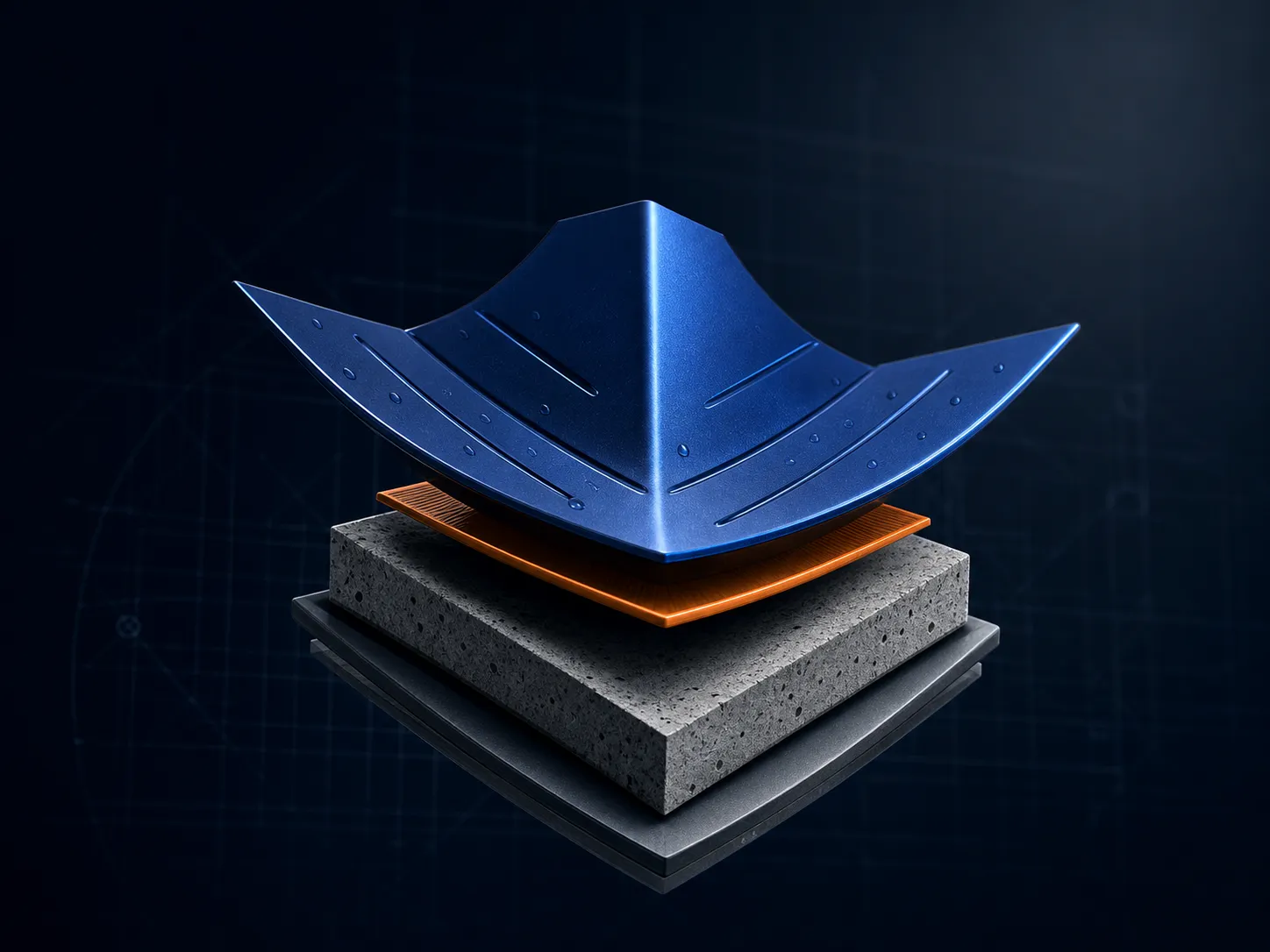
“Coating or membrane?” is the first waterproofing question on almost every Singapore roof, deck and wet area — and it is the wrong question, because there are not two systems but eight, and each one belongs somewhere. This guide sets out what each type is, where it suits in Singapore’s climate, where it fails, and how the decision is made surface by surface. It ends with the trap that defeats all eight.
1. Torch-on bituminous sheet membrane
A modified-bitumen sheet, typically polyester-reinforced, heated with a gas torch and bonded to a primed concrete substrate, with side and end laps torched together.
Where it suits. Large, simple areas where the membrane will be protected — under a screed, under ballast, on a podium under landscaping, or in buried tanking. It gives a factory-consistent thickness and performs well under sustained water pressure.
Where it fails. At the laps and the terminations. A torch-on roof is a field of seams, and every seam is a workmanship point; when a torch-on system leaks it is almost always a lap that was under-heated, an upstand termination that was not sealed, or a detail around an outlet that the sheet could not follow. Left exposed, it also weathers and requires a protective coating. And because it is hidden, water that gets under it can travel a long way from the visible leak before it is found.
2. Liquid-applied polyurea membrane
A two-component liquid applied cold by roller, brush or spray that cures into a seamless, highly elastic, hydrophobic film. In the aliphatic grade it is UV-stable; in the aromatic grade it is used where it will be covered.
Where it suits. Exposed concrete roofs, roof terraces, parapets and plant decks — anywhere the surface is dense with outlets, upstands and penetrations and stays in full sun. SealForce RC40, Rayson’s aliphatic polyurea for exposed roofs, holds its colour and gloss under UV, stays elastic from −35 °C to +80 °C, has effectively zero water uptake, is published for rooftops subject to prolonged ponding, and is walkable for maintenance access. It is also formulated to overcoat sound existing bitumen, PVC/TPO single-ply and PU-foam — which makes it the usual route for renewing an old roof without stripping it.
Beneath tiles and in wet areas, the roller-applied SealForce RC30 does the same seamless job in a concealed position: elongation above 500%, adhesion to concrete above 2.5 N/mm², serving continuously to 90 °C and shock to 200 °C, and locally repairable. It is the primary membrane in car-park deck systems and under bathroom and kitchen tiling. The toilet waterproofing page shows the concealed position step by step, from hacking to the flood test.
Where it fails. When it is asked to bridge standing water or a moving crack — no film does — and when it is applied to a damp, unprimed or unsound substrate. RC40 needs substrate moisture below 4%, relative humidity below 85% and a surface at least 3 °C above dew point, and it always goes over a primer matched to the roof material. It is not a vehicle wearing surface without a traffic system above it.
3. Liquid-applied polyurethane membrane
The most common general-purpose liquid membrane: a single- or two-component polyurethane applied by roller to form an elastic film. Aromatic grades are used where covered; aliphatic grades where exposed.
Where it suits. General roofing and balcony work, and — in the aliphatic, trafficable grade — as the wearing topcoat over a waterproof deck system. Rayson’s UraForce WB52, a water-based aliphatic urethane topcoat, is the low-odour, non-yellowing finish used over primed deck and walkway systems, taking broadcast aggregate for an anti-slip texture.
In its concealed, one-part, water-based form this is also the membrane most Singapore toilets and bathrooms are built on. SealForce WB20, Rayson’s polyurethane-modified wet-area membrane, is rolled straight from the pail in two coats at 0.4 mm wet film, bridges a 2 mm crack with elongation of at least 150%, and is flood-tested 24 hours after the final coat before the screed or tile bed covers it. No primer, no mixing, no solvent odour in an occupied home. A pre-launch trial batch was applied and flood-tested in an HDB toilet in Hougang in September 2026; the photographs are in the wet-area guide.
Where it fails. Aromatic polyurethane left exposed chalks and discolours under UV. Thin-film polyurethane on its own is not a traffic system, and — as with every liquid — thickness depends on the applicator achieving the published consumption.
4. Acrylic liquid membrane
A single-component, water-based acrylic that dries by evaporation to an elastic film, usually fibre-reinforced in multiple coats.
Where it suits. Low-cost, low-odour exposed roofing and maintenance recoats where the roof is sound and the falls work. Easy to apply, easy to recoat.
Where it fails. Under standing water — acrylics soften and re-emulsify if ponded for long — and in thin or under-reinforced films. It is a maintenance system for roofs that already drain, not a repair for roofs that do not.
Rayson’s acrylic. SealForce AC10 is a one-part, water-based acrylic for pitched and tiled roofs, external walls and sound roofs that drain freely: over its acrylic primer, SealForce AP05, two coats at about 0.68 kg/m² each as a roof coating, or three with a polyester reinforcing fleece as waterproofing. Its data sheet states the same limits: no long-term ponding water and no foot traffic.
5. Cementitious waterproofing
A polymer-modified cement slurry, rigid or flexible, brush- or trowel-applied to concrete and masonry, bonding into the substrate.
Where it suits. Wet areas that will be tiled — bathrooms, kitchens, wash bays — planters, water features and basements, where it is concealed, protected and in contact with a cementitious substrate. It is the most common wet-area system in Singapore because it is compatible with tile adhesives and tolerates damp concrete.
Where it fails. Rigid grades crack with movement; even flexible grades are not suited to full UV exposure or to surfaces that flex. It is not a roof system, and it does not follow a complex exposed detail the way a liquid film does.
A latex additive mixed into ordinary cement is a different product again, often sold as waterproof cement: it improves the render, screed or tile bed but is not a membrane. The waterproof cement guide explains where it belongs.
6. Crystalline waterproofing
A cementitious treatment whose active chemicals migrate into the concrete and react with moisture to grow crystals that block the capillaries. It waterproofs the concrete itself rather than forming a surface film.
Where it suits. Basements, lift pits, water-retaining structures and any concrete that will be buried, tiled or under negative-side water pressure — the one condition a surface film cannot handle from the wrong side.
Where it fails. It is not a membrane. It does not bridge cracks, does not protect an exposed surface from UV or wear, and does not seal a joint or an upstand. It is frequently combined with a surface system rather than used instead of one.
7. PVC and TPO single-ply sheet
Factory-made thermoplastic sheets, mechanically fixed or adhered, with seams hot-air welded on site.
Where it suits. Large, simple roofs — warehouses, factories, exposed or ballasted — where a uniform, factory-controlled membrane can be laid fast with welded seams that are stronger than torched laps. Where the warehouse or factory roof is profiled metal sheet rather than a deck, the liquid route over the laps and fasteners is on the industrial roof waterproofing page.
Where it fails. At seams and terminations under poor workmanship, at penetrations the sheet has to be cut around, and with age as plasticisers migrate and the sheet embrittles. An aged single-ply roof that is still sound is a common candidate for liquid overcoating rather than replacement — RC40 is formulated for exactly that.
8. Hot-spray pure polyurea
A 100%-solids, two-component polyurea sprayed hot through plural-component equipment. It gels in seconds and forms a thick, seamless, chemically resistant lining.
Where it suits. Tanks, bunds, secondary containment, below-grade structures, marine splash zones and water-retaining concrete — anywhere the lining must be thick, fast, seamless across joints and resistant to chemicals or immersion. SealForce SP200 is the general containment and below-grade grade; SealForce SP210 is the potable-grade lining for water tanks and reservoirs.
Where it fails. In the wrong hands. It is applied only by specialist applicators with heated plural-component plant, always over the specified primer, and the aromatic chemistry discolours under UV — physical properties unaffected — so exposed finishes need a stable topcoat. It is not a roller product and not a DIY one.
Liquid-applied or torch-on: side by side
The two systems Singapore roofs are most often quoted for, compared line by line. Cost and lifespan bands are those published in Singapore guides in 2026; the cost guide lists the sources.
| Liquid-applied membrane (PU or polyurea) | Torch-on modified bitumen | |
|---|---|---|
| Applied thickness | Two or more coats to a specified film, RC40 at 1 to 1.2 kg/m² over two layers | Factory sheet, typically 3 to 4 mm, one or two layers |
| Seams | None; one continuous film | Every side and end lap is torched on site |
| Detailing | Follows outlets, upstands and penetrations in the same film, reinforced with fabric | Sheet is cut, lapped and dressed around each detail; terminations sealed separately |
| Hot works | None for cold-applied systems | Gas torch on the roof; permit and fire watch on occupied buildings |
| Cost band, per m² | S$15 – 30 basic coating; S$25 – 60 higher-performance membrane | S$30 – 60 and above |
| Repairability | Local: clean, prime, recoat the area | Local patches possible, but water can travel beneath a sheet far from the visible leak |
| Typical life quoted | 8 – 15 years PU; 20 years or more claimed for aliphatic polyurea | 10 – 25 years, protected or ballasted |
| Best for | Roofs dense with details, exposed roofs, occupied buildings, roofs renewed without stripping | Large, simple, open roofs that will be protected or buried, and podiums under sustained water pressure |
The concession first: on a large, open roof with few details that is going to be covered by screed, ballast or landscaping, torch-on is the right system, and a manufacturer of liquid membranes should say so. The seams it depends on are a workmanship risk, not a material one, and on an open field a good crew makes them reliable. Liquid systems earn their place where the roof is not simple: many outlets, upstands and penetrations, full sun, an occupied building beneath that cannot take hot works, or an aged membrane that is sound enough to overcoat rather than strip. Rayson’s SealForce RC40 is the liquid route for that exposed, detail-heavy roof; for the buried podium it is not the answer, and the page says so.
Is waterproofing paint the same as a waterproofing membrane?
Plenty of people searching for a fix type “waterproofing paint”, and the honest answer is that the phrase covers two very different things.
A waterproofing paint, in the retail sense, is a thin decorative coating sold in a tin for damp walls — a single thin film, a few tenths of a millimetre, applied by brush over a surface that is already broadly sound. It resists damp and improves appearance. It is not designed to hold standing water, bridge a moving crack or survive a roof.
A liquid-applied waterproofing membrane also arrives as a liquid and also goes on by roller or brush, which is why the two get confused. The difference is what it becomes: a membrane is applied at a specified consumption in kilograms per square metre, in two or more coats, to a measured thickness, over a primer, with the details reinforced — and it cures to a continuous elastic film engineered to hold water under head and to move with the substrate. SealForce RC40 and SealForce RC30 are membranes in that sense. So is SealForce AC10: a one-part acrylic rolled on from the pail, the closest thing in the range to what people mean by waterproofing paint, with a published consumption, wet-film thickness, elongation and adhesion.
The test is not what it is called or how it is applied. It is whether the product publishes a consumption figure, a film thickness, an elongation and an adhesion value — and whether the specification names a primer and a detailing sequence. A tin that says only “waterproof” on the label is a paint. Rayson does not make retail waterproofing paint; it makes the membranes an applicator installs, and publishes the numbers that let you tell the two apart.
The decision, by surface
| Surface | Usually points to |
|---|---|
| Exposed RC roof with outlets, upstands and plant | Liquid aliphatic polyurea (RC40) |
| Roof terrace or plant deck, walked on | Aliphatic polyurea, with a wearing coat where traffic is constant |
| Car park deck, exposed or covered | Polyurea membrane (RC30) under a traffic system with a UV-stable topcoat |
| Car porch, balcony, landed-home terrace | Liquid membrane, tiled or exposed by design |
| Bathroom, kitchen, wash bay — to be tiled | One-part water-based membrane (WB20) beneath tiling; RC30 for heavier duty; flexible cementitious where specified |
| Podium under landscaping or screed | Sheet membrane, with liquid on exposed edges and details |
| Basement, lift pit, water table | Sheet tanking or crystalline, often together |
| Tank, bund, containment, reservoir | Hot-spray polyurea (SP200 / SP210) |
| Large simple warehouse roof | PVC/TPO single-ply, or liquid overcoat when aged |
| Sound but aged bitumen or single-ply roof | Liquid overcoat (RC40) after assessment |
| Pitched or tiled roof, external wall, or a sound roof that drains and is not walked on | One-part acrylic membrane (AC10), after repairs |
The hub page for waterproofing in Singapore routes each of these to the page with the depth for that surface; the roof guide and the car park deck guide cover the two most common in detail.
The trap that defeats all eight
The most expensive waterproofing mistake is not choosing the wrong category. It is choosing any category to cover a problem none of them can solve.
- Ponding water from failed falls will age and eventually defeat any system. Fix the falls first.
- Moving structural cracks reappear through liquid films and split sheet laps. Treat the crack — as a designed joint, or with a repair such as PatchBond TX80 where it is static — before waterproofing over it.
- Negative-side water pressure pushes water the wrong way through positive-side systems. It needs crystalline treatment or tanking designed for it, not a heavier coat.
- A saturated substrate or waterlogged old membrane cannot be sealed in. It is dried or removed.
No waterproofing product, however good, substitutes for correcting the water path. That is the honest heart of every waterproofing decision, and the first thing an assessment establishes.
Preparation is still the foundation
Whichever system is chosen, it is only as good as the surface it bonds to. Sound, clean, mechanically prepared concrete, at the moisture level the system allows, with the primer that system specifies for that substrate, is the base for every liquid membrane — just as a prepared and detailed substrate is for a sheet. See the surface preparation guide.
Getting the right call
If you are weighing these systems for a Singapore roof, deck or wet area, the fastest route to a good answer is to describe the surface, the exposure, the geometry and — crucially — any ponding or cracking. Rayson will specify the system where a liquid membrane genuinely fits, say so plainly when a sheet, a cementitious system or a structural repair is the right first step, and often recommend more than one in different zones. Rayson supplies the system and publishes its data; an applicator in the Rayson network assesses, quotes and installs it. Send us the surface and we will take it from there.