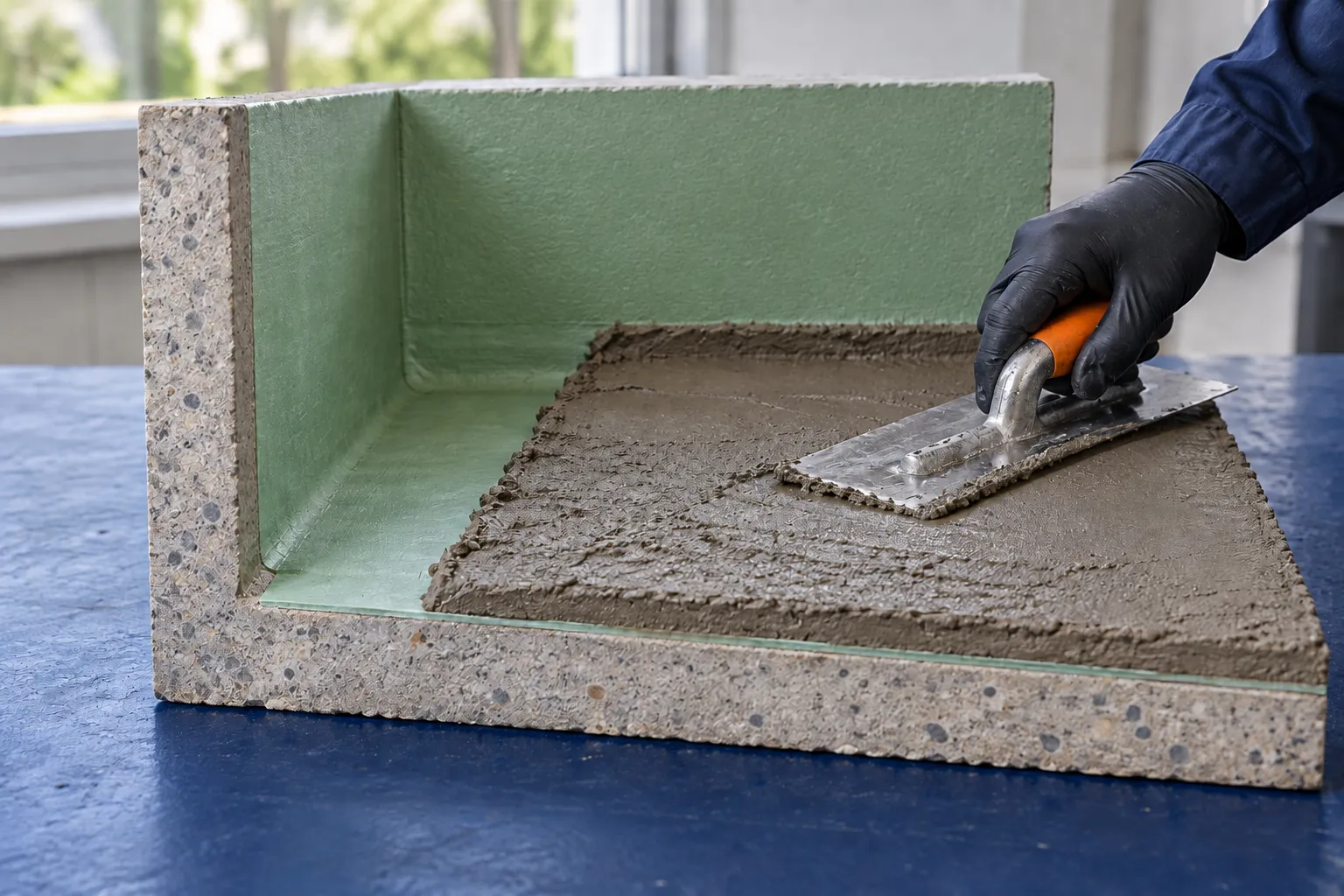
Search for waterproof cement in Singapore and you will find three different products under one name, sold for jobs as different as plastering a wall and waterproofing a toilet. Some of those jobs suit them. Others need a membrane, and the difference decides whether the ceiling below stays dry. This guide sets out what each product is, what a latex additive actually does to cement, where it belongs and where it does not.
Three things sold as waterproof cement
| What is sold | What it is | How it is used | Is it the waterproofing? |
|---|---|---|---|
| Latex or polymer additive | A liquid mixed into ordinary cement and sand in place of some or all of the water | Renders, screeds, slurry coats, tile adhesive and grout; bonding new work to old | No. It makes the cement layer resist water, and the layer stays rigid |
| Waterproof plaster or screed | A ready-mixed bag of cement, sand and a water-repellent admixture | Plastering walls and laying floor screeds | No, for the same reason |
| Cementitious waterproofing coating | A polymer-modified cement slurry, often supplied as a powder and a liquid, in rigid and flexible grades | Brushed or trowelled on in coats as the waterproof layer itself | Yes, in its flexible grades, where it is specified as the membrane under tiles |
The first two are what most people mean by waterproof cement. They make the render, screed or tile bed denser and less absorbent, which is worth having, but they do not turn it into a membrane. The third is a membrane system in its own right, and the membrane comparison sets out where it fits beside the liquid and sheet systems.
What a latex additive does to cement
A latex additive is mixed into the cement as part or all of the gauging water. As the mortar cures, the latex forms a film through the cement paste. Compared with a plain mix, the result:
- lets less water through the render, screed, slurry or grout it is mixed into;
- bonds better to old concrete, render and existing tiles, which plain mortar does poorly;
- is stronger and more flexible, so it cracks, dusts and debonds less.
Rayson’s additive, SealForce RW1, publishes its figures in its data sheet. Mortar modified with RW1 reaches a compressive strength above 50 N/mm² and a flexural strength above 10 N/mm², with a bond strength above 0.3 N/mm² for marble, granite and homogeneous tiles. The mixes are by volume:
- Slurry coat or thin-set: 1 part RW1, 1 part cement and 1 part sand, with sand under 0.5 mm for thin-set and grout. Lay the render, screed or tiles onto the slurry while it is still wet, never over a dried slurry.
- Renders, screeds and grout: RW1 diluted 1:1 with water, used as the mixing water. Add no extra water; it weakens the mortar.
Concrete should be at least 28 days old and render at least 7 days, and the fresh work is protected from rain, direct sun and drying wind while it cures. The technical data sheet sets out the full limits.
Why waterproof cement is not a membrane
However well it is modified, a cement layer stays far stiffer than a membrane. When the slab deflects, the screed shrinks or a wall moves against the floor, a crack opens through it, and water follows the crack. In a wet area that happens at the same places every time: the floor trap, the pipe penetrations, the wall–floor junction, the door threshold and the shower wall. The course BCA Academy runs on its good-practice guide for internal wet areas opens on the same point: most wet-area leaks occur at the floors and internal walls of toilets and kitchens.
A membrane is built for those places. It is a continuous elastic film across the whole floor, turned up every wall, dressed into the trap and around every pipe, and flood-tested before anything covers it. SealForce WB20, Rayson’s wet-area membrane, stretches by at least 150% before it breaks and bridges a 2 mm crack, and it is rolled on in two coats at 0.4 mm wet film each. A latex additive in the screed above it cannot do that job, and it is not meant to: the membrane is the waterproofing, and the modified cement makes the layers around it stronger and more water-resistant.
Where waterproof cement belongs
- Above a wet-area membrane. Once WB20 has passed its 24-hour flood test, the screed is laid with RW1 diluted 1:1, the tiles are bedded in adhesive or thin-set mixed with RW1, and the grout follows at least 24 hours later with RW1 in it.
- Render and plaster repairs on external walls, before the wall is primed with SealForce AP05 and coated with SealForce AC10.
- Bonding new to old. A 1:1:1 slurry coat, brushed onto roughened old concrete, holds a new render or screed that would otherwise come away.
- Tile over tile. In a new HDB flat, removing bathroom and toilet wall and floor finishes is restricted for the first three years, so new tiles go over the old on an RW1 slurry coat. It keeps the old membrane in place, which is right only while that membrane is sound.
- Hollow plaster and screed, re-bonded by injecting the additive behind them.
Where it does not belong
- As the only waterproofing in a toilet, bathroom, balcony or planter. Those take a membrane: WB20 in toilets and bathrooms, SealForce RC30 for decks and heavier-duty wet areas.
- As the waterproofing on an exposed roof. A roof that drains freely takes AC10; one where water ponds or people walk takes SealForce RC40. The roof waterproofing page sets out the choice by roof.
- Against groundwater, in water tanks or under permanent immersion. These need a system designed for water pressure or immersion, such as the tank linings SealForce SP200 and SP210.
- Over a leak that has not been traced. A stain on the ceiling below a toilet is a failed detail upstairs; the ceiling leak guide shows how it is found and repaired from above.
A Singapore toilet, layer by layer
| Layer | What it does | Rayson material |
|---|---|---|
| Concrete slab and screed to falls | Carries the floor and drains water to the trap | Prepared, sound and clean before the membrane |
| Membrane, two coats, up the walls and into the trap | The waterproofing, flood-tested for 24 hours before anything covers it | SealForce WB20 |
| Protection screed or tile bed | Protects the membrane and beds the tiles | Mortar or adhesive gauged with SealForce RW1 |
| Tiles | The finish | — |
| Grout, at least 24 hours after tiling | Fills the joints and slows surface water | Grout gauged with SealForce RW1 diluted 1:1 |
The toilet waterproofing page sets out the sequence on site, the HDB rules and the market costs, and the wet-area guide goes through the five details where nearly every Singapore bathroom leaks.
Buying it, or having the work done
SealForce RW1 comes in a 20 kg pail and is part of Rayson’s upcoming waterproofing release, alongside the WB20 membrane it works with. Rayson supplies the material to applicators, contractors and building owners, and publishes its technical data. Where you need the work done rather than the material, Rayson can pass the job to an applicator in its network, who inspects the site, issues the quotation and invoice, and gives the workmanship warranty.
Either way, start with the job rather than the product: send photographs of the wall, floor or bathroom and say what it is, and we will tell you whether it needs waterproof cement, a membrane, or both.