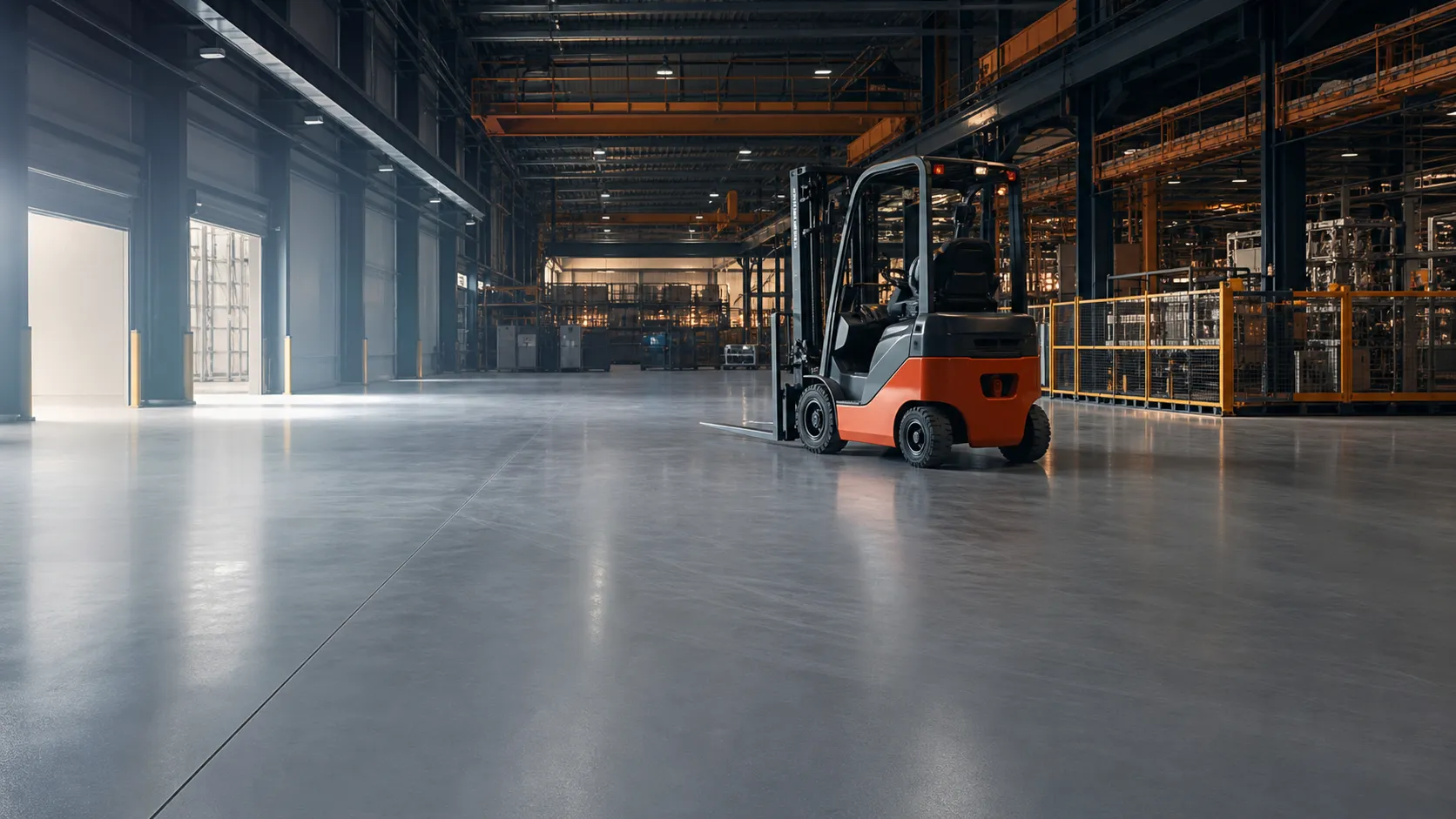
Singapore buyers search for “resin flooring”, “epoxy flooring” and “PU flooring” as if they were three products to choose between. They are three chemistries that do three different jobs, and most industrial facilities end up with two of them on the same floor plate. This guide sets out what each one is, where it wins, where it fails, and which one each kind of facility actually needs — from the manufacturer that makes all three.
The three chemistries in one table
| Epoxy | Polyurethane (PU) | PU-cement | |
|---|---|---|---|
| What it is | Two-part resin that cures hard and rigid | Two-part resin that cures tough and flexible | Polyurethane resin blended with cement and aggregate; trowelled or self-smoothing screed |
| Typical role | The body of the floor — roller coating or self-levelling system | The finish — UV-stable, flexible, scuff-resistant topcoat | The whole floor in wet, hot, chemical service |
| Build | Coating 0.3–0.5 kg/m² per coat; self-levelling 1.6–2.0 kg/m² | 0.1–0.3 mm topcoat | 1.5–3 mm self-smoothing; 6–9 mm trowel-applied heavy duty |
| Heat and thermal shock | Softens above its glass-transition; hot wash-down and steam crack it | Better flex, similar heat limit | Built for hot water, steam and blast-chill cycles |
| Chemical resistance | Very good against oils, fuels, most acids and alkalis | Good; depends on grade | Excellent against food acids, fats, sugars, caustic cleaners |
| UV | Aromatic epoxy yellows and chalks in sun | Aliphatic PU holds colour and gloss outdoors | Not a finish; matt, colour-stable enough for interiors |
| Impact and movement | Rigid — cracks rather than flexes | Elastic — absorbs impact and movement | Very high impact tolerance in heavy-duty grade |
| Moisture in the slab | Needs a dry slab or a damp-tolerant primer / water-based grade | Needs a dry, primed surface | Tolerant of damp and highly absorbent substrates |
| Return to service | Typically 24 h foot, 48–72 h light traffic, 7 d full cure at 25 °C | Similar | Fast — often 24–48 h to traffic, subject to grade and TDS |
| Relative material cost | Lowest (coating) to moderate (self-levelling) | Low as a topcoat | Highest per m² — and the only one that survives its duty |
Every figure above is a family characteristic; the exact numbers for a Rayson product are on its technical data sheet, and those are the numbers a specification uses.
Epoxy: the body of the industrial floor
Epoxy is where most Singapore industrial floors start and, for dry duties, where they stay. It bonds hard to prepared concrete, wears well, cleans easily and resists the oils, fuels, forklift tyres and most of the chemicals a warehouse or workshop sees. It comes in three builds that share a name and little else:
- Roller-applied epoxy coating — FloorGuard R50, a solvent-free high-solids epoxy at 0.3–0.5 kg/m² per coat in two coats. Smooth and glossy plain, slip-resistant with a quartz broadcast. The economical answer for warehouses, workshops, garages, plant rooms and car parks.
- Self-levelling epoxy — LevelShield SL120, a 100%-solids poured wearing coat at 1.6–2.0 kg/m² that flows out to a seamless, dead flat, heavier-build floor for production, cleanrooms, forklift routes and loading bays. The self-levelling epoxy page sets out when the extra build is worth it.
- Water-based epoxy — HydroShield WE40, damp-tolerant and low-odour, for occupied buildings and slabs that cannot be dried, at the cost of a thinner film.
Where epoxy fails. Under permanent sun, where aromatic epoxy chalks and yellows. Under hot wash-down, steam and thermal shock, where the rigid film cracks and delaminates. Over a moving crack or joint, which it will not bridge. And over a damp slab without the right primer, where it blisters. Each of those is where one of the other two chemistries takes over.
Polyurethane: the finish epoxy cannot be
Polyurethane cures tougher and more elastic than epoxy, and an aliphatic PU keeps its colour and gloss under Singapore sun where an epoxy or an aromatic PU will not. It is rarely the whole floor. It is the finish over an epoxy or polyurea build where the floor is exposed to UV, needs to flex, or is scuffed and cleaned constantly.
- Exposed and decorative finishes — UraForce SB72, an aliphatic polyurethane topcoat for car park decks, ramps, car porches, loading aprons and any floor the sun reaches.
- Low-odour interior finishes — water-based UraForce grades over an epoxy body coat in offices, schools and retail, where solvent odour is the constraint.
Where PU fails. As a body coat on its own, it is too thin to carry heavy build; as a topcoat over an unprepared or incompatible base it peels with the base. And a PU finish on a floor that gets hot wash-down does not rescue the epoxy underneath — that floor needed a screed. The PU flooring page separates the polyurethane finish from the PU-cement screed, because the abbreviation hides the difference.
PU-cement: the screed for heat, wet and chemicals
Polyurethane-cement — also called polyurethane concrete or PU screed — is a hybrid of polyurethane resin, cement and graded aggregate, laid as a screed rather than a coating. It exists because epoxy fails in food factories, central kitchens, breweries, pharmaceutical wet rooms and chemical process areas: hot water and steam cycling, blast-chilling, fats, sugars, lactic acid and caustic clean-in-place chemicals.
- Self-smoothing grade, 1.5–3 mm — PurScreed PC70, a four-part water-based PU-cement at about 1.8 kg/m² per millimetre, for medium- to heavy-duty floors with forklift traffic, wet processing and washdown. It tolerates damp and highly absorbent substrates that would blister an epoxy.
- Trowel-applied heavy duty, 6–9 mm — for impact, dropped loads, steel-wheeled traffic and the harshest thermal shock. The PU screed page covers the duty grades.
Where PU-cement fails. Nowhere it was specified for. It fails commercially: on a dry warehouse or office floor it costs several times an epoxy for conditions that never occur. And it fails at the details like every other system — coves, drains and joints done badly leak underneath the best screed in the building.
Which resin floor, by facility
| Facility | Wet / hot / chemical zones | Dry zones | Exposed to sun |
|---|---|---|---|
| Food factory, central kitchen | PU-cement screed | Anti-slip epoxy | — |
| Commercial kitchen, F&B back of house | PU-cement screed | Epoxy | — |
| Warehouse, logistics | — | Roller epoxy or self-levelling epoxy on forklift routes | Aliphatic PU finish on aprons |
| Manufacturing, assembly | PU-cement where process liquids or heat | Self-levelling epoxy | — |
| Electronics, cleanroom | — | Self-levelling epoxy; conductive epoxy where ESD control is required | — |
| Chemical processing, plant rooms | PU-cement or chemical-resistant epoxy by exposure | Epoxy | Aliphatic PU finish |
| Car park, ramp, car porch | — | Epoxy traffic system indoors | Polyurea membrane + aliphatic PU finish on exposed decks |
| Workshop, garage | Epoxy | Epoxy | Aliphatic PU finish |
| Office, school, retail | — | Water-based epoxy + water-based PU finish | — |
The pattern is the same in every row: the wet, hot or chemical zone decides whether PU-cement is needed; the dry zone is epoxy; the sun decides whether an aliphatic PU goes on top. Get the zoning right and the chemistry follows.
Reading a quotation that says “resin flooring”
The word covers a 0.3 mm coating and a 9 mm screed — a difference of thirty times in material. A quotation that can be compared with another names the chemistry, the system, the applied thickness or consumption, the primer, the preparation and the technical data sheet. Rayson publishes coverage for every product, so the material allowance inside any quotation built on Rayson systems can be checked; the floor coating cost guide sets out what else moves the number.
Rayson makes all three chemistries in Singapore and supplies them to applicators, contractors and facility teams. Send us the floor — the zones, what happens in each, what is on the slab now and the shutdown window — and we will specify the system for each zone, send the data sheets, and introduce an applicator in the Rayson network where you need the floor installed.