Interior duty
Seamless, cleanable floors for warehouses, production areas, plant rooms and commercial back-of-house spaces.
- Indoor exposure
- Concrete or prepared screed
- Traffic-led film build
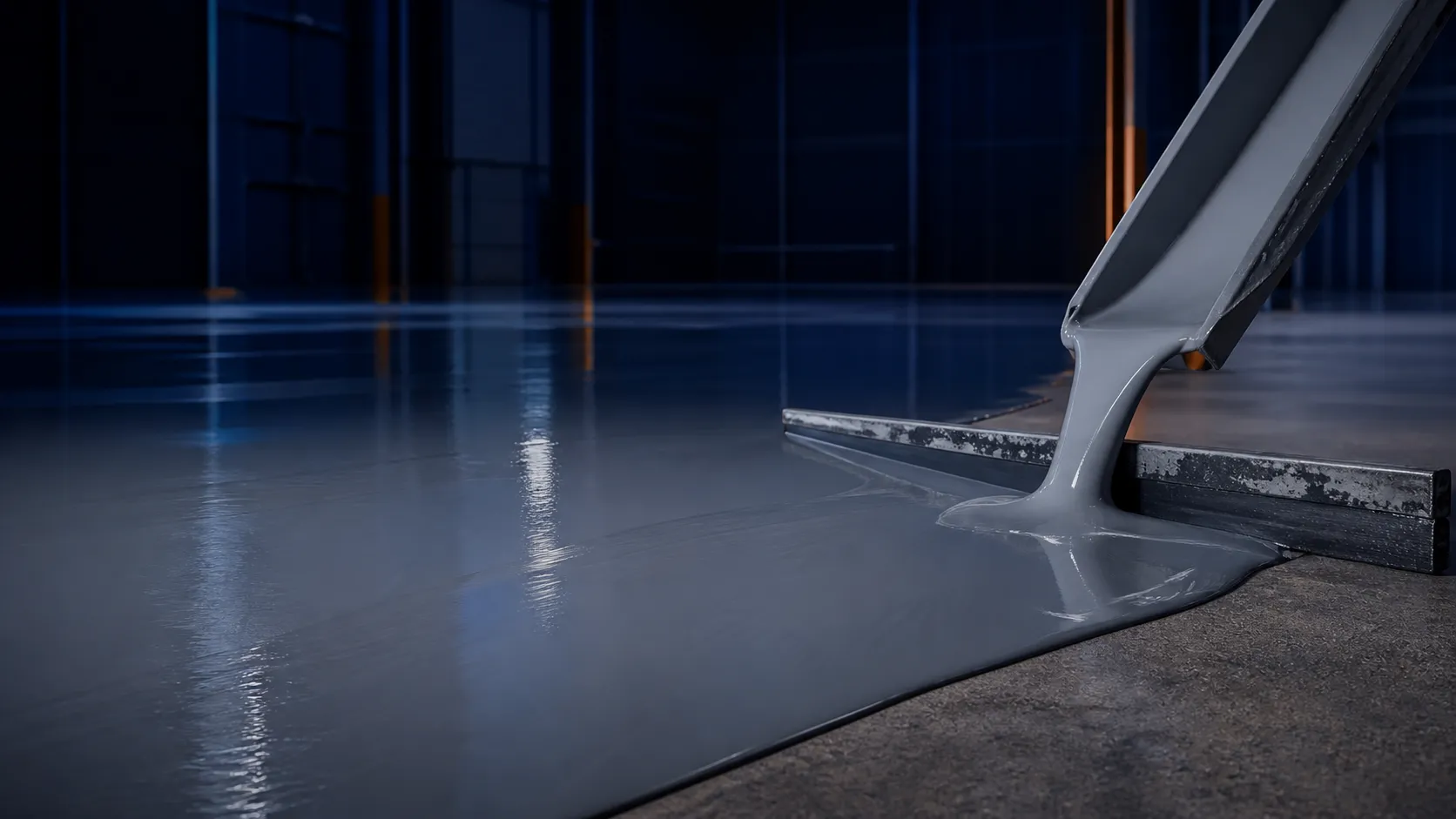
Epoxy resin flooring, epoxy floor coating, epoxy screed: mostly the same chemistry at different thicknesses. For a factory, a warehouse or an HDB, condo or landed home, tell us the traffic, the slab and the window you have, and we will match the primer, epoxy build and finish to what the floor actually faces, then quote the job and have an applicator from our network install it.
Reviewed: September 2026
Reply within one working day, Mon–Fri. Rayson quotes; an applicator from its network inspects and installs.
Epoxy flooring in Singapore costs about S$3–6 per sq ft for a roller-applied epoxy floor coating, S$6–12 per sq ft for a self-levelling epoxy floor and S$8–15 per sq ft for anti-slip or ESD systems, supplied and applied, according to Singapore price guides checked on 26 September 2026. Home floors run S$4–12 per sq ft. The words epoxy flooring, epoxy resin flooring and epoxy floor coating describe one family of systems at very different thicknesses, which is why two quotes for the same floor disagree. Rayson formulates and specifies the systems in Singapore, releases every batch here, publishes a technical data sheet for each, and quotes the job, which an applicator from its network installs.
Price bands by system ↓Epoxy for homes ↓Singapore rules ↓Full cost guide with sources →
The useful decision is not “epoxy or not?” It is whether the full system fits the real environment before work begins.
Seamless, cleanable floors for warehouses, production areas, plant rooms and commercial back-of-house spaces.
Damp slabs, existing coatings, joints, local cracking and narrow shutdown windows need a closer technical review.
Direct UV, hot wash-down, steam, thermal cycling or active movement can call for a PU, PU-cement or repair route.
Singapore buyers meet all of these words for what is broadly one chemistry. They are not synonyms in practice—and the difference between them is usually why two quotations disagree.
| The phrase you will meet | What it usually means on a Singapore job | Where it lands in the Rayson range |
|---|---|---|
| Epoxy flooring / epoxy floor | The umbrella term for any floor whose binder is epoxy resin — anything from a two-coat film to a poured build. It says nothing about thickness, which is exactly why it hides the difference between two prices. | Everything below. Settle the build before you compare rates. |
| Epoxy resin flooring / epoxy resin floor | The same family, named after the binder. Specifiers and architects tend to use it for poured, seamless finishes rather than thin films, so it usually signals a self-levelling build. | LevelShield SL120 self-levelling epoxy |
| Epoxy floor coating / epoxy coating | Almost always the thin-film end: a roller- or squeegee-applied film measured in tenths of a millimetre, applied over an epoxy primer. Economical, cleanable, and the fastest to reinstate. | FloorGuard R50, or HydroShield WE40 where odour matters |
| Epoxy self-levelling / self-smoothing epoxy | Material poured, spread with a notched rake and spike-rolled so it finds its own level — a seamless wearing floor rather than a film on top of one. | Self-levelling epoxy flooring, LevelShield SL120 at roughly 1.6–2.0 kg/m² |
| Epoxy screed / epoxy mortar | Resin mixed with graded aggregate and laid with a trowel to a set depth: used to rebuild concrete and to form heavy repairs. Careful — locally, “screed” is also used for PU-cement screeds, which are not epoxy. | MortarBond EM90 epoxy mortar; for PU-cement see PurScreed PC70 |
| Epoxy floor finish / seal coat | The last layer — what decides gloss, colour, cleanability and slip profile. Epoxy is not a UV-stable finish, so sunlight moves the finish to an aliphatic polyurethane over the epoxy build. | FloorGuard R50 as a seal coat; UraForce PU finishes where UV reaches the floor |
| Conductive / ESD / antistatic epoxy | An epoxy floor whose conductivity runs through the cured body and is earthed to grounding points, then verified by measurement after cure rather than assumed. | StaticGuard CX90, see conductive / ESD epoxy flooring |
If a quotation says only “epoxy flooring”, it has not yet told you the one thing that governs both performance and price: the applied build. Ask for the product name, the applied thickness or consumption rate, and the preparation scope — then two numbers can honestly be compared.
Select the operating reality. The guidance, product route and enquiry context follow it.
For production floors, warehouse aisles and clean environments where a smooth, level wearing surface is required — the build most people mean by “epoxy resin flooring”.
Typical route PrimeBond E20 → LevelShield SL120
Review LevelShield SL120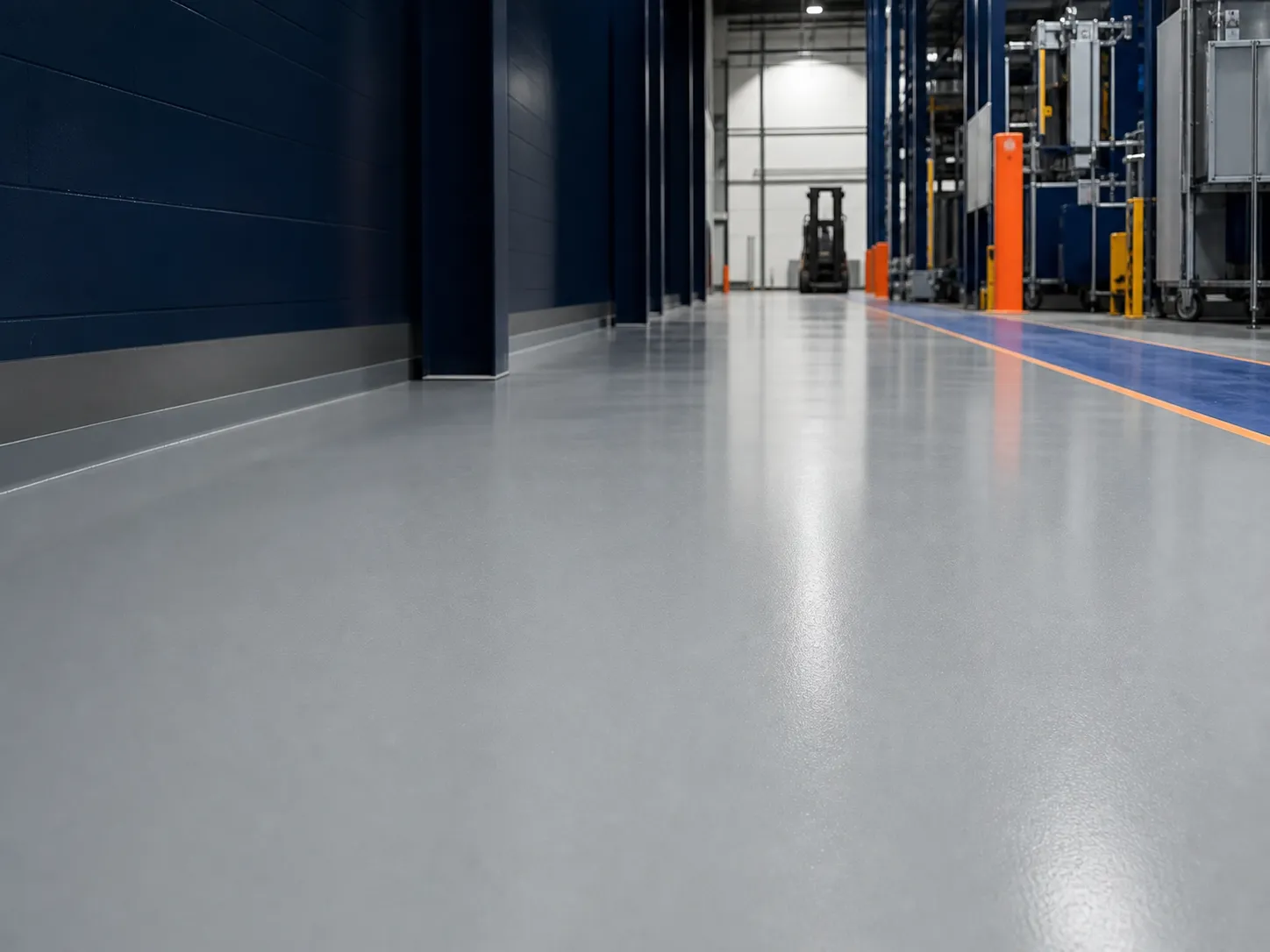
The classic epoxy floor coating: plant rooms, service corridors and lighter-duty operational areas where cleanability and sensible maintenance matter.
Typical route PrimeBond E20 → FloorGuard R50
Review FloorGuard R50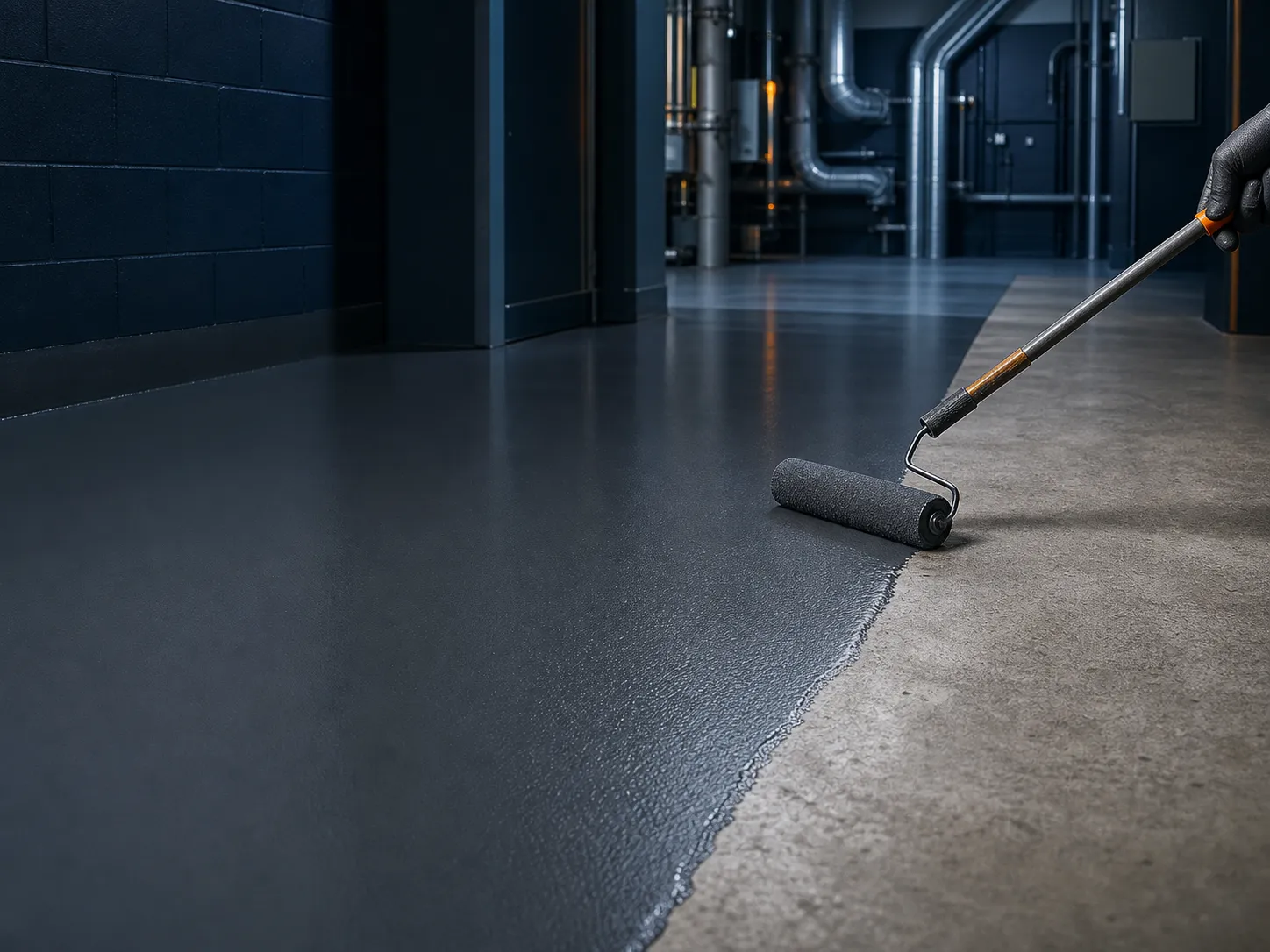
For schools, offices and retail settings where programme and occupancy shape the coating decision as much as the surface does.
Typical route HydroShield WE40 or WE45, selected for the substrate and duty
Review HydroShield systems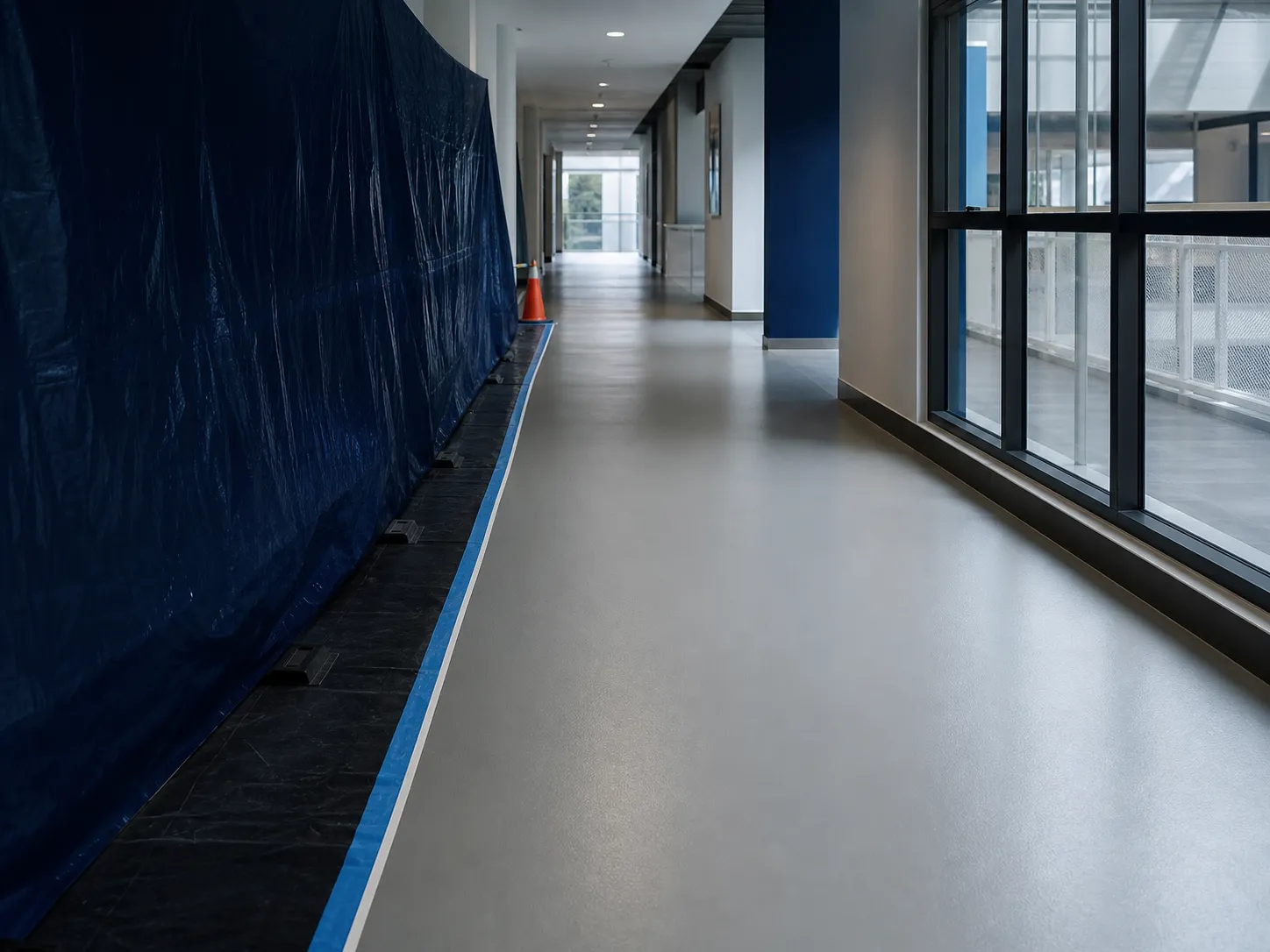
Published product data rather than a sales sheet. Read the TDS against your slab, exposure and shutdown window before anything is committed.
Solvent-free, high-solids epoxy floor coating that cures to a smooth gloss — or to a slip-resistant surface when aggregate is broadcast between coats.
Solvent-free, 100%-solids self-smoothing epoxy floor. Poured, raked and spike-rolled into a seamless wearing surface rather than a film on top of one.
Solvent-free conductive epoxy flooring for ESD-protected areas. Conductivity is built into the cured matrix, not applied as a surface treatment that wears away.
Not an epoxy. A four-part water-based polyurethane-cement screed, and the honest answer where an epoxy floor would be asked to do something it cannot.
Around those four: PrimeBond E20 (TDS) is the solvent-free epoxy primer under most of these builds, covering 6–8 m² per kg per coat and tolerating damp — though not wet — slabs up to 5% moisture content. PrimeBond S30 (TDS) is the solvent-based route where deeper penetration into a prepared mineral substrate is required, and needs suitable ventilation. Where the slab itself is broken before any coating goes down, MortarBond EM90 (TDS) is the epoxy mortar that rebuilds it at 80 N/mm² at 7 days. For low-odour work in occupied buildings, HydroShield WE40 (TDS) and WE45 (TDS) are the water-based epoxy options.
The visible surface is the final decision, not the first. Preparation, primer compatibility and film build determine whether the system stays bonded and useful.
Open PrimeBond E20 technical dataCheck the slab and select the primer from its actual condition. Active water ingress is a substrate problem first. Review epoxy floor coating preparation.
High temperatures shorten working time and pot life. Mixing and application discipline protect the selected build; confirm the selected product’s timing in its TDS.
The system needs to fit the preparation, recoat and return-to-service window the project can really afford. Send the actual shutdown window for review.
Epoxy is a strong interior starting point. UV stability, thermal shock and severe wash-down can change the chemistry required.
| Epoxy | Polyurethane | PU-cement | |
|---|---|---|---|
| Best role | Interior primers and body coats | UV-stable finishes | Heat and wash-down duty |
| UV exposure | Not a standard exposed finish | Suitable with selected system | Confirm the required build |
| Thermal shock | Limited | Limited | Designed for demanding wet-process duty |
| Typical selection question | What traffic and substrate? | What UV or flexibility? | What heat, chemistry or wash-down? |
For full coating-system selection guidance, read how to select a coating system, follow the epoxy floor application guide, or compare PU and PU-cement flooring routes.
Homeowners ask three things: is epoxy good for a house, is it slippery, and can it go over the tiles. The honest answers, and the HDB rules that shape the job.
Living areas and bedrooms once the old tiles are hacked out and the screed levelled, garages and store rooms, car porches, and shophouse or loft floors on bare concrete. Low-odour water-based epoxy and water-based PU topcoats suit an occupied home; a non-yellowing polyurethane finish handles sunlit rooms; broadcast aggregate gives wet areas and porches grip.
Hacking and re-laying floor finishes needs an HDB renovation permit, through a contractor on HDB's Directory of Renovation Contractors. Hacking and other noisy work runs 9 am to 5 pm on weekdays only. Floor finish and screed together may not exceed 50 mm. In a new flat, bathroom and toilet finishes cannot be replaced for three years from the block's completion.
Rayson's data sheets cover concrete and cement screed. No Rayson system is published for coating over glazed tiles without hacking, and there is no metallic or decorative-art finish. If that is the job you want, tell the applicator; they will assess the tiles and advise on the right route. Slippery bathroom, kitchen or corridor tiles are a different job: anti-slip floor treatment, applied over the existing tiles with no hacking.
The full guide covers rooms, disadvantages, epoxy versus tiles, slip ratings, timing and prices per square foot: epoxy flooring for homes in Singapore; the toilet job on its own, over the tiles or after hacking, is on toilet epoxy flooring. A toilet that also leaks to the flat below is waterproofed beneath the tiles before any floor coating goes down: toilet waterproofing in Singapore. HDB's rules are summarised from its renovation guidelines for building works and important information on renovations; confirm the current terms with HDB before you plan.
Singapore price guides checked on 26 September 2026 put the systems in the bands below, supplied and applied. Two quotes for the same floor still disagree, because they describe different builds and scopes. The full table with its sources is in the epoxy flooring cost guide; the drivers beneath it are the short version.
| System | Per sq ft | Per m² | Typical use |
|---|---|---|---|
| Roller-applied epoxy floor coating, 2–3 coats | S$3–6 | S$32–65 | Warehouses, workshops, garages, plant rooms |
| Self-levelling epoxy floor | S$6–12 | S$65–129 | Production floors, showrooms, clean rooms |
| Anti-slip or ESD epoxy systems | S$8–15 | S$86–161 | Ramps, wet zones, electronics floors |
| Home floors, epoxy over screed | S$4–12 | S$43–129 | Living areas, garages, porches; a single HDB toilet is a minimum-charge job at roughly S$650–1,200 |
Market ranges published by Singapore price guides and directories, checked on 26 September 2026, not Rayson quotations. Screed levelling adds about S$1–5 per sq ft, tile hacking and disposal S$3–8 per sq ft, and diamond grinding, crack repair and removal of a failed coating are quoted per job. Below about 100 m², expect the per-square-foot figure to sit above every band.
| Cost driver | Why it moves the number |
|---|---|
| Applied build | The dominant variable, and the one most often left out. A roller-applied epoxy floor coating is a film of a few tenths of a millimetre; a self-levelling epoxy floor is a poured build; an epoxy screed is trowelled to depth. Same word, several times the material. |
| Preparation and repair | Captive shot blasting, milling or diamond grinding, crack and spall repair, and removal of a failed coating are frequently excluded from a headline rate. They are also what decides whether the floor stays bonded. |
| Slab condition and moisture | A damp or contaminated slab changes the primer, and may add repair or a longer preparation route before the epoxy is even selected. |
| Supply-only or installed | Material supply and a complete installed floor are different scopes. Confirm whether labour, supervision, detailing and reopening sit inside the number. |
| Area, access and shutdown | Fixed mobilisation makes small areas far dearer per m². Night or phased work around a live operation costs more than a clear handover, and a compressed window can force a different system entirely. |
That public range is not a Rayson quotation. Rayson quotes each floor after an applicator from its network has inspected it — and because the material is ours, we can state coverage exactly from each TDS. Use the coverage calculator to check the material allowance inside any quote, and read the full epoxy flooring price guide for Singapore before comparing bottom lines.
Rayson is the manufacturer and does not install with its own crews. We supply the epoxy flooring products — primers, roller-applied coatings, self-levelling systems, water-based epoxies and the conductive ESD system — in sets to applicators, contractors, facility teams and specifiers, with the technical data sheet and a theoretical coverage figure for every product. If you need the floor installed, Rayson quotes the job and an applicator in the Rayson network installs it.
| Product | Format | Set size | Theoretical coverage (from TDS) |
|---|---|---|---|
| PrimeBond E20 | Solvent-free epoxy primer | 20 kg (Part A + Part B) | Per TDS; depends on porosity |
| FloorGuard R50 | Roller-applied epoxy floor coating, high solids | 20 kg set — Part A 16 kg + Part B 4 kg | 0.3–0.5 kg/m² per coat, two coats |
| LevelShield SL120 | Self-levelling epoxy wearing coat, 100% solids | 20 kg set — Part A 16 kg + Part B 4 kg | 1.6–2.0 kg/m² as a self-smoothing wearing coat |
| HydroShield WE40 | Water-based epoxy, damp-tolerant, low odour | 5 kg or 20 kg sets | Per TDS |
| StaticGuard CX90 | Conductive ESD epoxy, self-smoothing | Per TDS | Minimum 2.25 kg binder/m² per coat at 1.0–1.5 mm |
Coverage figures are theoretical; wastage, texture and substrate porosity set the real quantity. What a 20 kg epoxy kit actually covers works through the arithmetic, and the coverage calculator does it for your area. Not sure which epoxy — or whether epoxy at all? Read epoxy vs PU vs PU-cement flooring. Buying the floor rather than the material? Choosing an epoxy flooring contractor sets out what a quotation must show.
The regulations and standards that decide whether an epoxy floor passes inspection, and what each one asks of the system.
| Rule | Who it applies to | What it asks of the floor | What that means for the system |
|---|---|---|---|
| SFA Conditions of Licensing for food establishments, updated 1 January 2026 | Food factories, central kitchens, licensed food premises | Floors durable, impervious, non-absorbent, crack-resistant, non-slip and easy to clean; coved at the walls; graded to floor traps; resistant to whatever contacts them; heavy-duty non-slip flooring in cold stores. | Epoxy on dry preparation and dry-store zones; PU-cement screed on hot wash-down lines; coving and falls built into the floor, not added later. |
| SS 485:2022 slip resistance, with BCA's Code on Accessibility 2025 and NEA's Code of Practice on Environmental Health | Accessible routes in new and altered buildings; public toilets; any wet or oily floor | Floors on accessible routes must be slip-resistant, defined through SS 485. NEA recommends an R10 rating for public toilet floors. | Broadcast aggregate between coats or a textured topcoat; ask for the wet slip rating of the finish, not just the word “anti-slip”. |
| Workplace Safety and Health (General Provisions) Regulations, with WSH Council guidance on slips, trips and falls | Every workplace | Occupiers must drain floors their processes make wet, and choose suitable non-slip flooring as part of the risk assessment. Suppliers of hazardous substances must provide a safety data sheet. | Falls to drains where floors are washed; anti-slip finishes in wet or oily zones; a safety data sheet supplied with every product. |
| BCA Green Mark 2021, criterion HW1.2 on low-VOC finishes | Projects seeking Green Mark certification | Points for interior finishes, including floor finishes, that are SGBP 4-tick certified or tested to a total VOC emission of 0.25 mg/m³/h or less after 24 hours. | Water-based epoxy and water-based PU systems, with the test data or certificate in the submission. |
| Building Control Regulations 2003, First Schedule; SCDF Fire Code 2023, clause 3.13 | Owners replacing floor finishes; exit staircases and passageways | Replacing floor finishes counts as insignificant building works, so no plan submission is needed. Finishes in exit staircases and passageways must be non-combustible or Class 0. | No BCA submission for a re-coat; resin floors stop at the exit-staircase door unless your qualified person confirms the finish class. |
Sources: SFA conditions of licensing; SS 485:2022; BCA Code on Accessibility 2025; NEA Code of Practice on Environmental Health 2025; WSH (General Provisions) Regulations; WSH Council; Green Mark 2021 Health and Wellbeing guide; Building Control Regulations, First Schedule; SCDF Fire Code 2023, clause 3.13. Checked 26 September 2026; confirm the current text with the authority before you specify.
Start from the floor you actually have: the building it sits in, the state it is in now, or the data you need to specify it.
Send the area, current condition, traffic and available shutdown window. Our technical team will review the starting point within one working day.
Answer four questions about your surface and conditions to shortlist suitable Rayson systems.
Find your systemEstimate material quantities from your floor area, coats and coverage rate.
Estimate quantitiesOpen technical data sheets for every Rayson product — no forms, no gating.
Open the libraryEpoxy resin flooring is the same family of floors as epoxy flooring — the phrase simply names the binder. In Singapore it is used most often for poured, seamless finishes such as a self-levelling epoxy floor, but it is also applied to roller-applied epoxy coatings. Because the phrase says nothing about applied thickness, confirm the product, the build and the preparation scope before comparing two epoxy resin floor quotations.
Not quite. Epoxy flooring is the umbrella term for any epoxy-bound floor. Epoxy floor coating usually means the thin-film end of that range: a roller- or squeegee-applied film of a few tenths of a millimetre over a primer, such as Rayson FloorGuard R50. A self-levelling epoxy floor or an epoxy screed is a thicker, different system with different preparation and cost.
An epoxy screed — more precisely an epoxy mortar — is epoxy resin mixed with graded aggregate and laid with a trowel to a set depth, rather than rolled on as a film. Rayson MortarBond EM90 is a three-pack epoxy mortar that reaches 80 N/mm² compressive strength at 7 days and is used to rebuild damaged concrete before the floor system goes down. Note that in Singapore the word screed is also used loosely for PU-cement screeds such as PurScreed PC70, which are not epoxy at all.
The finish is the last layer of the system — the one that decides gloss, colour, cleanability and slip profile. FloorGuard R50 cures to a smooth gloss, or to a slip-resistant surface when aggregate is broadcast between coats. Epoxy is not a UV-stable finish: where sunlight reaches the floor, an aliphatic polyurethane is specified as the finish over the epoxy build.
Rayson formulates and specifies its epoxy floor systems in Singapore and has them made to that specification by its production partners, with every batch tested and released in Singapore, across several families: FloorGuard roller-applied epoxy coatings, LevelShield self-levelling epoxy floors, StaticGuard conductive epoxy flooring, PrimeBond epoxy primers, HydroShield water-based epoxy and MortarBond epoxy mortar. Every product has an open technical data sheet published on this site — no form and no email address required.
A conductive epoxy floor carries static charge to earth through the cured coating body rather than through a surface treatment that wears away. Rayson StaticGuard CX90 is a solvent-free, self-smoothing conductive epoxy measuring on average in the 10⁴–10⁶ ohm range, installed at a target 1.0–1.5 mm over an earthing layer and grounding points. Applying more than the stated thickness reduces conductivity, and floor resistance must be verified on site after cure.
Film build follows the duty, not a default thickness. A roller-applied epoxy coating is a film measured in tenths of a millimetre; a self-levelling epoxy floor is a poured build; an epoxy screed is trowelled to a set depth. These are different systems, so confirm the selected build, substrate preparation and coverage against the relevant product TDS.
Singapore guides quote 5 to 10 years for commercial epoxy floors, and a 2–3 mm self-levelling floor indoors commonly serves 10 years or more. Thin roller-applied coatings in busy aisles need recoating in about 3 to 5 years. Lifespan is set by preparation and by matching the build to the traffic: most short-lived epoxy floors failed at the bond line, not in the resin.
Singapore price guides checked on 26 September 2026 put a roller-applied epoxy floor coating at S$3–6 per sq ft (about S$32–65 per m²), a self-levelling epoxy floor at S$6–12 per sq ft and anti-slip or ESD systems at S$8–15 per sq ft, supplied and applied. Home floors run S$4–12 per sq ft, and a single HDB toilet is priced as a minimum-charge job at roughly S$650–1,200. Preparation, repairs and removal of an old finish are often extra. These are market ranges, not Rayson quotations; the applicator sets the installed price.
Epoxy is commonly used for hard, economical interior primers and body coats. Polyurethane provides UV stability and flexibility as a finish. Many floors use both: an epoxy build under a PU topcoat. For hot wash-down and thermal shock, review a PU-cement screed instead.
Water-based epoxy is useful where low odour matters and ventilation is limited. Solvent-free systems can provide greater film build for heavier-duty floor applications. Confirm the selected product build in its TDS.
Only with a suitable damp-tolerant primer and after checking the substrate. PrimeBond E20 is formulated for dry or damp substrates with moisture content up to 5%, but standing water and active water ingress must be resolved first.
The slab needs to be sound, mechanically prepared — captive shot blasting, milling or diamond grinding — and dust-free before priming, with prepared pull-off strength above 1.5 N/mm² and moisture content no higher than 5%. Weak concrete, local defects, standing water and active moisture ingress must be addressed before the epoxy system is selected.
Peeling almost always traces to the bond line rather than the resin: insufficient mechanical preparation, laitance or contamination left on the slab, moisture driving up through the concrete, or a recoat window that was missed. Diagnose the mechanism before recoating — a new coat over the same fault fails the same way.
Standard epoxy chalks and yellows under UV. Exposed areas normally need a UV-stable polyurethane finish; select the full build-up for the exposure rather than using indoor epoxy alone.
Standard epoxy yellows and chalks under sunlight, so sunlit rooms and exteriors need a UV-stable polyurethane topcoat. A smooth gloss finish is slippery when wet unless aggregate is broadcast into it. Gloss and dark colours show scratches and dust. The floor is only as good as the preparation and the dryness of the slab beneath it, repairs show, and it cannot bridge a moving crack. The hardener has an odour during application, less so with solvent-free and water-based systems.
Where you need a seamless, cleanable, hard-wearing floor, yes: warehouses, production floors, garages, plant rooms and wet-process areas get a surface with no grout lines to trap dirt, and a 2–3 mm self-levelling floor commonly serves 10 years or more indoors. In a living room it is a style choice whose value depends on the thickness laid and the preparation done. It is not worth it over a damp or unsound slab, or on a sunlit balcony without a UV-stable finish.
Yes, on a concrete or cement-screed floor: living areas after the old tiles are hacked out, garages, store rooms, car porches and shophouse floors. Choose a low-odour water-based epoxy and a water-based PU topcoat for an occupied home, a non-yellowing polyurethane finish where the sun reaches, and an anti-slip broadcast in wet areas. Rayson publishes no system for coating over glazed tiles without hacking, and no metallic finish; ask the applicator about those jobs.
A smooth gloss epoxy is slippery when wet or soapy. Broadcasting aggregate between coats, or using a textured topcoat, gives the floor grip at some cost to easy cleaning. Singapore measures slip resistance under SS 485:2022; BCA requires slip-resistant floors on accessible routes, and NEA recommends an R10 rating for public toilet floors. Ask for the wet slip rating of the finish rather than the word anti-slip.
A cured epoxy floor is a dense film that resists water and seals the surface, but it is not a waterproofing membrane. It can crack at wall junctions and drains, and it cannot stop water already in the slab or the pipes. Toilets and bathrooms need a membrane beneath the screed and tiles; see toilet and bathroom waterproofing in Singapore. Epoxy above it keeps the surface cleanable.
Epoxy gives a seamless floor with no grout lines, laid in days, at about S$4–12 per sq ft on a prepared screed; tiles give a harder, cooler, scratch-resistant surface with a longer track record and easier local repair. Epoxy suits garages, porches and living areas on a sound screed. Where the old tiles must come out, hacking and disposal add about S$3–8 per sq ft to either route, and the job needs an HDB permit and a registered renovation contractor.
A roller-applied epoxy floor coating is two coats over a primer, usually two days on site and walkable the next morning. A self-levelling floor with LevelShield SL120 takes foot traffic in 18–24 hours, light traffic in 2–4 days and cures fully in 5–7 days at Singapore temperatures. The UraForce WB52 topcoat is trafficable three hours after application. Add preparation days for grinding, repairs and any hacking, and keep the recoat windows on the data sheet.
It depends on the system. A 20 kg set of FloorGuard R50 at 0.3–0.5 kg/m² per coat covers about 40–66 m² per coat, so roughly 20–33 m² in two coats. A 20 kg set of LevelShield SL120 at 1.6–2.0 kg/m² covers about 10–12.5 m² as a self-smoothing wearing coat. A 20 kg set of PrimeBond E20 primer at 6–8 m² per kg covers 120–160 m². These are theoretical figures; substrate porosity, texture and wastage set the real quantity.
Rayson formulates the material in Singapore, releases every batch here, and publishes a technical data sheet for every product. Rayson quotes and contracts the job, and an applicator in the Rayson network inspects the floor and installs it; the workmanship warranty is set out in Rayson's quotation, and Singapore contractors commonly offer one to two years on home jobs and longer terms on commercial contracts by agreement. Rayson supplies the material against its published data sheet. Ask for both warranties in writing before you order. In an HDB flat, HDB's rules let only a contractor on its Directory of Renovation Contractors take on renovation work, so there a listed applicator quotes and contracts with you directly.
SFA licensing conditions require food-premises floors to be impervious, non-absorbent, crack-resistant, non-slip, easy to clean, coved at the walls and graded to floor traps. Slip resistance is measured under SS 485:2022, which BCA's accessibility code and NEA's code of practice both reference. Workplace safety regulations require wet floors to be drained and a safety data sheet to be supplied with hazardous products, and Green Mark awards points for low-VOC floor finishes.
Tell us your surface, area and timeline — our Singapore technical team will recommend a practical system and price it fast.
Rayson assistant
Answers from Rayson's own product information
Guidance only — confirm specifications with the Rayson technical team.