Reviewed: August 2026
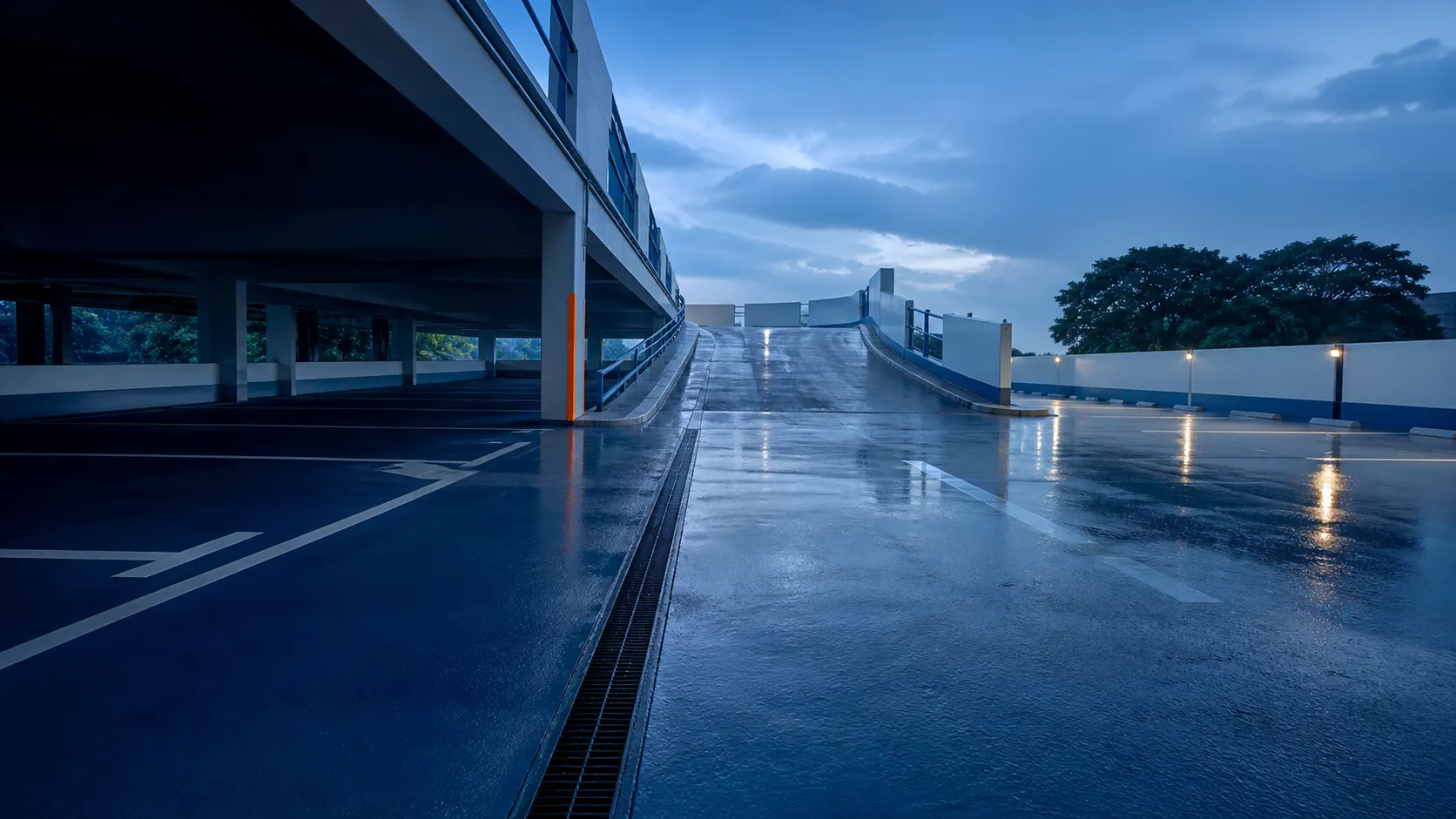
Car park deck coating in Singapore, engineered zone by zone.
Covered bays take tyre wear. Ramps must grip when wet. Exposed decks are both a road and the roof over the spaces below. A car porch at home is the same problem in miniature. Rayson specifies every layer around the duty of its zone.
Car-park deck coating should be selected by zone—not by one product name.
Parking bays, ramps and exposed upper decks face different water, tyre shear, UV and closure conditions. The right car-park system defines the operating risk first, then confirms compatible primer, waterproofing, wearing course and texture. A car porch on a landed home follows the same logic at a smaller scale: the area is trivial, but it sits over living space, and the upstand and outlet details decide the result. Rayson formulates and specifies the system materials in Singapore, has them made to that specification by its production partners, tests and releases every batch in Singapore, and publishes the TDS for every specified layer.
Choose the zone. See the system logic.
One car park should not receive one surface treatment and one thickness everywhere.
Stay bonded where tyres stop and start every day.
Covered levels deal mainly with vehicle wear, hot-tyre pickup, oil drips and daily cleaning. The right route establishes dependable adhesion to prepared concrete, then provides a maintainable epoxy wearing surface.
- Vehicle wear and warm tyres
- Oil drips and routine cleaning
- Adhesion to prepared concrete
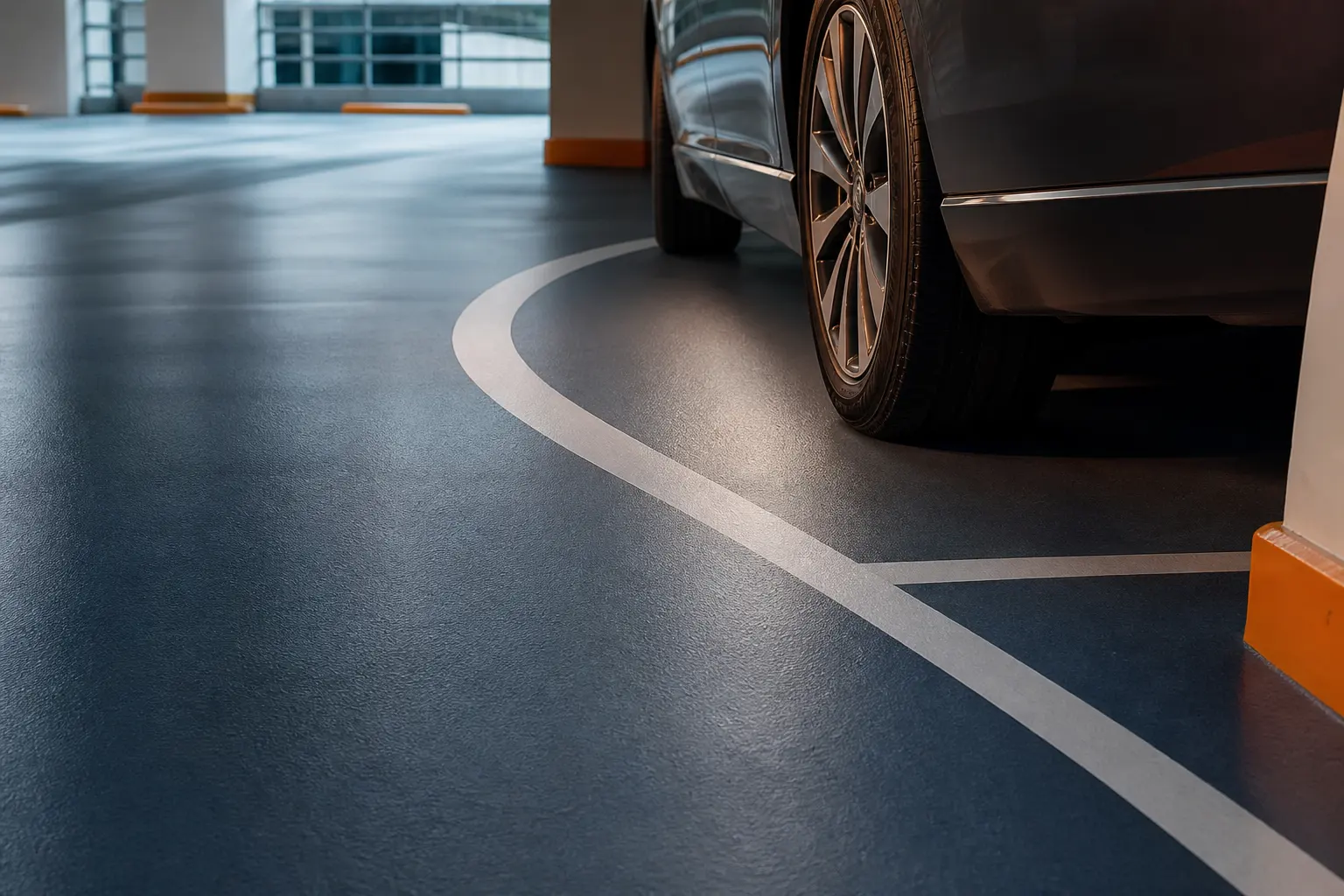
Grip when it rains. Hold when tyres turn.
Gradient, wet tyres, braking and power steering multiply shear. Ramps need a heavier build and texture than parking bays, with drainage treated as part of the system—not an afterthought.
- Wet braking and traction
- Power-steering tyre shear
- Directed drainage and texture
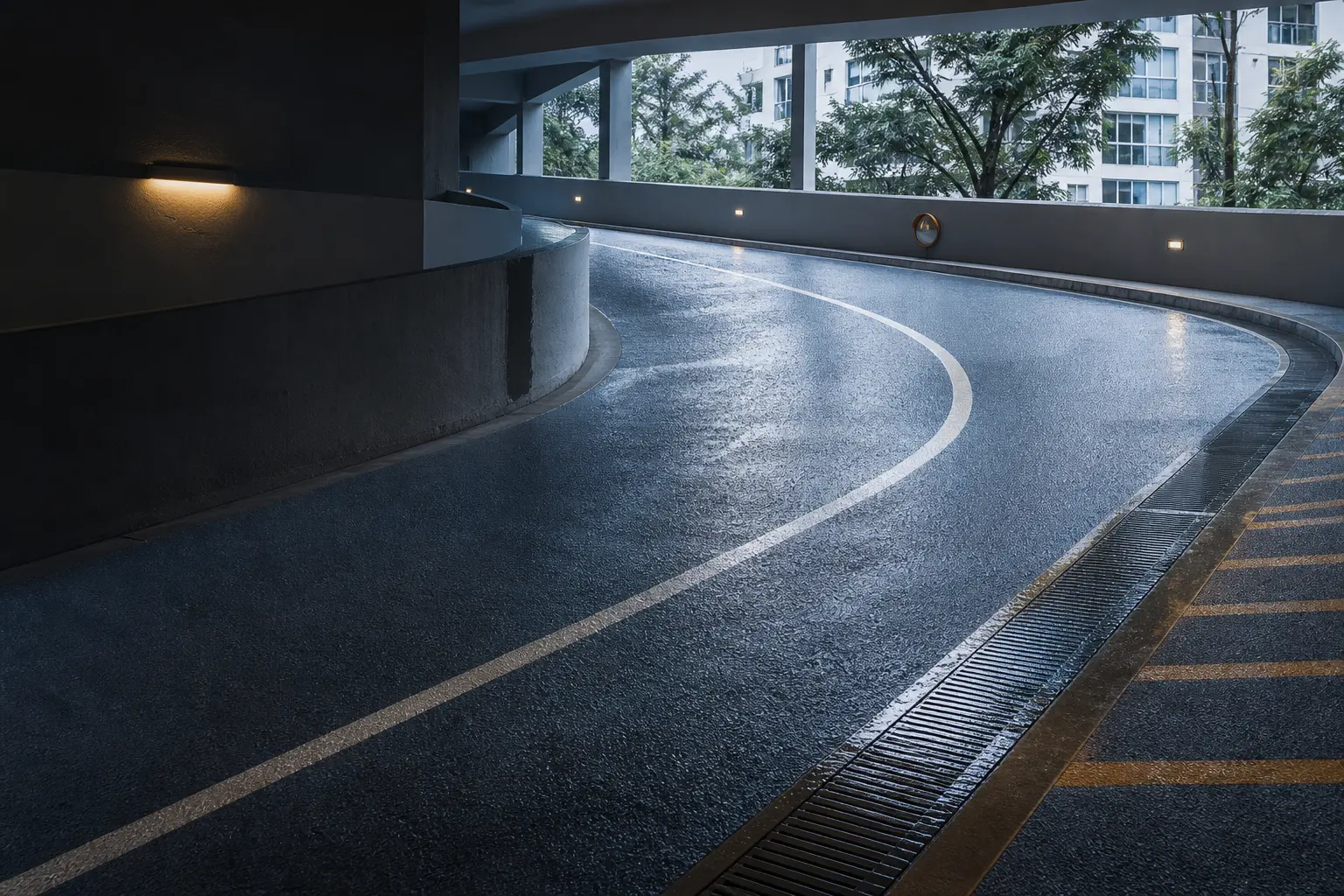
The upper deck is both a road and a roof.
Where sunlight, rain, junctions and traffic meet, a rigid coating alone is not enough protection for the slab. An exposed deck needs a continuous elastic waterproofing route, completed with a UV-stable protective wearing finish.
- Continuous waterproofing at details
- UV and heat exposure
- Trafficable protective finish
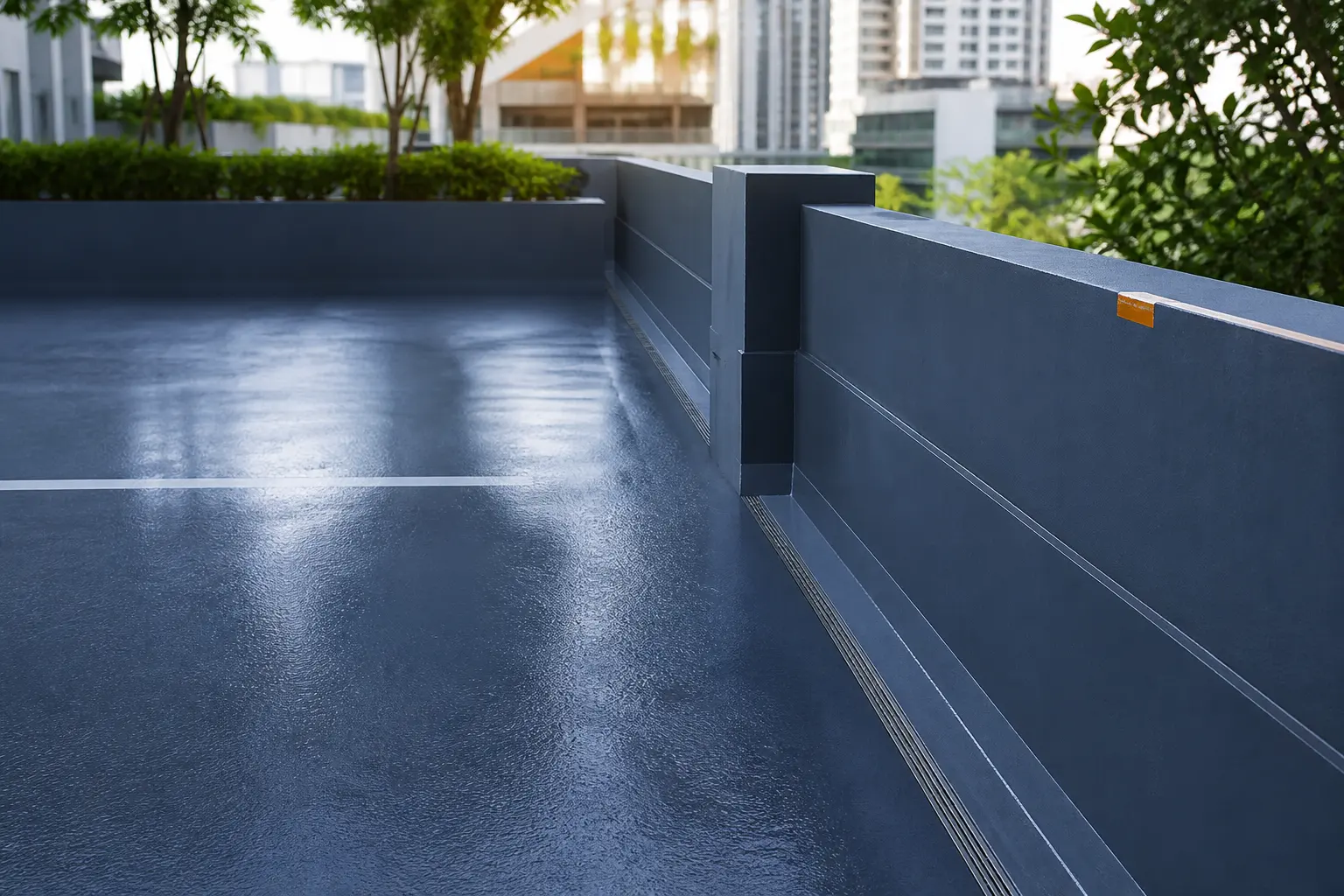
Rooftop, indoor and multi-storey decks fail for different reasons.
An exposed rooftop deck, a basement level and a multi-storey traffic deck share a name and almost nothing else. Each has its own dominant risk, and that risk decides the system.
Exposed top decks: UV, ponding and daily thermal cycling.
The top deck is a roof that carries cars. Full sun, monsoon rain and the daily heating and cooling of the slab work on the coating and its details at the same time. It needs a continuous elastic membrane that does not soften in heat, finished with a UV-stable trafficable topcoat — SealForce RC30 serves continuously to around 90 °C and elongates over 500%, and UraForce SB72 is the aliphatic polyurethane that holds colour and gloss where an epoxy chalks and yellows. Falls and drainage decide how long any of it lasts: standing water ages an exposed deck faster than traffic does.
- UV and thermal cycling on an exposed slab
- Ponding at flat spots and around outlets
- Movement at crack and joint details
Enclosed levels: no UV, but wheel loads and no ventilation.
Below ground there is no sunlight to design against, so UV stability stops being the deciding factor and wheel loads, oil drips, tyre shear and washdown take over. What usually constrains the specification instead is air: an occupied basement often cannot take solvent odour. FloorGuard R50 is solvent-free and can be laid where ventilation is limited, and where a level cannot be ventilated at all, HydroShield WE40 is a water-based, self-priming two-component epoxy that also tolerates a damp slab. A deck over occupied space still needs its water resistance and joints designed, even with no sky above it.
- Wheel loads, oil drips and washdown
- Ventilation and odour constraints
- Damp slabs and substrate moisture
Traffic decks: movement joints, turning tyres and hot-tyre pickup.
Between levels the deck is a road. Vehicles turn under power steering, brake on gradients and park with warm tyres — the three loads that find every weak bond. Movement joints are the other half of the problem: a working joint has to be detailed as a joint, because a coating stretched across it will split. Cracks and arrises are reinstated first with a compatible repair such as PatchBond TX80, which holds 13–15 mm on a vertical surface without sagging, and ramps and turning aisles take the heavier build with aggregate broadcast for wet grip.
- Joints detailed as joints, not bridged
- Power-steering shear at turning aisles
- Cure time before warm tyres return
Car porch waterproofing for landed homes in Singapore.
A car porch is a small deck that also happens to be a roof. When it leaks, nobody sees the porch — they see the stain spreading across the ceiling of the room below.
Most car porches in Singapore sit directly over a living room, a bedroom, a store or the entrance hall. The slab is tiled or screeded, it falls to one or two outlets, and it meets the house wall at an upstand — which is usually where the water actually gets in. It carries one car rather than a hundred, so wear is rarely the problem. Detailing is.
That changes what a porch specification is about. On a commercial deck the open area drives the cost and the programme; on a porch the metres are trivial and almost all the work is at the edges — the upstand against the wall, the outlet, the threshold at the front door, and the joint where the porch meets the driveway. Get those right and the porch stays dry for years; skip them and a fresh coating over the middle of the slab changes nothing.
The other difference is that the family is still living there. The porch is the way in and out of the house, so the programme is planned around the car, the front door and the weather — exposed work in Singapore is governed by rain and dew point, not by the calendar.
Two honest routes for a car porch
Where the porch will be re-tiled, SealForce RC30 goes down as the hidden waterproofing layer — a two-component polyurea-based liquid membrane, roller-applied in two coats at about 0.75–0.9 kg/m² each over a prepared and primed slab. It is made to be tiled over once cured, so the finished porch reads as tiling and the waterproofing lives underneath it.
Where the porch stays a coated deck, the same membrane is finished with UraForce SB72 — a two-component aliphatic polyurethane that keeps its colour and gloss in direct sun where an epoxy chalks, applied at 0.10 L/m² per coat. Texture is specified into the finish where the porch slopes and gets wet.
Repair first, then waterproofCracks, arrises and a failed upstand are reinstated first — PatchBond TX80 is the non-sag epoxy repair compound for vertical and overhead details, and it bonds to mat-damp concrete. PatchBond TX80 PatchBond TX80 TDS (PDF)
Six ways a car porch differs from a car park deck
Upstands, outlets, the door threshold and the driveway joint decide the outcome — not the few square metres in the middle.
The existing tile or screed has to be assessed first: a membrane can be laid concealed beneath new tiling, or the porch can be finished as an exposed coated deck.
A porch that ponds after every storm ages any system early. Falls are corrected before waterproofing, not after.
Water enters at the junction with the wall far more often than through the middle of the slab. The upstand is terminated properly and reinstated where it has cracked.
This is the front of a home. Colour, gloss and how the finish meets the tiling matter in a way they never do in a basement.
Coats carry recoat windows and cure times — SealForce RC30 needs 6–12 hours between coats, and UraForce SB72 accepts vehicular traffic after about 48 hours at 25 °C. The car parks elsewhere for those windows.
What actually drives the cost of a car porch
Car porch cost depends on area, detailing, the condition of the existing finish, access and whether falls need correction. Compare quotations on the same system, preparation and detailing scope, and confirm whether they include materials only or installation.
Match the deck to the route, then check the data.
Four decks, four dominant risks. Every route below links to the product page and the published technical data sheet, so the choice can be checked rather than taken on trust.
| Deck | What decides it | Rayson route | Published data |
|---|---|---|---|
| Car porch (landed home) | Detailing at upstands and outlets, appearance, and a household living there during the work. | SealForce RC30 as a concealed membrane under new tiling, or SealForce RC30 → UraForce SB72 as an exposed coated deck. | |
| Rooftop / exposed top deck | UV, thermal cycling and ponding; the deck is also the roof over the level below. | SealForce RC30 → UraForce SB72; SealForce SP200 with a UV-stable finish where a sprayed membrane and fast return are specified. | |
| Indoor + basement levels | Wheel loads, oil, washdown, ventilation limits and damp slabs; no UV. | PrimeBond S30 → FloorGuard R50; HydroShield WE40 where the level cannot be ventilated. | |
| Multi-storey decks + ramps | Movement joints, turning shear and hot-tyre pickup. | PrimeBond S30 → FloorGuard R50 with aggregate broadcast at ramps and turning aisles; details reinstated with PatchBond TX80. |
SealForce SP200 is an aromatic polyurea placed by specialist applicators with heated plural-component spray equipment; it can discolour under prolonged UV without affecting performance, so a UV-stable finish is specified where appearance matters. Final build-up, thickness and detailing must be confirmed against the selected products’ TDS and the actual deck.
Identify the risk before selecting the system.
Hot-tyre pickup
Warm parked tyres can lift a coating that was under-cured or poorly bonded.
Ramp delamination
Turning, braking and water push a weaker ramp build-up toward failure first.
Leakage below
Water on an exposed deck finds cracks and details before it reaches the spaces below.
Two real routes. Not one generic car-park recipe.
Covered traffic deck
For sheltered bays, aisles and ramps that need added texture where duty requires.
- WEARING COATFloorGuard R50FloorGuard R50 TDS (PDF)
- PENETRATING PRIMERPrimeBond S30PrimeBond S30 TDS (PDF)
- PREPARED SUBSTRATEMechanically prepared concrete
Exposed waterproof deck
For upper levels that must address water, UV and traffic together.
- UV-STABLE PROTECTIVE FINISHUraForce SB72UraForce SB72 TDS (PDF)
- ELASTIC WATERPROOFING MEMBRANESealForce RC30SealForce RC30 TDS (PDF)
- PREPARED DECK + DETAILSPrepared slab, joints and upstands
The closure plan also decides the system.
Whole-level, half-level or night-shift work changes traffic management, preparation, coating sequence and the return-to-service plan. Tell us what can close and when; the final programme must still be confirmed against the selected products’ TDS and actual site conditions.
Inspect every layer through real products and open data.
Every system connects directly to its product and technical data sheet, so consultants, facilities teams and procurement can check the same evidence.
Covered traffic deck
PrimeBond S30 → FloorGuard R50
Exposed waterproof deck
SealForce RC30 → UraForce SB72
Show us the ramps, joints and leak locations.
Your first message does not need to be a full specification. Plans, area, traffic, current coating, photographs and the available closure window are enough to start a useful discussion.
- Areas split by covered bays, ramps and exposed decks
- Current coating, peeling, hot-tyre marks or leakage below
- Whole-level, half-level or night-shift closure options
- Photos of ramps, joints, drains and any leak staining
- For a car porch: area, existing finish (tiled or screeded), and where the ceiling below is staining
Plan your project
Product Selector
Answer four questions about your surface and conditions to shortlist suitable Rayson systems.
Find your systemCoverage Calculator
Estimate material quantities from your floor area, coats and coverage rate.
Estimate quantitiesTDS Library
Open technical data sheets for every Rayson product — no forms, no gating.
Open the libraryFrequently asked questions
What coating is best for a car park deck in Singapore?
The correct coating depends on the zone. Covered bays and aisles need a trafficable epoxy route; ramps need a heavier aggregate texture for wet traction and tyre shear; exposed upper decks need waterproofing plus a UV-stable protective finish. A car park should not receive one generic coating everywhere.
Why do car park coatings fail at ramps first?
Power-steering scrub, braking, wet tyres and gradient create higher shear than straight parking aisles. Proper mechanical preparation, compatible priming, a heavier build and suitable aggregate texture are assessed together for ramp zones.
What is hot-tyre pickup and how is it prevented?
A warm parked tyre can lift a coating that was under-cured or poorly bonded, pulling it away with the tread. Preventing it begins with substrate preparation, correct priming, a suitable vehicle-traffic system and the required cure window before reopening.
Do exposed decks need waterproofing as well as a coating?
Yes. An exposed upper deck is both a traffic surface and the roof over the level below. It needs a continuous waterproofing route around details, followed by a compatible protective finish for UV and vehicle traffic.
Can a car park be recoated level by level while open?
A phased programme can be planned by full level, half level or available night window. The final traffic-management and reopening plan must be checked against the selected products’ TDS and the actual site conditions.
What information is needed for a car park coating quotation?
Send the area split between covered bays, ramps and exposed decks; the current coating condition; any leakage or joint issues; available closure windows; and photographs of ramps, drains, joints and underside staining.
What is car porch waterproofing and how much disruption is it?
A car porch is the small covered deck at the front of a landed home, and because it sits over living space it is a roof as much as a driveway — which is why a leak first appears as a stain on the ceiling below. Waterproofing it means preparing the slab, reinstating cracks and the upstand where the porch meets the house wall, correcting falls to the outlet if the porch ponds, then applying the membrane and its finish. The disruption is mostly the waiting: SealForce RC30 needs 6–12 hours between coats, and where the porch is finished with UraForce SB72 the deck accepts vehicular traffic after about 48 hours at 25 °C, so the car parks elsewhere across those windows. Exposed work is also weather-governed — rain and dew point set the programme, not the calendar.
How is a car porch different from a commercial car park deck?
Almost entirely in where the work sits. A commercial deck is dominated by open area and vehicle wear; a porch carries one car, so wear is rarely the issue and nearly all the risk is at the edges — the upstand against the house wall, the outlet, the door threshold and the joint where the porch meets the driveway. Porches are also tiled or screeded rather than coated, they must still fall correctly to their outlet, appearance matters because it is the front of a home, and the household is living there throughout the work.
Can a car porch be waterproofed and still finished with tiles?
Yes. Where the porch will be re-tiled, SealForce RC30 is laid as a concealed membrane over the prepared and primed slab — a two-component polyurea-based liquid membrane, roller-applied in two coats at about 0.75–0.9 kg/m² each — and tiled over once cured. Where the porch stays an exposed coated deck instead, the same membrane is finished with UraForce SB72, an aliphatic polyurethane that holds colour and gloss in direct sun where an epoxy chalks and yellows.
What is different about rooftop car park waterproofing?
An exposed top deck adds full UV, monsoon rain and the daily thermal cycling of the slab on top of traffic. That calls for a continuous elastic membrane that does not soften in heat — SealForce RC30 serves continuously to around 90 °C and elongates over 500% — finished with a UV-stable trafficable topcoat such as UraForce SB72. Falls and drainage matter as much as the coating: ponding water ages an exposed deck faster than traffic does.
What changes for waterproofing indoor and basement car parks?
There is no UV to design against, so the deciding factors become wheel loads, oil drips, tyre shear, washdown and — usually the real constraint — ventilation. FloorGuard R50 is solvent-free and can be applied where ventilation is limited; where a level cannot be ventilated at all, HydroShield WE40 is a water-based, self-priming two-component epoxy that also tolerates a damp slab. A deck over occupied space still needs its water resistance and joint detailing designed even with no sky above it.
How are movement joints handled on a multi-storey car park deck?
As joints, not as coating. A working movement joint keeps moving, and a membrane or coating stretched across it will eventually split, so the joint is detailed with a joint system while cracks and arrises are reinstated first with a compatible repair such as PatchBond TX80, a non-sag epoxy that holds 13–15 mm on vertical surfaces and bonds to mat-damp concrete. Ramps and turning aisles then take the heavier build with aggregate broadcast for wet grip.
What does car porch waterproofing cost in Singapore?
Car porch cost depends on area, detailing, the condition of the existing tile or screed, access and whether falls need correction. Compare quotations on the same system, preparation and detailing scope, and confirm whether they include materials only or installation. Our waterproofing cost article explains the cost drivers; the coverage calculator estimates theoretical material quantities from published consumption figures, before site losses and wastage.
Not sure which system fits your project?
Tell us your surface, area and timeline — our Singapore technical team will recommend a practical system and price it fast.