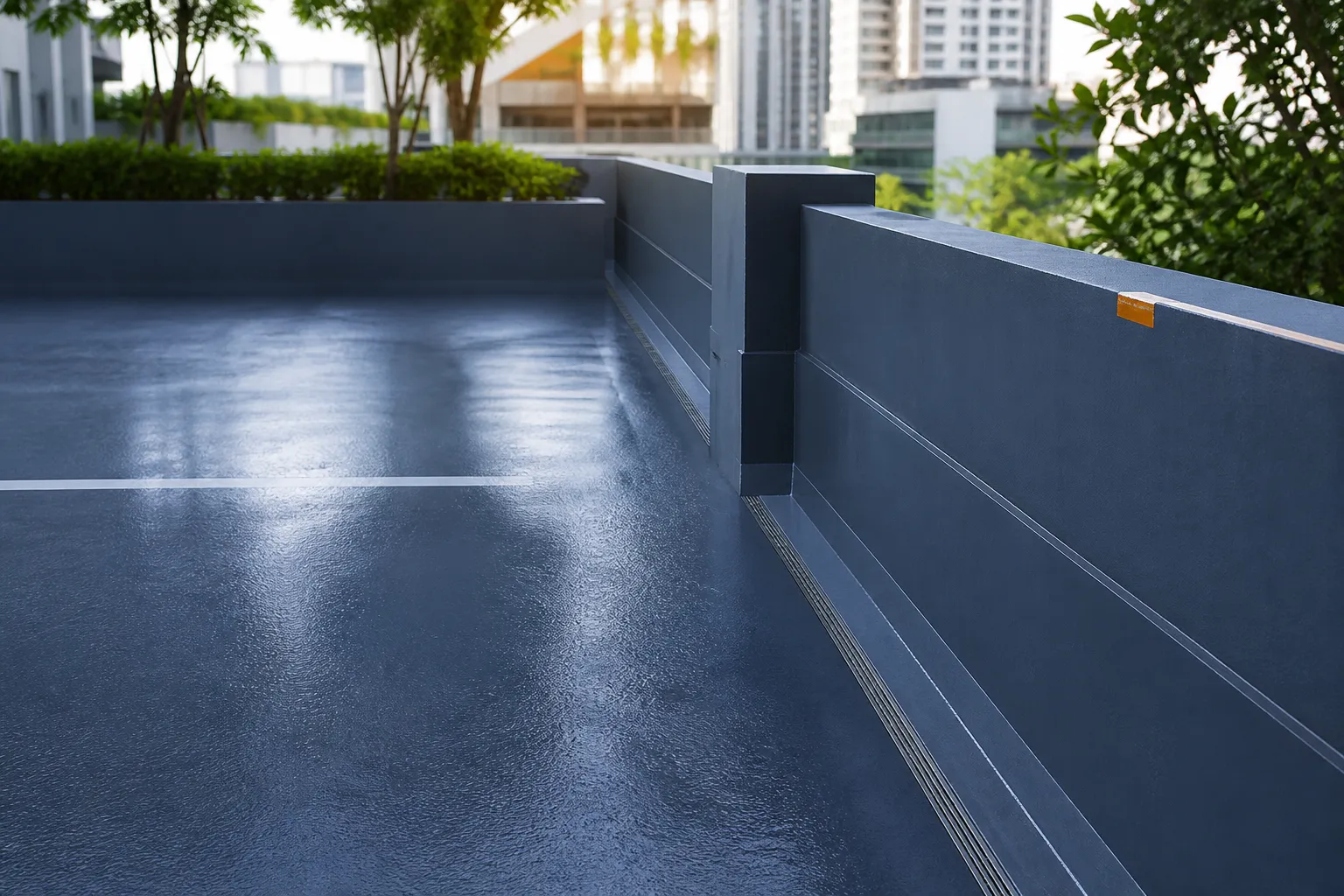
Car park decks are among the most demanding surfaces a coating faces. They have to keep water out of the structure and the levels below, and survive constant turning, braking vehicle traffic — and on a rooftop deck, do it under full Singapore sun and monsoon rain. Specifying a deck system is really specifying for two jobs at once, and the common failures all come from getting the balance or the details wrong. This guide separates the three kinds of deck, sets out the build-up for each, and covers the two failures that account for most of the trouble.
Three decks, three build-ups
The single most important distinction is what sits above and below the slab.
Rooftop and exposed decks
The top deck of a multi-storey car park takes everything: UV, driving rain, thermal cycling and traffic, with occupied or serviced floors underneath. Three consequences follow.
- A waterproofing membrane is mandatory, and it sits under the traffic system. SealForce RC30 — a roller-applied polyurea membrane with elongation above 500%, adhesion to concrete above 2.5 N/mm², and published for use as the primary waterproofing membrane in car-park deck systems — goes over a primed slab at 1.5–1.8 kg/m² in two coats. It is not a wearing surface; the traffic build-up goes on top.
- UV stability is non-negotiable at the surface. Standard epoxies and aromatic coatings yellow and chalk in sun. The finish is an aliphatic urethane such as UraForce WB52, which takes broadcast aggregate for grip.
- Falls and drainage decide the lifespan. Ponding water on a flat spot ages any system and drives water into the smallest defect. Correct falls to outlets matter as much as the membrane, and the outlets themselves are detailed before the field.
Intermediate decks
An intermediate deck is sheltered from rain and UV, but it still sits over the level below, and water from washing, wet tyres and wind-driven rain at the open sides reaches the slab. The membrane and the joint and crack detailing stay in the specification; the UV-stable finish becomes optional; adhesion and wear resistance matter as much as on the roof, and oil resistance more.
Covered ground-floor decks
A ground-floor slab on grade with nothing beneath it needs no waterproofing membrane. It needs a durable, well-adhered traffic system — and the same attention to ramps, turning bays and cure time as any other deck. Treating it as a rooftop wastes money; treating a rooftop as a ground floor is how leaks reach the level below.
Indoor and multi-storey car park waterproofing
Most enquiries for car park waterproofing are not about the roof deck. They are about the levels below it — the intermediate decks of a multi-storey car park, and indoor and basement levels with no sky above them. Three rules cover them.
- Any deck with occupied or serviced space underneath is waterproofed, sheltered or not. Washdown water, wet tyres and wind-driven rain at the open sides reach the slab; the membrane and the joint detailing stay in the specification even though the UV-stable finish does not have to.
- Ventilation decides the chemistry indoors. A basement or enclosed level cannot clear solvent, so the traffic system is built from solvent-free or water-based products — FloorGuard R50 where ventilation is limited, HydroShield WE40 where a level cannot be ventilated at all or the slab is damp.
- Movement joints and ramps are detailed as joints and ramps, not as floor. A multi-storey deck moves; the joint gets a joint system, the cracks get reinstated, and the ramp gets the heaviest build and the longest cure.
A level-by-level programme — full level, half level or night windows — keeps the car park partly open while each deck is done; the shutdown plan is confirmed against the selected products’ data sheets, not a generic cure time.
The two failures to design out
Hot-tyre pickup
The most common car park coating failure is hot-tyre pickup — warm tyres bonding to a weak, under-cured or poorly adhered coating and lifting it off, worst on ramps and turning bays. It is a specification and workmanship failure, not a usage one. The defence is thorough mechanical preparation, a properly matched primer such as PrimeBond E20 on the traffic layers, a system built for vehicular traffic, and adequate cure before cars return. We cover it fully in hot-tyre pickup: why car park coatings fail at the ramp.
Ponding and cracked details
Water is patient. It finds the low spot, sits there, and works into any crack or open joint. Two things prevent it: correcting falls so water drains rather than pools, and reinstating cracks and details — with a compatible repair such as PatchBond TX80 — before the membrane goes on rather than bridging them with the membrane itself. Moving joints are detailed as joints, with a flexible reinforced treatment. No system compensates for a deck that holds water.
Ramps, turning zones and drainage
Ramps and turning aisles are the hardest-working square metres in the car park and deserve the most robust part of the specification:
- Anti-slip texture for wet-braking safety and mechanical key — GripSafe AP12 builds a quartz texture directly onto the surface, or the topcoat takes broadcast aggregate.
- Longest protection during cure. Ramps are the last areas to reopen.
- Drainage at the bottom of every ramp. Water arriving from the deck above collects there; if the outlet is undersized or blocked, the ramp becomes the pond.
- Kerbs, plinths and column bases on a rooftop deck are upstands, and the membrane turns up them and terminates properly — the same rule as any roof.
A sensible deck specification
- Assess and repair. Check falls, ponding, existing waterproofing and structural condition. Correct falls and reinstate cracks and joints first.
- Prepare and prime. Mechanical preparation for a sound bond — the real defence against hot-tyre pickup — with a primer matched to the deck and to the layer going on.
- Waterproof where the deck sits over something. Rooftop and intermediate decks take the polyurea membrane, detailed first at outlets, upstands and joints.
- Build the traffic coat. A tough, well-adhered wearing system suited to vehicle traffic over the membrane.
- Finish for the exposure. UV-stable aliphatic urethane on exposed decks; a durable finish on sheltered decks.
- Detail the ramps. Anti-slip texture on ramps and turning aisles, and the longest cure before reopening.
- Mark it out. Bay numbering, arrows and pedestrian routes integrated into the system rather than taped on later.
Monsoon programming
Exposed-deck work in Singapore is governed by weather, not the calendar. Rain and dew point set the windows, and a deck that has not dried from the last storm must not be coated — that shortcut is how blisters and adhesion failures happen. Plan exposed-deck programmes with weather contingency built in, and phase the work so the car park stays partly open.
What Rayson needs to quote
The quotation comes from Rayson after the inspection, and it comes faster with the right starting information: which decks are exposed, intermediate and covered; the area of each; photographs of ramps, bays, outlets and any ponding or cracking; what is on the deck now and how it is failing; and how long each level can be closed. Send that to Rayson and we will specify the build-up for each deck, send the technical data sheets, and — where you need the work done — arrange an inspection by an applicator in the Rayson network, then quote the work, which the applicator carries out under the workmanship warranty in Rayson’s quotation.
The car park deck coating page covers the zone-by- zone logic and the landed-home car porch; the waterproofing membrane guide sets out where a deck system sits among the alternatives.
The hub page for waterproofing in Singapore sets decks beside roofs, wet areas and tanks.