Nine in ten searches for epoxy flooring in Singapore are made by someone who wants the floor installed, not by someone buying the material. Rayson does not install — it makes the systems and introduces applicators who do — so this guide is the checklist Rayson itself uses before it puts its name next to a contractor’s. It applies to any contractor you find on your own. It is written for facility managers, operations teams, landlords and homeowners who have a warehouse, a factory floor, a kitchen, a car park or a garage to get right the first time.
Start with the slab, not the price
An epoxy floor is only as good as what it is bonded to. The preparation, the moisture in the concrete, the cracks and the old coating decide whether the new floor lasts ten years or ten months — and none of that can be priced from a floor area or a photograph. A contractor who gives a firm price without standing on the slab is either pricing high to cover what they have not seen, or intending to add variations once the work starts.
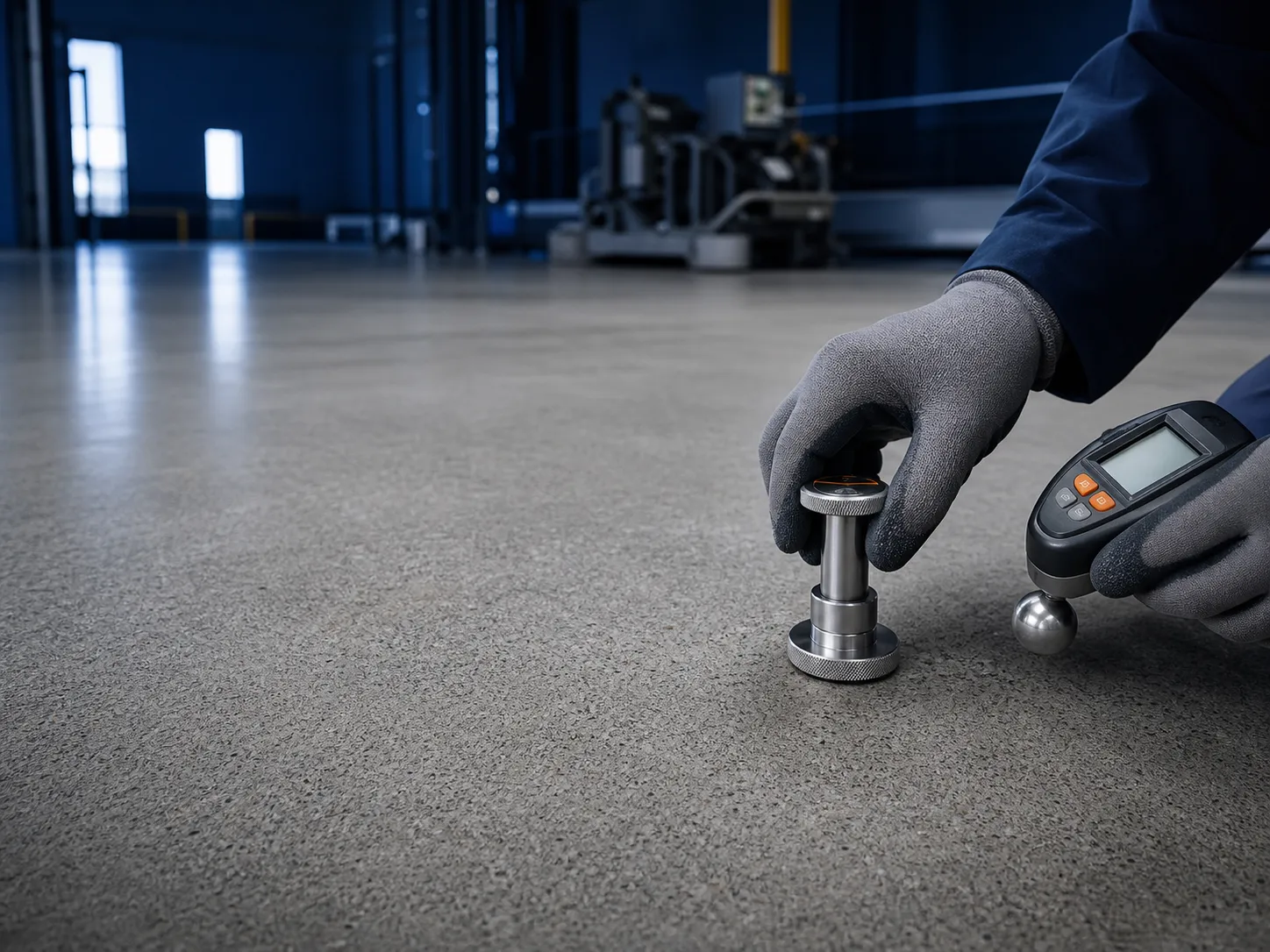
The first thing to ask for is a site visit, and the first thing to judge is what they do on it. Did they test the slab for moisture? Did they check the existing coating for adhesion, or just say they would coat over it? Did they look at the joints, the cracks, the drains and the wall junctions? Did they ask what the floor carries, what is spilled on it and how it is cleaned? The warehouse traffic-class guide and the moisture-testing guide set out what a proper assessment covers.
Seven questions to ask before anyone quotes
- Which system, from which manufacturer, and can I see its technical data sheet? A named system with a published TDS is checkable. “Industrial epoxy” is not.
- What thickness, and how many coats? The answer separates a 0.3 mm coating from a 2 mm self-levelling floor — several times the material. If they cannot say, they cannot have priced it.
- How will you prepare the slab? Listen for grinding or shot blasting, not “clean and coat”. Acid etching is not mechanical preparation.
- Will you test the slab for moisture, and what happens if it fails? The commonest first-year failure; a contractor with a plan for a damp slab has seen one.
- What happens to the existing coating, cracks and joints? Coating over a failed coating relocates the failure. Cracks are reinstated; moving joints are detailed as joints.
- What is the return-to-service programme, and what does it assume? Temperature, ventilation and thickness set cure; a promise that ignores them is a promise that will be broken on site.
- Show me three floors like mine. Same duty, same system, one to three years old, with a contact you can call. New photographs of fresh floors prove nothing; a floor that still looks right after a year of forklifts does.
The twelve lines an epoxy quotation must show
| # | Line | Why it matters | What “missing” looks like |
|---|---|---|---|
| 1 | Named system and its TDS | Makes the scope checkable against published data | “2 coats industrial epoxy” |
| 2 | Applied thickness or consumption per coat (mm, kg/m²) | Sets the material actually going down | A rate per m² with no quantity |
| 3 | Primer, named | The bond is made here; the wrong primer on a damp slab fails first | No primer line |
| 4 | Preparation method | Grinding, shot blasting, milling — and the surface profile it targets | “Surface preparation” with no method |
| 5 | Moisture test and treatment | Decides the primer and the system; the first-year failure nobody budgets for | Not mentioned |
| 6 | Repairs and their basis | Cracks, spalls, joints — priced per item or provisional | Silence, then a variation |
| 7 | Joint, crack and cove detailing | Moving joints as joints; coves where wash-down needs them | “All details included” |
| 8 | Slip texture and where it goes | Broadcast or quartz texture on ramps, wet zones, loading areas — and smooth where cleaning needs it | One finish everywhere |
| 9 | Cure and return-to-service times | Foot, light traffic, full load — at a stated temperature | “Ready next day” |
| 10 | Warranty split | Workmanship (contractor, signed) vs material (manufacturer’s data) | “10-year warranty” with no signatory |
| 11 | Exclusions | Existing coating removal, repairs, joints, line marking, out-of-hours work — in or out | Found out on site |
| 12 | Variation basis | How anything discovered on site will be priced | Not stated |
Two quotations that show all twelve are comparable. A quotation that shows a rate per square metre and a warranty is a price waiting for its scope. The floor coating cost guide explains why the build and the preparation, not the area, are where the money goes, and what a 20 kg epoxy kit covers lets you check the material allowance inside any quotation built on Rayson systems.
Red flags on an epoxy quotation
- A firm price with no site visit and no moisture test.
- “Epoxy” with no thickness. The word covers a thirty-fold range of material.
- A system with no manufacturer or no data sheet — or one the contractor will not name.
- “We’ll coat over the existing floor” before anyone has tested whether it is bonded.
- Acid etching as the preparation for an industrial floor.
- A single finish everywhere on a floor with ramps, wet zones and forklift routes.
- Return-to-service promised without a temperature or a thickness.
- A warranty longer than the manufacturer’s data supports, with no signatory, from a company younger than the warranty.
- Pressure to decide today. A floor that has waited five years can wait a week for a second quotation.
Who actually warrants the floor
Two parties stand behind an epoxy floor, and a good quotation says which is which.
The applicator’s workmanship warranty covers the installation — that the slab was prepared and tested, the primer and system applied at the stated thickness, the details done — and that failures arising from the work will be made good. It is signed by the company that did the work, for a stated period. It is the only warranty that covers a peeling floor.
The manufacturer’s published data covers the material — that the product, applied within its data sheet, performs as published. It is the basis on which the applicator’s specification stands, not a promise about your particular slab. When a contractor offers a “manufacturer’s warranty” on your behalf, ask to see it in writing from the manufacturer.
Rayson publishes its technical data openly, so any applicator’s specification can be checked against it — and so can any competitor’s.
Where Rayson fits
Rayson makes and specifies the systems — FloorGuard R50 roller-applied, LevelShield SL120 self-levelling, PrimeBond E20 beneath both — and publishes their data. Applicators in the Rayson network inspect, quote, install and warrant the work under their own terms. When you send Rayson a floor, we specify the system, send the data sheets, and introduce an applicator whose quotation is expected to show the twelve lines above. If you already have a contractor, send us their quotation and the floor; we will tell you whether the system fits and what is missing.
The epoxy flooring page is the starting point for the system; the comparison of epoxy, PU and PU-cement tells you whether epoxy is the right chemistry at all; and the failure guide shows what the twelve lines are there to prevent.