Most people searching for anti-slip floor treatment in Singapore have a specific wet floor in mind: a toilet that an elderly parent uses, a kitchen that is greasy by the end of service, a ramp that cars skid on when it rains. This guide gives the published Singapore prices for the two ways of fixing that floor, treatment and coating, as checked on 6 October 2026, explains why a small toilet is priced as a job rather than by area, and sets out the HDB subsidy that makes the question moot for an eligible household. Rayson manufactures the coating route and introduces applicators for both; the prices below are other people’s published figures, not Rayson quotations.
What anti-slip costs in Singapore, October 2026
Two different jobs hide behind one search. A treatment is a liquid worked into existing glazed, porcelain, homogeneous or stone tiles, which etches a microscopic texture into the surface and leaves the floor looking much as it did. A coating is a new textured layer, with quartz or other aggregate held in a binder, applied to concrete, asphalt, metal or a floor that will be recoated anyway.
Treatment of existing tiles
| Job | Published range, S$ | Basis |
|---|---|---|
| Chemical anti-slip treatment, per sq ft | 2 – 4 | Goodrich Global guide, 10 April 2026 |
| A typical HDB toilet, as a minimum-charge job | from about 250 – 300 | Treatment companies’ advertised packages, seen 6 October 2026 |
| Nano clear anti-slip treatment, 25–50 sq ft | 300 – 500 | Home & Decor, 26 March 2023 |
| Second and third bathroom in the same visit | Discounted | Bundle pricing is standard; ask for the per-bathroom figure |
| Slip-resistant treatment of one bathroom under HDB EASE | 239.80 before subsidy; resident pays 11.95 – 29.95 | HDB tendered rate, as reported 21 March 2025 |
Coatings on concrete, asphalt and ramps
| System | Published range, S$ per sq ft | Basis |
|---|---|---|
| Aggregate anti-slip coating, single textured coat on a sound surface | 3 – 6 | Goodrich Global guide, 10 April 2026 |
| Anti-slip epoxy system, primer plus build coats, supplied and applied | 8 – 15 | Terris price bands, updated 16 August 2026 |
| Two-pack anti-slip epoxy, material only | about 4 per sq ft (S$205 before GST for 3.8 litres, about 4.6 m²) | Industrial marketplace listing, seen 6 October 2026 |
| Preparation, crack repair, access and shutdown | Quoted on inspection | The lines that separate two quotes for the same ramp |
Read the two coating bands as two different scopes, not as a disagreement. The lower band is one textured coat over a surface that is already sound and sealed. The upper band is a complete epoxy build-up: primer, body coat and the aggregate finish, the route a commercial kitchen or a loading bay takes. The material is a small part of either figure, which is why a quotation that leads with the product name tells you little.
Why a small toilet is priced as a job, not per square foot
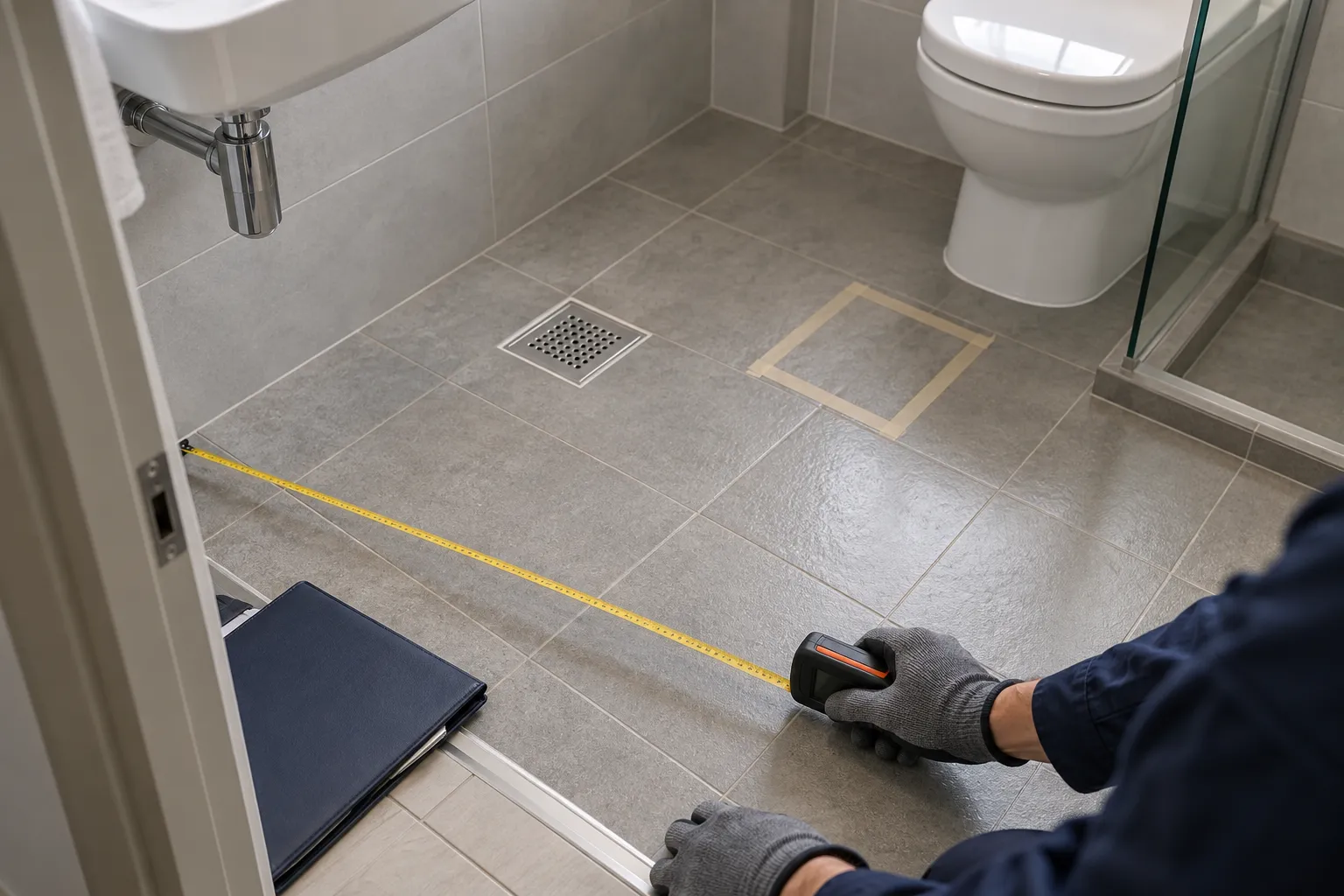
An HDB toilet floor is roughly 25 to 35 sq ft. At S$2–4 per sq ft that would be S$50–140, which does not pay for a crew to travel, clean the floor, run a test patch, apply the treatment in two or more cycles, test it wet and come back if a corner is missed. So treatment companies quote a minimum charge per toilet, from about S$250 to S$300 in the packages seen in October 2026, and discount the second and third bathroom done in the same visit. The per-square-foot rate only applies once the area is large enough, a hawker centre back-of-house or a condominium pool deck, to absorb that fixed cost.
The same logic runs the other way for coatings. A 50 m² ramp (about 540 sq ft) is roughly S$1,600–3,200 as a single textured coat and S$4,300–8,100 as a full anti-slip epoxy system on the published bands above, before preparation and repairs. Below about 20 m² most applicators quote a minimum mobilisation instead of the rate.
The HDB EASE route: S$12 to S$30 instead of S$250
If the floor is in an HDB flat and someone in the household is 65 or older, or 60 to 64 and needs help with at least one activity of daily living, the cheapest anti-slip treatment in Singapore is HDB’s own. Under the Enhancement for Active Seniors (EASE) programme, a Singapore Citizen flat owner can apply directly for a slip-resistant treatment of the floor tiles of up to two toilets or bathrooms. The tendered cost is S$239.80 per bathroom before subsidy, and the resident’s share, as reported in March 2025, is S$11.95 in a 1-, 2- or 3-room flat, S$17.95 in a 4-room, S$23.95 in a 5-room and S$29.95 in an executive flat. HDB states that works take about a month from a successful application and that the treatment lasts about three to five years with regular cleaning; acidic cleaners such as bleach wear it off faster. Confirm the current figures with HDB before applying, and apply there first: no private quotation will match the co-payment.
EASE does not replace tiles. A floor whose tiles are cracked, hollow or sitting on a failed membrane is a renovation job, and the toilet waterproofing page covers that sequence.
Treatment or coating: which one your floor needs
Treat glazed, porcelain, homogeneous and natural-stone tiles that must keep their appearance: bathrooms, lift lobbies, hotel pool decks, condominium corridors. The treatment changes the look very little, has no build, and the floor is usually back in use the same day. It wears rather than peels, and is renewed every few years. The anti-slip floor treatment page sets out the test patch, the process and what to ask the applicator.
Coat concrete, asphalt, metal chequer plate and any floor that is being recoated anyway: ramps, loading bays, wash bays, external walkways, back-of-house kitchens being refurbished. A coating builds a texture you can specify by aggregate size and grade, and it is part of a system: primer, body and finish. Rayson’s coating route is GripSafe AP12, a one-pack acrylic primer filler loaded with 0.5–1.5 mm silicate quartz that builds the anti-slip texture directly onto concrete and asphalt, supplied in a 22 litre pail at a theoretical 5–8 m² per litre, so one pail covers roughly 110–176 m² per coat. GripSafe AP12 is priced on quotation to the applicator, not per square foot to the public, and it is not a treatment for glazed tiles. The anti-slip flooring page matches texture to duty zone by zone.
What moves the price
- Tile type. Polished porcelain and dense homogeneous tiles take longer to etch than ceramic; natural stone needs a gentler product and more cycles. Expect the higher end of the band and insist on a test patch.
- Area and bundles. One toilet carries the whole minimum charge; two or three in the same visit are cheaper each. Commercial areas move onto the per-square-foot rate.
- Cleaning before treatment. Soap scum, body oils and old sealers block the treatment. Deep cleaning is part of a proper job and should be on the quotation.
- Preparation for a coating. Grinding, crack repair, removal of a failed coating and drying time are the lines that double a ramp quotation. They are quoted on inspection, not from a floor area.
- Access and shutdown. A hawker centre treated overnight, a car park ramp closed for a 72-hour cure, a hotel corridor done in sections: time costs money.
- The rating required. A floor that must meet a specified class under SS 485:2022 needs a test patch measured wet and the result written into the quotation. That is cheap compared with doing the floor twice.
- The warranty. Ask what it covers and for how long. Written one-year on-site warranties on treatments exist; a coating’s warranty follows the system’s published service life and the applicator’s workmanship terms.
Ask for the rating, not the adjective
“Anti-slip” is a claim. The measurement is a wet pendulum test under SS 485:2022, which adopts the Australian classification: P0 to P5 from the wet pendulum, R9 to R13 from the oil-wet ramp. A bathroom used barefoot, a wet kitchen and an external ramp need different classes, and the slip resistance standards guide explains which. Ask the applicator to measure the test patch wet and to state the class in the quotation; a product name is not a result, and neither is a brochure value measured on a different surface.
Getting a real number
Send photographs of the floor, its approximate area, what it is made of, where it gets wet or greasy, and who uses it. Rayson will say whether the floor is a treatment or a coating job, send the data sheet for the coating route, and introduce an applicator in the Rayson network who runs the test patch, quotes to the lines above and warrants the work. If the floor is in an HDB flat with an eligible senior in the household, apply to HDB under EASE first.
The epoxy flooring cost guide covers the full-floor epoxy systems the upper coating band belongs to, and the commercial kitchen flooring page covers the one floor where slip resistance, cleaning and hot wash-down have to be solved together.