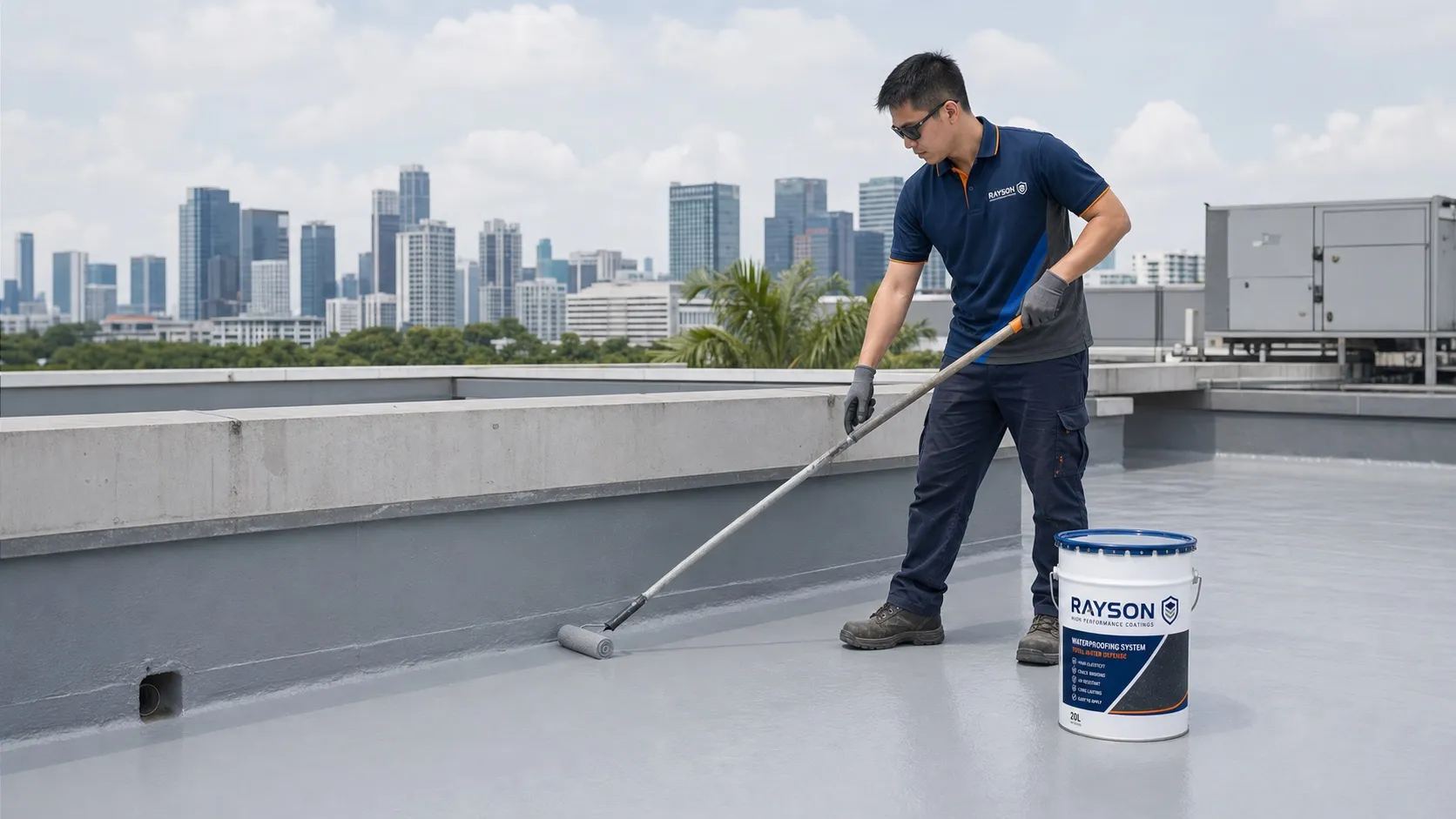
Most concrete roofs in Singapore do not fail because the wrong membrane was chosen. They fail because the roof was never properly assessed before the membrane went on — and the falls, the cracks and the details that were already leaking simply kept leaking, underneath a new coating. This guide sets out how an RC roof is assessed, what each finding changes, and how the system is then built up. It is written for building owners, facilities managers and specifiers who want to understand the job before they commission it.
First, what a roof assessment actually determines
An applicator standing on the roof is looking for six things. Each one changes the specification, and several of them rule out coating until they are fixed.
Falls and ponding
Walk the roof after rain, or look for the tide-marks and biological growth that show where water sits. Standing water — ponding — is the single most common reason a waterproofed roof leaks again. It ages every membrane, keeps the surface wet and cool so nothing dries properly, and works water into the smallest defect. Where falls do not carry water to the drains, the falls are corrected first. Some systems tolerate prolonged ponding better than others — SealForce RC40 is formulated for rooftops subject to prolonged ponding water — but that is a resilience margin, not permission to leave a roof that holds water.
Cracks, and whether they move
A static shrinkage crack is a detail to reinstate. A crack that opens and closes with thermal movement is a joint that was never designed, and it will reappear through any membrane that is simply painted across it. The assessment distinguishes the two. Static cracks are cut, cleaned and filled — a non-sag epoxy such as PatchBond TX80 holds on vertical faces and mat-damp concrete — and moving cracks are detailed as joints with a flexible, reinforced treatment before the field membrane is applied.
Drains, outlets and upstands
Leaks rarely begin in the open field. They begin at the roof outlet where the membrane has to turn down into a pipe, at the upstand where it has to turn up a parapet and terminate, at the plinth under a chiller, and at every pipe that passes through the slab. The assessment counts these details, checks their condition and confirms how the membrane will be terminated at each one. A roof dense with details rewards a seamless liquid system precisely because it can follow every change of plane without a lap.
The existing membrane
Many Singapore roofs already carry a membrane — torch-on bitumen, a PVC or TPO single-ply sheet, an old acrylic, or PU-foam insulation with a coating over it. The assessment answers one question: is it sound enough to keep? A sound, well-bonded, compatible membrane can be prepared, primed and overcoated. RC40 is formulated for recoating sound existing waterproofing membranes and for overcoating bitumen, PVC/TPO single-ply and PU-foam insulation. Failed, debonded or waterlogged areas cannot be sealed in; they are removed and reinstated, and a membrane that is holding water underneath is a strip-and-replace, not an overcoat. The roof page covers this in assess before overcoating.
Substrate soundness and moisture
Concrete that is friable, laitance-covered or contaminated will not hold a membrane regardless of the product. Mechanical preparation brings it to a sound, clean surface. Moisture is measured, not guessed: RC40 requires substrate moisture below 4% and relative humidity below 85% at application, with the surface at least 3 °C above dew point. In Singapore those conditions come and go through the day, which is why roof work is programmed around weather windows.
Access, plant and the work window
Chillers, tanks, cable trays and solar frames sit on most commercial roofs. What can be lifted, what has to be detailed around, and how long the roof can be out of use all shape the specification — and the quotation. This is information the applicator needs before pricing the work.
The exposed RC roof decision
With the assessment done, the system for an exposed concrete roof in Singapore follows from three conditions.
Permanent UV. A roof in full sun needs an aliphatic chemistry that holds its colour, gloss and elasticity under sunlight for the life of the membrane. Aromatic materials — including many polyurethanes and the hot-spray polyurea used for tank linings — chalk and discolour under UV unless they are topcoated. RC40 is an aliphatic polyurea: UV-stable, walkable, and elastic from −35 °C to +80 °C.
Standing water and heat. A roof that holds water needs a membrane with effectively zero water uptake, and a Singapore roof surface runs hot. RC40 is published for prolonged ponding, and its white grade is formulated as a cool-roof finish — a high solar reflectance that reduces the heat load on the slab and the spaces below.
Detail density. The more outlets, upstands and penetrations a roof has, the more the case for a seamless liquid system that is applied continuously through every change of plane, with no laps to fail and every square metre visible for inspection.
Where the roof is a deck that carries vehicles, the decision changes: waterproofing becomes one layer of a traffic system, and the car park deck guide covers that case. Where the roof is a tank cover or containment structure, a hot-spray polyurea such as SealForce SP200 may be specified instead.
The build-up, step by step
- Prepare. Mechanically clean to sound concrete. Reinstate cracks and spalls. Correct falls that hold water. Confirm moisture and dew-point conditions.
- Detail first. Outlets, upstands, parapets, plinths and penetrations are primed and coated before the field — usually with local reinforcement at terminations and changes of plane. If the details are right, the field is straightforward. If they are wrong, nothing in the field will save them.
- Prime. RC40 is applied only over a primer, and the primer depends on the roof material — bare concrete, screed, old bitumen, single-ply sheet and metal each take a different one. The primer is specified from the assessment, not assumed.
- Apply the membrane in two layers. RC40 goes on by roller, brush or airless spray at 1–1.2 kg/m² total on cementitious surfaces, in at least two layers. Each unreinforced layer is kept below 1 kg/m² so solvent is not trapped in the film. Touch and recoat is around 18 hours at 23 °C; the film resists early rain after about three hours.
- Cure and return to service. Full hardening is around seven days. The membrane is walkable for maintenance access; it is not a wearing surface for vehicles, which need a dedicated traffic system above it.
The published consumption figures allow a theoretical material estimate for the roof area; wastage, surface texture and the number of details set the actual quantity, and the coverage calculator will give you the theoretical starting point.
Roof terraces, plant decks and lightly trafficked roofs
A roof terrace that people walk on, a plant deck with maintenance traffic, or a roof with a light foot-traffic finish sits between an exposed roof and a vehicle deck. RC40 is walkable and holds up to maintenance access. Where a terrace is finished with tiles or pavers on pedestals, the waterproofing is concealed and the emphasis shifts to outlets and upstands — SealForce RC30, the roller-applied polyurea used beneath tiling and in wet areas, is often the membrane of choice there. Where foot traffic is direct and constant, an anti-slip wearing coat over the membrane is specified rather than relying on the membrane surface.
Programming around the monsoon
Exposed roof work in Singapore is governed by the weather, not the calendar. A roof that has not dried from the last storm must not be coated, and a layer that will be rained on before it resists early rain is a layer that fails. Realistic programmes build in weather contingency, work the details in the dry mornings, and treat the dew-point rule — surface at least 3 °C above dew point — as a hard stop rather than a guideline.
What the applicator needs from you to quote
The quotation comes from the applicator, and it comes faster and more accurately with the right starting information: wide photographs of the whole roof and close-ups of every drain, upstand and penetration; the roof area and an approximate count of details; what is currently on the roof and how old it is; where water stands after rain; what plant sits on the slab and whether it can be lifted; and how long the roof can be out of use. Send that to Rayson and we will specify the system, send the technical data sheets, and — where you need one — introduce an applicator in the Rayson network who assesses the roof, issues the quotation and carries out the work under its own workmanship warranty.
For the wider decision between liquid-applied and sheet systems, see waterproofing membrane types in Singapore, and for what drives the price, the waterproofing cost guide.