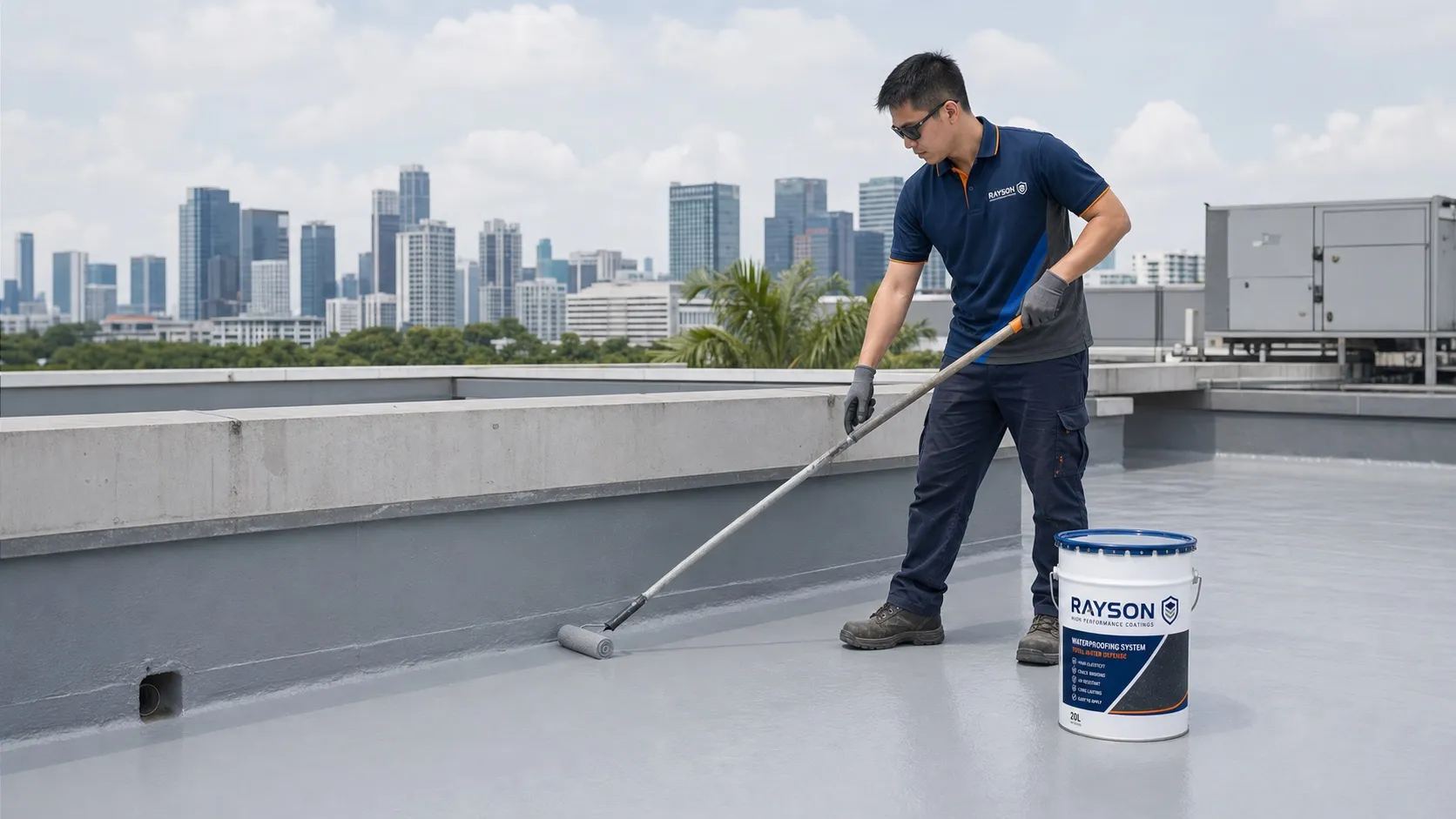
Six in ten people who search for waterproofing in Singapore are looking for someone to do the work, not for a product. Rayson does not install — it makes the systems and introduces applicators who do — so this guide is the checklist Rayson itself uses before it puts its name next to a contractor’s. It applies equally to any contractor you find on your own. It is written for building owners, facilities managers, MCSTs and homeowners who have a roof, a deck, a car porch or a bathroom to get right the first time.
Start with the assessment, not the price
Waterproofing is not priced by area. It is priced by the details — the upstands, outlets, penetrations, cracks and thresholds — and by what is already on the surface and whether it can stay. None of that can be counted from a plan or a phone call. A contractor who gives a firm price without standing on the roof or in the bathroom is either pricing high to cover what they have not seen, or intending to add variations once the work starts.
The first thing to ask for is therefore a site assessment, and the first thing to judge is the quality of it. Did they walk the whole surface? Did they look at the outlets, not just the field? Did they ask where water stands after rain, or plug the trap and flood the bathroom? Did they say what they would do about the existing membrane, and why? The RC roof guide and the wet-area guide set out what a proper assessment looks for.
Seven questions to ask before a quotation
- Which system, from which manufacturer, and can I see its technical data sheet? A named system with a published TDS is checkable. “Our own PU” is not.
- What is on the surface now, and will it stay? The answer decides half the price and most of the risk. “We’ll coat over it” without an assessment of adhesion and condition is the commonest cause of early failure.
- How will you detail the upstands, outlets, penetrations and joints? Listen for heights, reinforcement and terminations. A contractor who talks only about coats and thickness is describing the easy part.
- Will you flood-test, and when? For a wet area, always; for a roof or deck, at the outlets and low spots after the membrane cures. No test, no proof.
- What is your programme, and what happens when it rains? Exposed work is weather-governed. A programme with no weather allowance is a programme that will coat a damp surface.
- Who signs the workmanship warranty, for how long, and what does it cover? In writing, from the company doing the work, covering leaks arising from the work.
- Show me three jobs like mine. Same surface type, same system, with a contact you can call. Photographs alone are not a reference.
The twelve lines a quotation must show
| # | Line | Why it matters | What “missing” looks like |
|---|---|---|---|
| 1 | Named system and its TDS | Makes the scope checkable against published data | ”Waterproofing membrane, 2 coats” |
| 2 | Applied thickness or consumption (kg/m², mm) | Sets the material actually going down | A rate per m² with no quantity |
| 3 | Primer, named | Adhesion depends on it; the wrong one fails first | No primer line at all |
| 4 | Preparation method | Grinding, hacking, cleaning — the bond is made here | ”Surface preparation” with no method |
| 5 | Repairs and their basis | Cracks, spalls, falls — priced per item or provisional | Silence, then a variation |
| 6 | Detail schedule | Upstands with heights, outlets, penetrations, joints, thresholds — counted | ”All details included” |
| 7 | Reinforcement | Where fabric or tape goes: corners, junctions, cracks | Not mentioned |
| 8 | Flood / ponding test | The only proof the membrane works | Not mentioned |
| 9 | Programme and weather allowance | Prevents coating a wet surface to hit a date | A single completion date |
| 10 | Warranty split | Workmanship (contractor, signed) vs material (manufacturer’s data) | “10-year warranty” with no signatory |
| 11 | Exclusions | Tiles, screed, falls correction, plant lifting, access — in or out | Found out on site |
| 12 | Variation basis | How anything discovered on site will be priced | Not stated |
Two quotations that show all twelve are comparable. A quotation that shows a rate per square metre and a warranty is not a quotation; it is a price waiting for its scope. The cost guide explains why the details, not the area, are where the money goes.
Red flags
- A firm price with no site visit.
- A system with no manufacturer or no data sheet — or one the contractor will not name.
- “No hacking” promised before any test, in a bathroom with a failed membrane underneath. Sealers and injections stop grout weeping; they do not rebuild a membrane at a trap.
- A warranty longer than the manufacturer’s data supports, with no signatory, from a company younger than the warranty.
- No mention of falls, outlets or upstands in a roof or deck quotation. The field is the easy part; the quotation is silent on the hard part.
- A programme with no weather allowance for exposed work.
- Pressure to decide today. Waterproofing that has waited five years can wait a week for a second assessment.
How the warranty is actually split
Two parties stand behind a waterproofing job, and a good quotation says which is which.
The applicator’s workmanship warranty covers the installation — that the membrane was applied to the specification, at the stated consumption, with the details done, and that leaks arising from the work will be made good. It is signed by the company that did the work, for a stated period, and it is the only warranty that covers a leak.
The manufacturer’s published data covers the material — that the product, applied within its data sheet, performs as published. It is not a promise about a particular roof; it is the basis on which the applicator’s specification stands. When a contractor offers a “manufacturer’s warranty” on your behalf, ask to see it in writing from the manufacturer.
Rayson publishes its technical data openly, so any applicator’s specification can be checked against it — and so can any competitor’s.
Where Rayson fits
Rayson makes and specifies the systems — SealForce RC40 for exposed roofs, SealForce RC30 beneath tiles and in deck systems — and publishes their data. Applicators in the Rayson network inspect, quote, install and warrant the work under their own terms. When you send Rayson a roof, a deck or a bathroom, we specify the system, send the data sheets, and introduce an applicator whose quotation is expected to show the twelve lines above. If you already have a contractor, send us their quotation and the surface; we will tell you whether the system fits and what is missing.
The waterproofing systems page is the starting point for the system; the failure guide shows what the twelve lines are there to prevent.