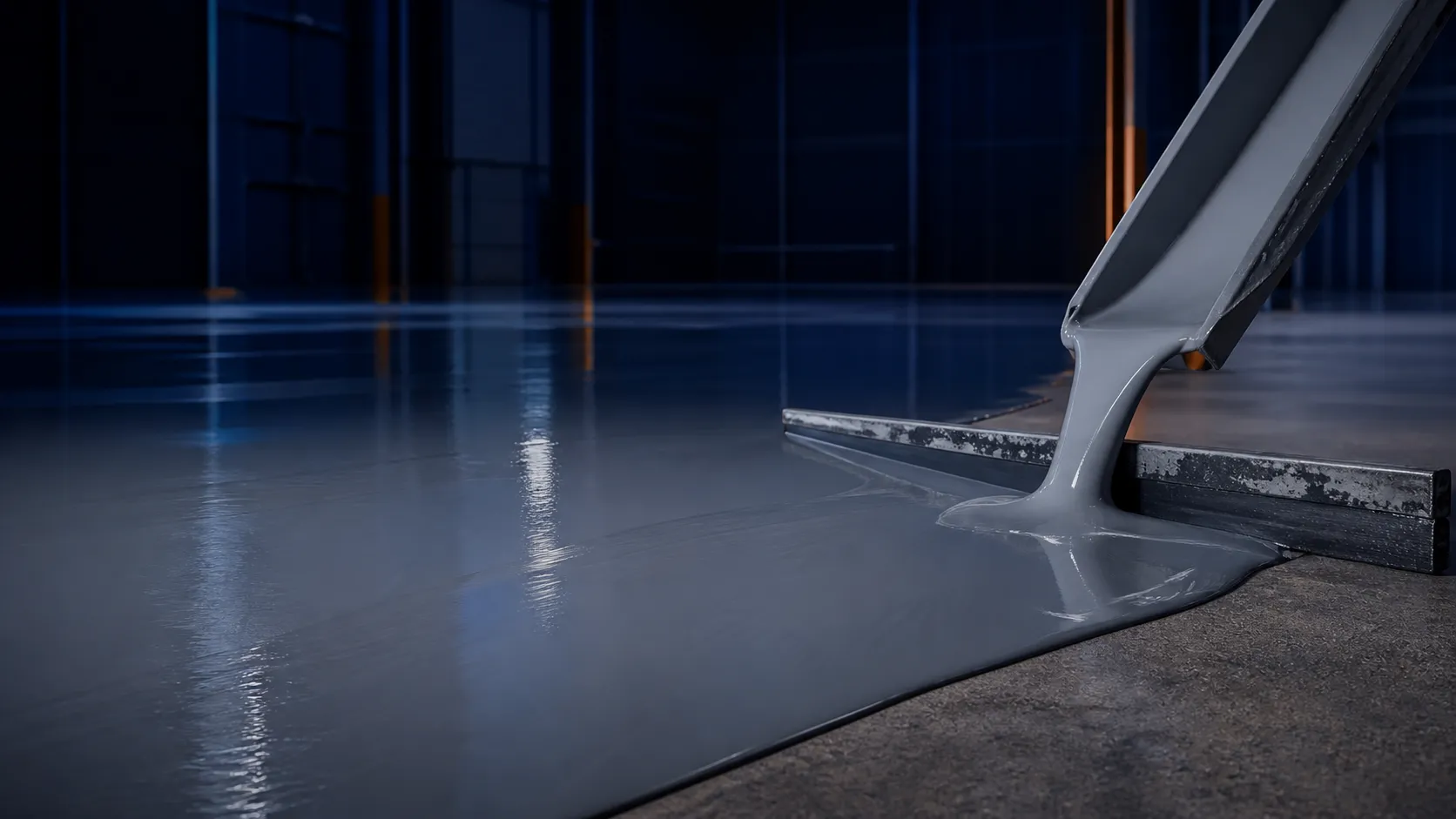
Epoxy flooring in Singapore costs about S$3–6 per sq ft for a roller-applied epoxy floor coating, S$6–12 per sq ft for a self-levelling epoxy floor and S$8–15 per sq ft for anti-slip or ESD systems, supplied and applied, according to Singapore price guides checked on 26 September 2026. Home floors run S$4–12 per sq ft. Those bands are not a Rayson price list: Rayson manufactures the material and the applicator sets the installed price. They are the market’s published range, dated, so you can tell a comparable quotation from one that has quietly removed part of the system.
What epoxy flooring costs in Singapore, September 2026
| Floor and system | Per sq ft | Per m² | Source, date |
|---|---|---|---|
| Warehouse or workshop, roller-applied epoxy, 2–3 coats | S$3–6 | S$32–65 | Terris, updated 16 Aug 2026 |
| Self-levelling epoxy floor, thickness not stated | S$6–12 | S$65–129 | Terris |
| Garage, showroom or clinic, epoxy flake finish | S$6–11 | S$65–118 | Terris |
| Anti-slip or ESD epoxy systems | S$8–15 | S$86–161 | Terris |
| Car park or cold room, PU coating | S$5–10 | S$54–108 | Terris |
| Home floors, epoxy over screed or tiles | S$4–12 | S$43–129 | SmartCalculator.sg, 16 Jul 2026 |
| One HDB toilet floor, overlay, minimum-charge job | S$650–1,200 per toilet | — | Advertised contractor prices, seen 26 Sep 2026 |
| HDB tile hacking and disposal | S$3–8 | S$32–86 | SmartCalculator.sg; Shiok Living, Sep 2026; Home Expo Asia, 2026 |
| Screed levelling after hacking | S$1–5 | S$11–54 | The same three |
| PU-cement screed | Quoted per project | — | No independent Singapore price published |
| Diamond grinding, shot blasting, coating removal | Quoted per job | — | No independent Singapore price published |
All figures are supplied-and-applied market ranges as published by the sources listed at the end of this guide. Three price sites that turned out to be one operator, a seller whose parent company is a manufacturer, all manufacturer pages, and figures older than 2024 or copied from overseas were left out. Below about 100 m², expect the per-square-foot figure to sit above every band.
Worked examples
- A 1,000 sq ft (93 m²) warehouse bay, roller-applied coating: S$3,000–6,000 at S$3–6 per sq ft on a sound slab. Grinding, crack repair and removal of a failed coating are quoted on top.
- A 5,000 sq ft (465 m²) production floor, self-levelling epoxy: S$30,000–60,000 at S$6–12 per sq ft. Thickness decides where in the band the job lands, so ask for the millimetres.
- A 4-room HDB flat, about 700 sq ft of living, dining and bedroom floor: S$2,800–8,400 at S$4–12 per sq ft once the floor is at screed. Hacking the old tiles adds S$2,100–5,600 and levelling S$700–3,500, so a full hack-and-coat job lands around S$5,600–17,500.
- One HDB toilet floor: S$650–1,200 as a minimum-charge overlay job, with walls roughly S$1,150 more. Rayson’s published systems are for concrete and screed, so ask the applicator to assess an overlay on tiles first.
Want a number for your floor rather than a band? Send the area, two or three photos of the floor as it is, and what it has to survive — traffic, water, chemicals, heat. Rayson specifies the tier, states the material coverage and, after an applicator in the Rayson network has seen the floor, quotes the job. Get a quotation from Rayson or WhatsApp the photos.
Home floors room by room: kitchen, toilet, living room and marble finishes
The per-square-foot bands above assume a floor of some size. Home work is priced differently, and the differences explain most of the surprise in a household quotation.
- Living, dining and bedrooms sit in the S$4–12 per sq ft home band, over a screed or over existing tiles, with hacking and levelling on top if the tiles come up. The band is wide because “epoxy” here can mean a two-coat roller finish or a poured self-smoothing floor.
- A toilet or kitchen floor is a minimum-charge job, not a per-square-foot one. A single HDB toilet is advertised at roughly S$650–1,200 as an overlay; a kitchen behaves the same way, with the extra detailing at the coved skirting and the drain deciding the price more than the area does.
- Marble, metallic and “designer” epoxy is a different product class — a multi-layer, hand-worked decorative system priced per job by the decorative applicator. None of the guides checked publishes an independent Singapore band for it, and Rayson does not make it: Rayson’s published floor systems are plain and broadcast industrial epoxies. Send the room anyway; we will say whether a Rayson system fits, or refer the job. An overlay coats the tiles; it does not waterproof the floor. If the ceiling below is stained, the job starts with toilet waterproofing and the epoxy comes after the flood test. What the toilet job itself involves, over the tiles or after hacking, is on the toilet epoxy flooring page.
The epoxy flooring for homes guide covers suitability, slip ratings, hacking versus overlay and living with the floor; this page stays with the money.
Epoxy paint, 20-litre kits and pail prices: material cost is not floor cost
Searches for “epoxy paint” and “epoxy flooring 20 litre price” are asking a different question from the table above. A 5-litre or 20-litre epoxy floor paint kit from a hardware chain is a single-pack or thin two-pack coating sold by the tin; a specified epoxy floor system is a primer plus two or more measured coats — or a poured self-levelling build — applied at a stated consumption over a prepared slab. The tin is usually the smaller part of an installed floor; preparation, primer, labour and detailing are the larger part, which is why a pail price never answers “how much will the floor cost”.
Rayson does not publish pail prices, because an installed job is quoted after the floor has been seen — applicators and contractors buying material can request trade pricing and data sheets. What Rayson does state exactly is coverage, from each technical data sheet:
- FloorGuard R50 roller-applied epoxy: a 20 kg set at 0.3–0.5 kg/m² per coat covers about 40–66 m² per coat, so roughly 20–33 m² in two coats.
- LevelShield SL120 self-levelling epoxy: a 20 kg set at 1.6–2.0 kg/m² covers about 10–12.5 m² as a wearing coat.
- PrimeBond E20 epoxy primer: a 20 kg set at 6–8 m² per kg covers 120–160 m².
Those are theoretical figures; porosity, texture and wastage set the real quantity. The coverage calculator turns your area into sets, and what a 20 kg epoxy kit covers works through the arithmetic system by system.
Why the published numbers disagree
Four things differ between any two published rates, and each moves the number substantially:
- Applied thickness. This is the dominant variable and the most commonly omitted one. A roller-applied coating is a film of a few tenths of a millimetre. A self-levelling floor is a poured build of two to five millimetres — an order of magnitude more material. Rates quoted for the two are not comparable, however similar the words look.
- Supply-only versus supply-and-apply. A material rate and a complete installed-system rate are different scopes. Confirm labour, supervision, testing and reopening.
- Whether preparation and repairs are inside the price. Grinding or shot blasting, crack and joint repair, and removal of a failed existing coating are frequently excluded from a headline rate.
- Job size and access. Mobilisation, setup and minimum crew time are fixed. A thousand-square-metre warehouse handed over empty and a forty-square- metre shop refitted overnight cannot carry the same per-m² rate.
Put differently: a published rate without a stated thickness and a stated preparation scope is not a price. It is a headline.
What each tier actually buys
The tiers are not “good, better, best” versions of one product — they are different machines for different duties:
| Tier | What it is | Right for |
|---|---|---|
| Roller-applied coating | Thin protective film, 2 coats | Dust-proofing, light foot traffic, refurbishment |
| Anti-slip system | Textured profile built into the finish | Ramps, wet zones, walkways |
| Self-levelling build | Seamless poured floor, millimetres thick | Forklifts, pallet traffic, production floors |
| Hygiene-duty build | Cleanable seamless system, coved details | Food production and wash-down areas |
| PU-cement screed | Trowel-applied, thermal-shock resistant | Hot wash-down, chemical duty |
| Decorative / metallic | Appearance-led finishes | Showrooms and retail |
A roller-applied coating is right for dust-proofing and light traffic and wrong under forklifts; a self-levelling system is a floor in its own right. Cheapest to dearest, the tiers run roller coating, polyurethane topcoat, self-levelling epoxy, then PU-cement screed — and each step up is buying a duty the one below cannot survive, which epoxy vs PU vs PU-cement sets out. Over-buying wastes money; under-buying buys a failure. The system selection guide matches tier to duty.
Check the material allowance and installation scope
Rayson formulates and specifies its coating materials in Singapore; they are made to that specification by its production partners, every batch is tested and released in Singapore, and Rayson quotes installation jobs that applicators in its network carry out. Ask for the material and installation scope to be stated separately, including preparation, repairs and the product and workmanship warranty responsibilities.
Each product’s TDS provides theoretical material coverage. The coverage calculator converts area, coats and thickness into a planning quantity. Actual consumption also depends on substrate profile, application method and wastage. Ask the supplier or applicator to explain any difference between the quotation and the calculated allowance before work starts.
Where quotes really diverge
- Preparation — mechanical grinding or shot blasting versus “clean and prime”. This single line explains most cheap quotes, and it is the line that decides coating life.
- Repairs — cracks, spalls and joint edges, included or excluded.
- The build — number of coats, thickness, primer (PrimeBond E20) — a “same” epoxy can be half the material.
- Removal — taking off a failed existing coating is often the biggest hidden cost in refurbishment.
- Programme — a clear building versus phased overnight sections around a running operation.
Ask every quoting contractor to state those five in writing, and the mystery between quotes disappears — the twelve lines an epoxy quotation must show expand them into a checklist you can hand over.
How much of the price is labour, and can you apply it yourself?
In every band above, preparation and application are normally the larger share of the figure and the material the smaller — the same slab can carry a cheap or an expensive quotation on labour alone. That is why two quotations with the same product name can differ so much, and why the cheaper one usually skipped the grinding.
What a competent owner can do alone: a two-coat roller epoxy on a sound, dry, mechanically cleaned garage or store-room slab, applied within the pot life stated on the data sheet, with the room closed to traffic for the cure. What does not survive a first attempt: any slab with moisture in it, any self-levelling or screed system, any floor that will carry forklifts or hot wash-down, and any job where the old coating has to come off. Those are applicator work, and the labour in the quotation is buying the preparation that makes the floor last.
A note on very small areas
Mobilisation, setup and minimum crew time are fixed. Below roughly a hundred square metres, expect the per-m² number to sit well above any advertised rate — that is arithmetic, not profiteering.
Getting a real number
The systems behind every band, and the applicators who install them, are set out under epoxy flooring in Singapore; home projects start at epoxy flooring for homes.
Send the area, photos of the current floor, the duty (traffic, water, chemicals, heat) and your access window — Rayson will specify the honest tier for the duty, state the material coverage from the relevant TDS, and put you in front of a real price rather than a headline: request a quote. Where a budget roller coat genuinely covers the duty, that is what we will say.