Technical supervisor inspecting a seamless conductive epoxy floor in an electronics production facility
ESD Flooring Singapore

ESD flooring systems for Singapore electronics facilities.

Rayson formulates and specifies StaticGuard CX90, a conductive ESD epoxy system, in Singapore and has it made to that specification by its production partners; every batch is tested and released in Singapore. From substrate assessment and grounding coordination to post-installation resistance verification, every layer creates one measurable path to earth.

Conductive epoxy systemGrounding layout coordinatedInstalled floor verified
The direct answer

ESD flooring is not a conductive coating. It is a controlled system.

It creates a controlled path for electrostatic charge through substrate preparation, primer, conductive layers, grounding points and a conductive wearing coat. Set the conductive or static-dissipative target from the facility ESD programme first, then verify the installed floor on site.

Read the StaticGuard CX90 technical data 
Set the target first

Conductive or static-dissipative? Set the requirement first.

This is not a visual choice. The facility ESD programme, sensitive components, personnel contact, footwear and verification method decide the target; the floor system and earthing path follow.

01

Conductive flooring

For controlled areas whose specification calls for a lower resistance range. The published StaticGuard CX90 data reports average electrostatic behaviour of 10⁴–10⁶ Ω when installed and earthed correctly.

StaticGuard CX90 TDS (PDF) 
02

Static-dissipative flooring

For areas whose specification calls for a higher resistance range. Confirm the target, test method and acceptance criteria with the facility ESD coordinator; do not assume every conductive coating is suitable.

Read the ESD standards guide 
Conductive vs static-dissipative

The band is an electrical specification, not a product grade.

Both classes drain charge to earth. They differ in how fast, and in how much resistance stays in the path. Conductive flooring occupies the lower resistance band and drains charge fastest; static-dissipative flooring sits in a higher band and drains it in a more controlled way. Neither is universally better, and neither is visible — two floors in the same colour can belong to different classes, and the same product can measure differently in two buildings.

01

What the band actually describes

Resistance to ground: the electrical resistance between the walking surface and the facility earth. A class name is shorthand for that one measured value. It is a property of the installed system — material, thickness, earthing layer, grounding connections and the concrete underneath — not a property of a pail of resin.

02

Why the target changes the system

A lower target demands a continuous conductive network, tighter thickness control and a denser earthing layout. A higher, more controlled target changes the primer route and the acceptance criteria. Fix the target first: the build-up, the earthing plan and the test method all follow from it, and moving a finished floor between bands usually means removing it.

03

Who sets it, and who proves it

The facility ESD coordinator sets the band from the ESD control programme and the sensitivity of what is handled. The manufacturer states what the system is designed to achieve. The applicator installs it. The measured floor proves it. Rayson publishes the StaticGuard CX90 data so the first of those four is checkable before anyone orders material.

Rayson does not decide your band. Bring the requirement out of your facility ESD control programme, then read how a stated band becomes a site measurement in the ESD flooring standards guide.

The vocabulary on a quotation

Five names for the same floor. They do not promise the same thing.

Quotations, tenders and product pages use these terms almost interchangeably, and only some of them carry an electrical commitment. Read every one of them as a question: which band, and how will it be measured?

Anti-static flooring
The loosest term in the trade. It can describe a floor specified to a measured band, or simply a floor that does not generate much charge underfoot. On its own it commits to nothing — ask which resistance band and which test method sit behind the word.
ESD flooring / ESD-safe flooring
The general description for a floor inside an ESD-protected area. It means something only alongside a stated target and a verification method: the floor is safe when the readings say so, not when the label does.
Electrostatic dissipative flooring
The written-out form of static-dissipative — a floor in the higher resistance band, draining charge in a more controlled way. Spelled out or abbreviated, it names a band the facility programme sets, not a brand of resin.
Conductive epoxy flooring
A resin floor in the lower resistance band, with the conductive network built into the coating body. StaticGuard CX90 is Rayson’s conductive ESD epoxy system, laid over a conductive primer and an earthing layer with grounding points.
Conductive floor paint
Usually a thin coating rolled over an existing slab. It is not interchangeable with a conductive epoxy flooring system at 1.0–1.5 mm, and without an earthing layer bonded back to the building earth it controls nothing at all. A paint quoted against a system specification is not a comparable offer.

None of these names replaces the two things that matter: the band the system is designed for, and the measured record from the finished floor. Read the ESD flooring standards guide, or go straight to the StaticGuard CX90 TDS (PDF).

Specify by requirement

What does the floor need to protect?

Define the requirement around people, sensitive components or the electrical path before discussing a coating.

01 / People, footwear and floor contact

Every crossing of the floor is part of the system.

Across workstations, routes and transitions, people, footwear and flooring need to support the facility’s defined ESD-control requirement.

  • Walking routes
  • Footwear contact
  • Workstation transitions
See electronics facility systems 
ESD-safe footwear moving across a seamless conductive floor in an electronics facility
What the standard actually governs

ANSI/ESD S20.20 certifies a programme. It does not certify a floor.

The ESD programme standards most audits reference — the ANSI/ESD S20.20 family and its IEC 61340 counterparts — describe how a facility controls static, not which coating to buy. They define grounded work surfaces, personnel grounding, handling procedures, training and verification. The floor is one element inside that: its job is to provide a controlled electrical path from a standing person to earth, working together with ESD footwear.

  1. 01The floorA continuous conductive or dissipative surface bonded to earth, measured after installation and re-measured in service. This is the element Rayson manufactures — one of five.
  2. 02Footwear and personnel groundingThe path only closes when the person is coupled to the floor: ESD footwear at walking positions, wrist straps at seated ones. A conductive floor under ordinary shoes controls very little.
  3. 03Grounded work surfacesBenches, mats and fixtures carry their own bonded path to earth. They are audited alongside the floor, never instead of it.
  4. 04Equipment and EPA groundingMachines, racking, trolleys, ionisers and the boundary of the EPA itself are bonded and documented. A single unbonded steel structure inside a controlled area is a real finding.
  5. 05Verification and trainingDocumented readings, a re-test schedule, defined cleaning methods and trained people. An audit examines the record as closely as it examines the floor.

So no supplier — Rayson included — can sell compliance in a pail. What a manufacturer can honestly offer is a system designed to a stated electrical target, published data you can read before ordering, and an installed floor that is measured and documented. The rest of the programme belongs to the facility. See electronics facility flooring for how these elements sit together on a real production floor.

System anatomy

A conductive floor is a circuit you walk on.

The target resistance range defines the system, grounding layout and verification method. Product selection follows that target.

Read the StaticGuard CX90 technical data 
StaticGuard CX90Conductive layer + grounding pointsPrepared concrete substrate
  1. 01Prepare the substrateSound, clean concrete with moisture assessed
  2. 02Reinstate defectsUse PatchBond TX80 where repairs are required
  3. 03Prime and groundSet the conductive layer, copper points and grounding layout
  4. 04Apply the conductive coatStaticGuard CX90 at the specified thickness
  5. 05Verify the installed floorMeasure and record against the project method

The system primer and grounding layout must be confirmed for the project by the Rayson technical team, facility engineer and relevant electrical personnel. Read the ESD flooring standards guide to understand how project requirements become site verification.

The path to earth

The grounding layout is designed before the first pail is opened.

A conductive coat that is not bonded to the facility earth is an expensive grey floor. The path runs from the walking surface, through the conductive network in the build-up, into copper grounding strips, out to earth points, and back to the building earth. Every joint in that chain is installation work — and every joint is a place a floor can measure wrong while looking perfect.

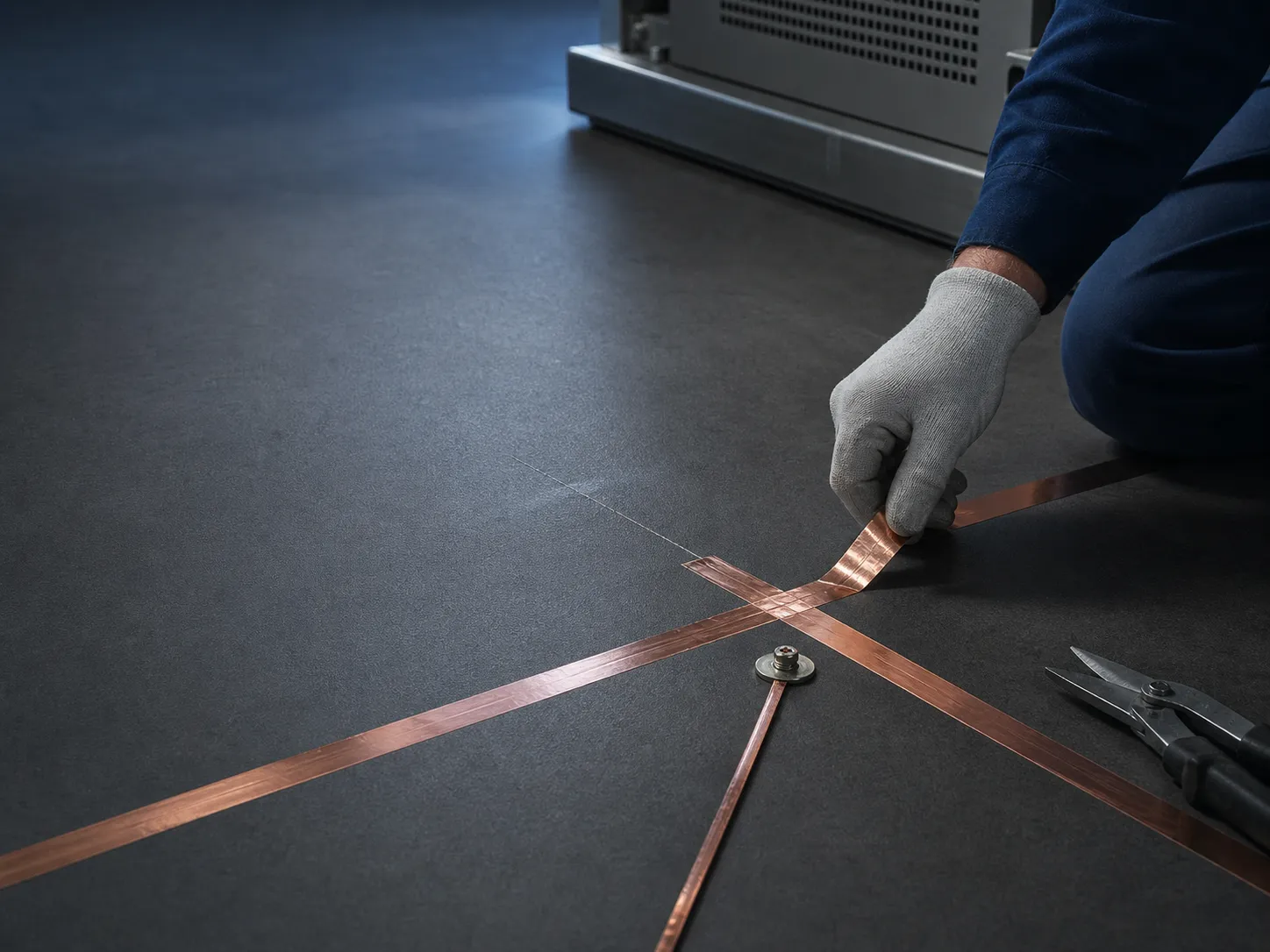
  1. 01Copper grounding strips inside the build-upCopper tape is laid into the system beneath the conductive coat, at the intervals prescribed for the project, so the conductive network is collected rather than left to find its own way out. The strip layout follows the room shape, the earth-point positions and the area being covered.
  2. 02Earth pointsDefined positions where the copper network leaves the floor and terminates for connection. Their number and placement belong in the design, not to improvisation on site — and they must stay accessible after the floor is finished and the machines are back in.
  3. 03Bonding back to the facility earthThe connection from earth point to building earth is made by the electrical contractor, not by the flooring crew. Agree who does it, when, and how it is recorded before installation starts. This is the single most common gap in an otherwise good ESD floor.
  4. 04Continuity across the whole areaDoorways, movement joints, plant plinths, later penetrations and the boundary with an adjacent non-ESD floor all interrupt the network. Each one needs a decision at design stage, because none of them is visible once the floor is down.

The published StaticGuard CX90 build-up places the conductive earthing layer and grounding points directly beneath the wearing coat, over a conductive primer on prepared concrete. Rayson’s technical team confirms the primer route and earthing layout for the project with the facility engineer and the electrical contractor. Read the StaticGuard CX90 TDS (PDF).

The system, layer by layer

StaticGuard CX90: what is actually specified.

This is the published build-up and the published numbers. Read the technical data sheet while you are writing the specification — not after the material arrives on site.

  1. 01Rayson StaticGuard CX90 conductive coatThis product. Self-smoothing, solvent-free, 100% solids; conductivity built into the cured matrix rather than applied as a surface treatment that wears away.
  2. 02Conductive earthing layer + grounding pointsSystem element. Copper network and earth points installed to the agreed layout.
  3. 03Rayson conductive primerPer system. The primer route is confirmed for the project by the Rayson technical team.
  4. 04Prepared concrete substrateMechanically prepared, minimum 28 days old, moisture content below 5%, pull-off strength above 1.5 N/mm² after preparation.
Target dry film thickness
1.0–1.5 mm — thickness control is a performance requirement, not a finish tolerance
Applying above the stated thickness
Reduces conductivity and can push the floor out of its target band
Mix ratio
4:1 (A:B) by weight, mixed mechanically for at least 2–3 minutes
Pot life
Up to 25 minutes at 28 °C
Coverage
Minimum 2.25 kg binder per m² per coat at approximately 1.5 mm
Cure before verification
Minimise heavy traffic for 72 hours; full cure approximately 7 days

Curing between +10 °C and +35 °C, minimum substrate temperature 5 °C. The full published data — surface preparation, application conditions, storage and the complete build-up — is in the StaticGuard CX90 TDS (PDF), and material quantities can be estimated with the coverage calculator. Rayson manufactures the material; the installed price is set by the applicator.

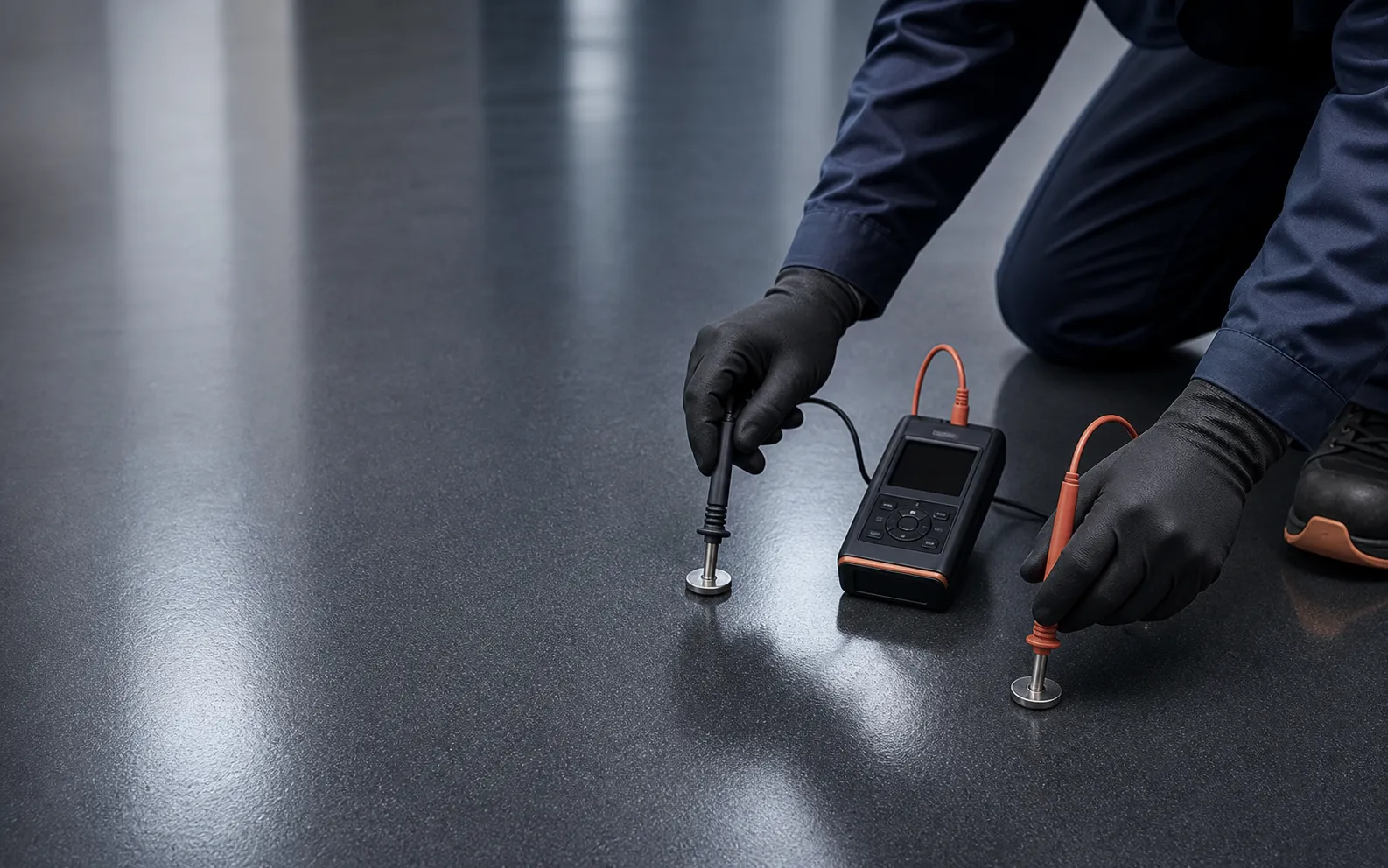
Technician verifying a completed conductive epoxy floor with a professional resistance meter
Handover evidence

If it is not measured, it is not verified.

The completed floor must be measured and documented using the method agreed for the project. The published TDS is the starting point; site verification is the handover evidence.

01

Agree

Confirm the target, test method and measurement positions.

02

Measure

Test the completed floor after the appropriate cure.

03

Document

Record the result for handover and future maintenance.

Read the StaticGuard CX90 technical data 
Testing an ESD floor

How a finished floor is measured and signed off.

Colour does not prove performance. A product name does not prove performance. A number recorded at a known position, on a known date, with a calibrated instrument is the only thing that does. This is the sequence a Rayson ESD floor should be handed over on.

  1. 01Agree the method before installationWhich test — resistance to ground, point-to-point, or both — which instrument and electrodes, which acceptance criteria, and who witnesses it. Agreeing this after the floor is down turns a technical question into a commercial argument.
  2. 02Set and mark the test pointsPositions are fixed on the floor plan across the whole area, not chosen on the day by whoever is holding the meter. Include the difficult places: far corners, the ends of copper runs, doorways, under-plant zones and areas near the boundary with a non-ESD floor.
  3. 03Wait for cure, then cleanTesting a floor that has not reached its cure measures something that no longer exists a week later. StaticGuard CX90 reaches full cure in approximately 7 days. Clean the surface using the method the facility will actually use, and record the ambient conditions.
  4. 04Measure resistance to groundFrom the walking surface at each marked point to the facility earth, using a calibrated meter and the electrodes the test method specifies. Point-to-point readings are taken across the surface where the project calls for them.
  5. 05Record every reading, including the poor onesPosition reference, value, instrument, date, ambient conditions and who took it. A report containing only the good points is not a verification record — the outliers are exactly what tell you where the network or a bond is weak.
  6. 06Issue the record with the handover documentsThe readings become the baseline for the facility ESD programme. Re-test on the schedule that programme sets; every future reading is compared against this document.

The published StaticGuard CX90 data is explicit that measured readings are affected by:

  • ESD clothing
  • Ambient conditions
  • Measurement equipment
  • Floor cleaning
  • Test personnel

So compare like with like. A reading that moves between two visits may be telling you about the meter, the footwear or last night’s cleaning chemistry rather than about the floor. Fix the method first, then trust the trend. Read the StaticGuard CX90 TDS (PDF).

How ESD floors fail

Most failed ESD floors were never bad coatings.

They were correct materials dropped into an incomplete system. These are the ways a floor that looks right ends up measuring wrong.

  1. 01The earth connection was never madeCopper laid, earth points installed, and nobody ever bonded them back to the building earth — because the task sat between the flooring package and the electrical package. The floor measures as an insulator. It is also the cheapest failure to prevent: assign the connection in writing before installation.
  2. 02Applied thicker than specifiedConductivity depends on the network through the coating body. Going over the stated 1.0–1.5 mm to bury a defect or use up material raises resistance and can move the floor out of its band. Here, thickness is a performance parameter, not a finish preference.
  3. 03The cleaning regime defeats the floorWaxes, polymer polishes and film-forming cleaners lay an insulating skin over a perfectly good conductive surface. The floor beneath the film is still conductive — the person standing on it is no longer coupled to it. Put the cleaning method in the handover pack and brief the cleaning contractor, not only the engineer.
  4. 04Verified once, then never againA handover reading proves the day of handover. Wear, cleaning residues and changing air-conditioning regimes all move readings in service. A programme with no re-test schedule finds out its floor has drifted at the same moment an auditor does.
  5. 05The ESD area quietly grewProduction expands into the next bay and a general-purpose epoxy floor gets treated as part of the controlled area because it happens to be the same colour. Adjacent non-ESD floors — LevelShield SL120 among them — should never be assumed to be part of the ESD system.
  6. 06Damage repaired like ordinary flooringA patch made with non-conductive material, or a repair that cuts a copper run without re-bonding it, creates a dead zone in the middle of a compliant floor. Repairs to an ESD floor are re-tested, not just re-coated.

None of these is solved by changing coating. They are prevented by grounding coordination at design stage, thickness control during installation, and a measured record at handover. For adjacent general-production zones see LevelShield SL120; for static-control areas see StaticGuard CX90.

A typical system route

From prepared slab to a verified conductive wearing surface.

03GroundConductive layer and copper points

Defined by the system and electrical coordination

05VerifySite measurement

Record against the project ESD target

For adjacent general-production zones, review LevelShield SL120 self-levelling epoxy. It should not automatically be treated as part of the ESD system.

Qualifying an ESD flooring supplier

Eight questions to ask before you commit.

Anyone can call a floor “ESD”. These questions separate a specified electrical system from a grey coating with a claim attached. Rayson’s answers are on this page and in the published data — ask any supplier for theirs in writing.

  1. 01What electrical target is this system designed to achieve, and where is it published?You should be able to read it before you order, not receive it afterwards.
  2. 02May I see the technical data sheet now?An open TDS is the baseline. If performance data only arrives attached to a quotation, ask why.
  3. 03What is the complete build-up, including the earthing layer?A conductive topcoat quoted without a primer route, copper network and earth points is not a system.
  4. 04Who installs the grounding, and who bonds it to the building earth?Get the split between flooring and electrical contractor in writing, with the earthing layout agreed before work starts.
  5. 05What test method will prove the finished floor, and who witnesses it?Method, instrument, test-point plan and acceptance criteria — agreed before installation, not after.
  6. 06What thickness is specified, and how is it controlled on site?Because on a conductive floor, thickness changes the reading.
  7. 07Which cleaning products are compatible, and which will defeat the performance?Ask for this in writing so it can go straight to the cleaning contractor.
  8. 08What is the re-test recommendation, and what happens if a reading drifts?A supplier who has thought about year three is a different supplier from one who has thought about handover.
Send the ESD requirement for review
Ready to define the project?

Send the ESD requirement before choosing the coating.

Send the floor plan, existing surface, target requirement and programme. Rayson will return an initial technical direction within one working day.

Frequently asked questions

What is ESD flooring?

ESD flooring is a conductive or static-dissipative floor system that gives static charge a controlled path to earth. The floor works as part of a complete ESD programme that includes the specified target, grounding arrangement, footwear and post-installation verification.

Does ESD flooring require grounding?

Yes. A conductive wearing coat alone does not establish a verified path to earth. The earthing layer, copper grounding points and connection to building earth must be agreed for the project with the relevant facility and electrical personnel.

What is the difference between conductive and static-dissipative flooring?

They are different electrical-performance classes. The correct class and target range come from the facility ESD programme or project specification. Select the target first, then design the complete flooring and grounding system around it.

How is an ESD floor verified after installation?

The completed floor is measured after the appropriate cure using the project-agreed method, including resistance-to-ground and/or point-to-point testing as required. Readings should be documented for handover and future maintenance.

Can an existing epoxy floor be upgraded to ESD?

The existing coating and substrate must first be assessed. A conductive system requires its own controlled build-up and grounding arrangement, so local appearance alone cannot confirm suitability. Send the current floor details and ESD target for review.

How should an ESD floor be maintained?

Use cleaning products that do not leave an insulating film. Waxes and some polymer polishes can change surface behaviour. Repair damage promptly and schedule retesting in line with the facility ESD programme.

What resistance does StaticGuard CX90 achieve?

The published Rayson StaticGuard CX90 data reports average electrostatic behaviour in the 10⁴–10⁶ ohm range when the system is installed and earthed correctly. Final acceptance must use the target and test method set by the facility ESD programme.

Does an ESD floor make a facility compliant with an ESD standard?

No. An ESD floor is one controlled element within the wider ESD programme. Footwear, personnel practices, equipment grounding, test method and documented results also need to meet the facility’s applicable requirements.

Is anti-static flooring the same as ESD flooring?

“Anti-static” is used loosely for anything that reduces static build-up. ESD flooring is specified by measured resistance to ground and a defined class — conductive or static-dissipative. A floor described only as anti-static, with no stated electrical target and no test method, is a marketing description rather than a specification. Ask which band it is designed for, and how the installed floor will be verified.

What does an ESD floor test involve?

Test points are fixed on the floor plan across the whole area before installation, and the method, instrument and acceptance criteria are agreed at the same time. After full cure the surface is cleaned and each marked point is measured from the walking surface to the facility earth with a calibrated meter, with point-to-point readings added where the project calls for them. Every reading is recorded with its position, instrument, date and ambient conditions, then issued with the handover documents.

Is conductive epoxy flooring the same as conductive floor paint?

No. A thin conductive paint and a conductive epoxy flooring system are not interchangeable. StaticGuard CX90 is a two-component, solvent-free, self-smoothing epoxy applied at a target 1.0–1.5 mm, with conductivity built into the cured matrix rather than applied as a surface treatment, and it works over a conductive primer with an earthing layer and grounding points. Any coating installed without that earthing system has no verified path to earth, whatever it is called.

Can a supplier sell an ANSI/ESD S20.20 compliant floor?

No. ANSI/ESD S20.20 and its IEC 61340 counterparts define an ESD control programme — grounded work surfaces, personnel grounding through footwear or wrist straps, handling procedures, training and verification. The floor is one element of it. A manufacturer can supply a system designed to a stated electrical target with published data, and the installed floor can be measured and documented; compliance is assessed across the whole programme, not on a product.

How do I qualify an ESD flooring supplier?

Ask in writing for: the electrical target the system is designed to achieve and where it is published; the technical data sheet before ordering; the complete build-up including the conductive primer and earthing layer; who bonds the grounding back to the building earth; the test method, test-point plan and acceptance criteria; the specified thickness and how it is controlled on site; compatible cleaning products; and the re-test recommendation.

What thickness is StaticGuard CX90 applied at, and why does it matter?

The published target dry film thickness is 1.0–1.5 mm. Conductivity depends on the conductive network through the coating body, so applying above the stated thickness increases resistance and can push the floor out of its target band. On a conductive floor, thickness control is a performance requirement rather than a finish tolerance.


Not sure which system fits your project?

Tell us your surface, area and timeline — our Singapore technical team will recommend a practical system and price it fast.