Ask three contractors to price the same roof and the numbers can differ by a multiple. That is not (usually) dishonesty — it is because waterproofing cost lives in places a per-m² rate cannot see. Here is where the money actually goes, so you can budget realistically and read quotes fairly.
Detailing beats area
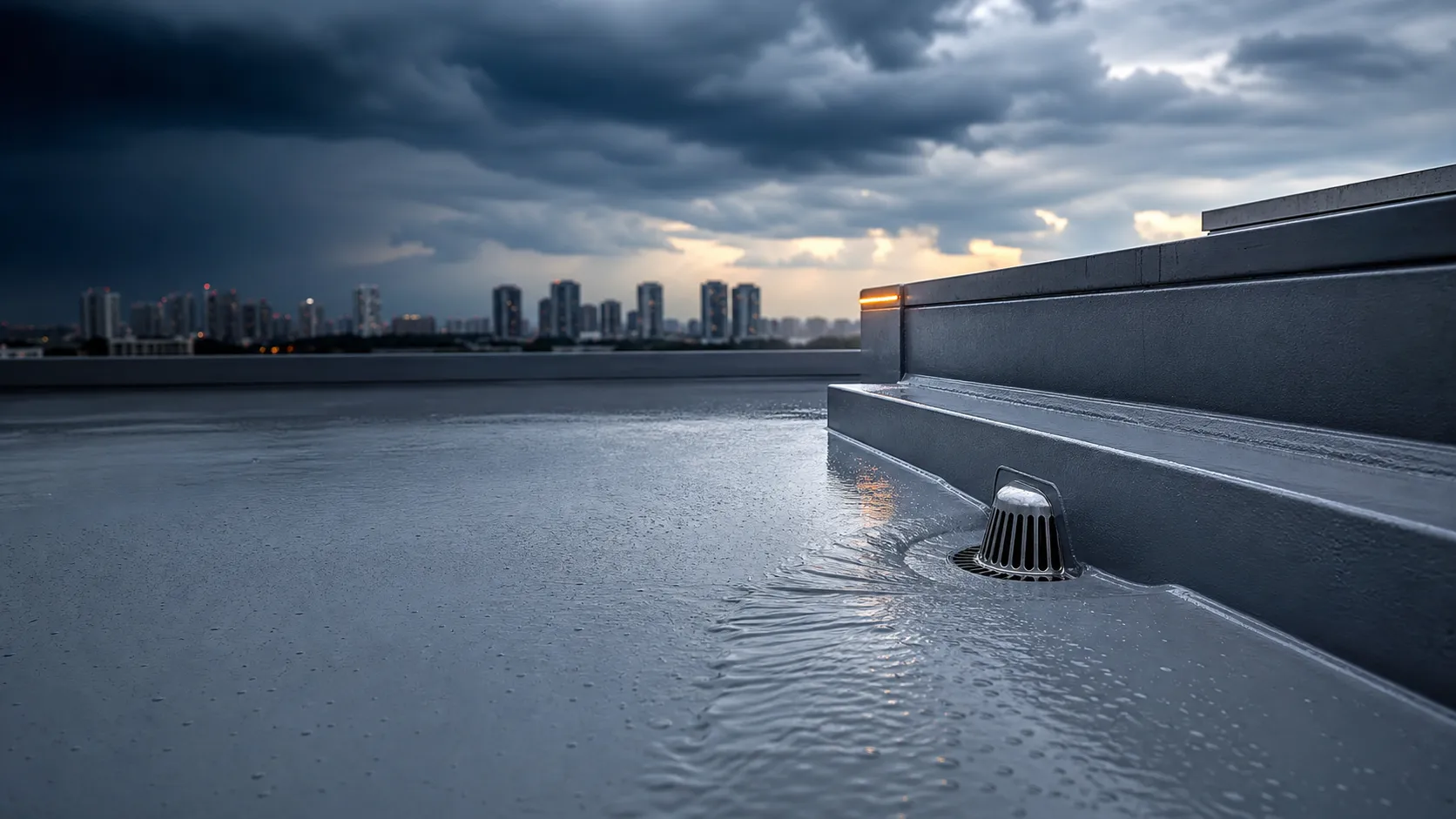
The open field of a roof or deck is the easy part: prepare, prime, apply. The cost — and the risk — concentrates at the details:
- upstands and parapet terminations, where membranes must turn and anchor;
- drainage outlets, the single most common leak point;
- pipe and service penetrations, each one a hand-detailed interruption;
- joints and cracks, which move and must be treated as movement details;
- edges, gutters and thresholds, where systems end and water probes.
A plant roof crowded with services can carry several times the cost of a clean open deck of the same area — legitimately. When a quote is suspiciously cheap, the detailing scope is usually what went missing, and the details are exactly where leaks start.
System class sets the base price
- Cementitious and acrylic coatings are the economical end — suited to selected wet areas and protected surfaces, with shorter recoat cycles.
- Liquid-applied membranes are the exposed-roof workhorse: seamless, cold-applied films that follow every detail. Rayson’s route here is SealForce RC40, a two-component, cold-applied aliphatic polyurea membrane — roller-, brush- or spray-applied, UV-stable, walkable and elastic through Singapore’s daily thermal cycling.
- Hot-spray pure polyurea such as SealForce SP200 is the premium route — fast-curing hot-spray application by specialist crews that returns the area to service quickly, which is often what pays for it on live sites, car park decks and containment work.
Higher class buys thickness, speed, elasticity and service life — the honest question is which duty the surface actually faces. Exposed tropical roofs, trafficked decks and bunds are different problems; the waterproofing systems page separates them.
The existing surface is half the quote
Waterproofing is rarely applied to a new, clean slab. Removing a failed membrane, drying and repairing the substrate, re-establishing falls so water reaches the outlets — this reinstatement work can equal or exceed the new system’s cost, and no serious contractor can price it without seeing the roof. A quote produced without an inspection is a guess with a signature.
Repair, recoat or replace
- Repair when the breach is local and the surrounding membrane is sound.
- Recoat when the membrane is ageing uniformly but still bonded — a liquid-applied overlay buys years at a fraction of replacement cost.
- Replace when adhesion has failed or water is tracking beneath the membrane — patching a floating membrane pays for the same leak twice.
Water travels: the stain on the ceiling is often metres from the breach. Spend on finding the real entry point before spending on coverage.
Comparing quotes: the five lines that matter
- System and applied thickness (with the TDS named).
- Preparation and repairs — included or excluded.
- Detailing scope: upstands, outlets, penetrations, terminations, joints.
- Warranty — years, and what it actually covers.
- Programme and weather allowance.
Two quotes stating all five are comparable. Headline rates are not.
Getting a real number
Send photos of the surface and its details, the approximate area, the history (when it last leaked, what was done), and the access situation — Rayson will recommend a system class honestly, including when a repair rather than a re-waterproof is the right answer: request a quote or WhatsApp the photos.