Warehouses and logistics
Concrete dust settles on stock, racking and scanners, and forklift aisles wear to a rough, open surface.
Harden and seal the slab clear. Add an epoxy system only where colour, line marking or a thicker build is needed.
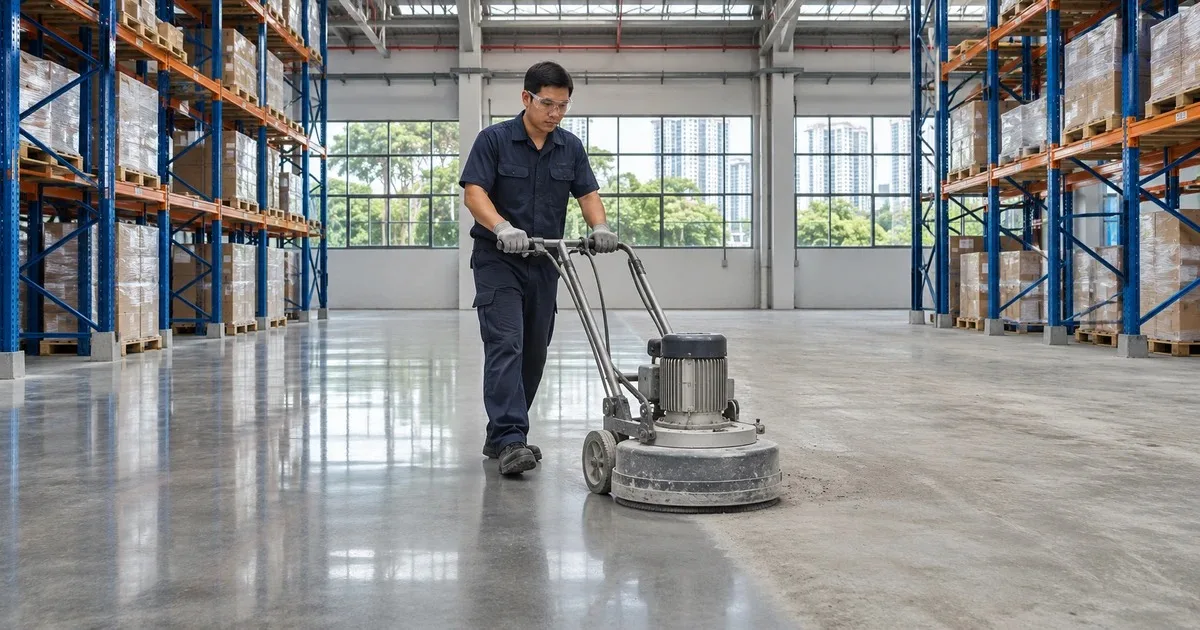
A slab that dusts and stains has a surface problem. Rayson TopShield CH460-S hardens and seals concrete in three thin, clear coats, so warehouses, factories and car parks get a dust-free floor that is easy to clean, without a thick coating.
New in the Rayson range, November 2026. Ask about availability and a trial area.
WhatsApp is answered every day, 8:30am to 10pm, usually within an hour. Rayson recommends an applicator from its network, who inspects, quotes and installs.
Updated: November 2026
A concrete floor hardener stops a slab from dusting and wearing by hardening and sealing its surface. Rayson TopShield CH460-S is a two-part, clear inorganic–organic hybrid applied in three thin coats, 0.35 kg/m² in total, with a polish after the first coat. It takes foot traffic after 12 hours and reaches full hardness in 72 hours at 20 °C. Unlike a dry-shake hardener, it goes onto existing concrete as well as new.
Build-up from data sheet RY-TDS-CH460. Consumption depends on the slab; confirm it on a trial area.
Source: Rayson TopShield CH460-S data sheet, RY-TDS-CH460, Rev. 1.0.
Six kinds of floor owner have the same complaint: the concrete sheds dust, stains and is hard to keep clean. Choose the one closest to yours and send it with your enquiry.
Concrete dust settles on stock, racking and scanners, and forklift aisles wear to a rough, open surface.
Harden and seal the slab clear. Add an epoxy system only where colour, line marking or a thicker build is needed.
Dust reaches machines and product, and oil soaks into bare concrete and stains it.
A sealed, stain-resistant surface that is easy to clean. Chemical process areas still need a coating system chosen for the chemical.
Bare decks dust, mark and hold dirt, and a full deck coating is more than the budget allows.
Harden and dust-proof bays and aisles under cover. Exposed top decks need a waterproof deck system instead.
A bare slab or screed sheds dust into M&E rooms, stores and service corridors.
A clear sealed finish, roller-applied. Coats go on 4 to 24 hours apart, so three coats fit into two working days.
The floor must be dust-free at handover, and the slab was cast without a dry-shake hardener.
TopShield CH460-S goes onto new concrete once it has fully cured and its moisture content is below 8%.
You want a thin-film job that is quick to apply and simple to price per square metre.
Three roller or rake coats and one polishing pass, at about 0.35 kg/m² of material. Ask about joining the Rayson applicator network.
Four ways to stop a concrete floor dusting. They differ in when they can be applied and in what they leave on the surface.
| Option | How it works | Where it fits | Watch for |
|---|---|---|---|
| Dry-shake hardener (powder) | Trowelled into the surface of fresh concrete while the slab is being cast. | New slabs only, decided before the pour. | Cannot be added to an existing floor. |
| Silicate densifier (liquid) | Soaks in and reacts with the cement paste to densify the surface. Leaves no film. | Sound slabs with light dusting. | The result depends on the slab’s own quality. With no film, stain protection is limited. |
| Hybrid hardener and sealer: Rayson TopShield CH460-S | Penetrates and binds the surface, then builds a thin, hard, clear wearing film over three coats. | New and old concrete, mortar and screed that dust or stain. | A thin film: it does not level rough concrete or bridge moving cracks. |
| Epoxy floor coating | A coloured resin film, from a roller coat to a self-levelling layer. | Colour, line marking, heavier wear and chemical exposure. | More material, more preparation and a longer shutdown. |
The dry-shake and densifier rows describe product types in general, not any one maker’s product. Check the data sheet of whatever is specified. Because TopShield CH460-S forms its own thin wear surface, its result depends less on slab quality than a conventional silicate hardener does.
Both sequences come from the data sheet. An applicator confirms the rates on a trial area before the full floor.
For bare concrete, mortar or screed that dusts
Total material: 0.35 kg/m²
For floors that will be finished with TopShield CH465-S
Primer coat: 0.10–0.15 kg/m²
A hardener is a thin film. These six conditions need something else first, or instead.
A thin film follows the surface; it does not level it. A self-levelling epoxy builds a new flat wearing layer.
Self-levelling epoxy flooring →Repair them before any coat goes down. The hardener does not bridge moving cracks.
Concrete floor repair →Polished, hardened floors can be slippery when wet, and no slip rating is published for this system. Hot wash-down areas need a PU-cement screed.
PU screed flooring →The concrete must be dry, with a moisture content below 8%. Do not apply over damp concrete, standing water or condensation.
TopShield CH460-S is clear. For a coloured floor use the ceramic-hybrid colour system or an epoxy coating.
Concrete floor sealer and colour system →The data sheet states resistance to water and common chemicals only. Named chemicals need a system chosen for them.
Chemical-resistant flooring →Each product page carries the full data sheet. Read the limits on the sheet before specifying.
Two-part clear hybrid, 5:1 by weight, 18 kg set. Three coats harden and dust-proof; one coat primes under CH465-S.
Two-part clear hybrid top coat, 3:1 by weight, for a harder, stain-resistant wearing surface over the primer coat.
Three-part epoxy mortar for potholes, spalls and joint edges, placed before the hardener.
Non-sag epoxy paste for cracks, voids and vertical details, placed before the hardener.
Rayson makes the material and recommends the job to an applicator in its network, who quotes and contracts it with you directly, under the workmanship warranty in its own quotation. For materials only, Rayson quotes you directly. There is no published price per square metre yet: the price follows the area, the preparation the slab needs and the shutdown window.
Send photos and the area. Rayson replies within one working day with a direction and what needs checking on site.
Answer four questions about your surface and conditions to shortlist suitable Rayson systems.
Find your systemEstimate material quantities from your floor area, coats and coverage rate.
Estimate quantitiesOpen technical data sheets for every Rayson product — no forms, no gating.
Open the libraryA concrete floor hardener is a treatment that hardens and seals the surface of a slab so it stops dusting and wears more slowly. Rayson TopShield CH460-S is a two-part, clear inorganic–organic hybrid applied in three thin coats, 0.35 kg/m² in total. It penetrates and binds the surface and leaves a hard, dust-free, stain-resistant finish.
Dust comes from a weak surface layer. Too much water in the mix, finishing while bleed water is still on the surface and poor curing all leave a soft skin of cement paste that traffic grinds into powder. Sweeping removes the dust but not the weak layer; a hardener binds it, or grinding removes it before coating.
A dry-shake hardener is a powder trowelled into fresh concrete, so it suits new pours only. A silicate densifier is a liquid that reacts inside the slab and leaves no film. TopShield CH460-S penetrates and also builds a thin, hard, clear film, so it goes onto existing floors and adds stain resistance.
Yes. TopShield CH460-S is for new, fully cured concrete and for old concrete, cement mortar and screed. The floor is repaired, ground and vacuumed first, and its moisture content must be below 8%. On existing epoxy or stone, complete a test area first.
The hardening system uses 0.35 kg/m²: coat 1 at 0.15 kg/m² and coats 2 and 3 at 0.10 kg/m² each. One 18 kg set therefore covers about 50 m² in three coats. Porous or rough slabs take more, which is why the rate is confirmed on a trial area.
TopShield CH460-S takes foot traffic and light work after 12 hours and reaches full hardness after 72 hours at 20 °C. Coats are applied 4 to 24 hours apart. Ask Rayson when forklifts or vehicles can return, because that depends on the load and the site temperature.
It can be when wet. The data sheet warns that polished, hardened floors can be slippery when wet, and no slip rating is published for this system. For wet or washed-down areas, have the slip resistance assessed and consider a textured anti-slip system instead.
Choose a hardener when the slab is sound and the problem is dust and stains: it is clear, thin and quick. Choose an epoxy coating when you need colour, line marking, a thicker wearing layer or resistance to specific chemicals. Many warehouses use both, zone by zone.
Rayson has not published a price per square metre for this system. The price depends on the area, how much grinding and repair the slab needs and the shutdown window, so it is quoted after photos or a site check. Material for the full system is about 0.35 kg/m².
An applicator in the Rayson network applies it and quotes and contracts the job with you directly; Rayson quotes materials-only orders. TopShield CH460-S is new in the Rayson range in November 2026, so ask about current availability and a trial area before you specify it.
Tell us your surface, area and timeline — our Singapore technical team will recommend a practical system and reply within one working day.
Rayson assistant
Answers from Rayson's own product information
Guidance only — confirm specifications with the Rayson technical team.