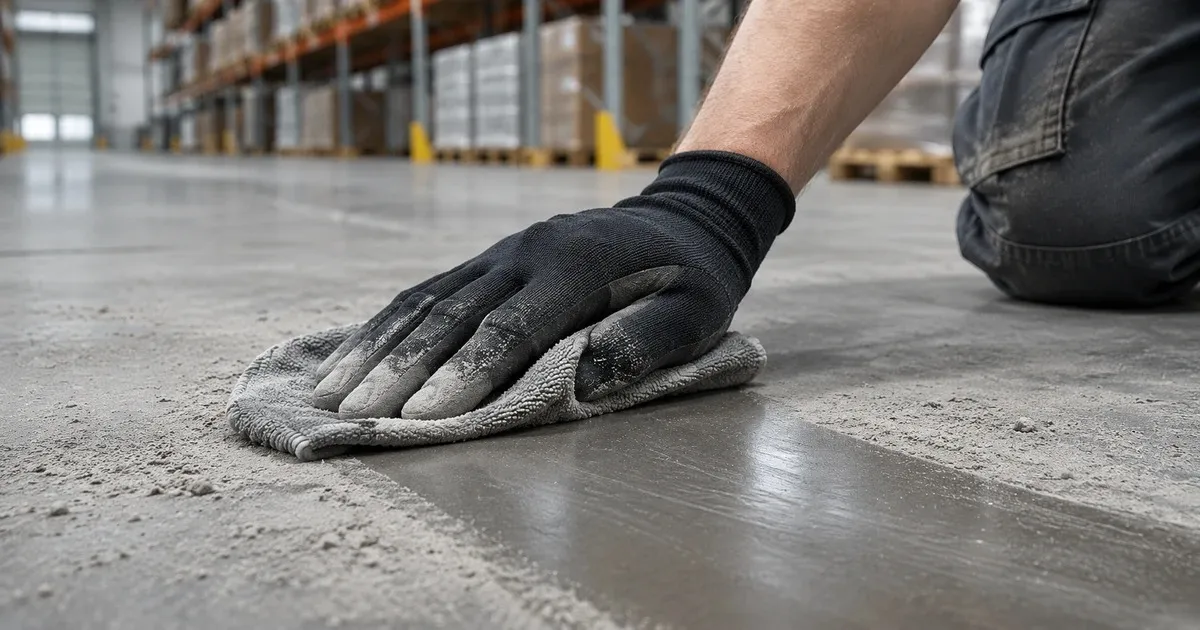
A concrete floor that keeps producing grey powder is not dirty. Its surface is wearing away. This guide explains why that happens, how to judge how serious it is, and which fix suits each case.
What dusting is
Dusting is a fine powder that forms as the surface of hardened concrete breaks down. The slab underneath is usually sound. The problem is a thin top layer that is weaker than the concrete below it, so feet, trolley wheels and forklifts grind it loose.
Why the surface is weak
The top few millimetres of a slab are decided on the day it is cast:
- Too much water in the mix. Extra water rises to the surface and leaves a porous, low-strength skin.
- Finishing over bleed water. Trowelling while water is still standing on the surface works that water back into the top layer.
- Poor curing. Concrete that dries too fast never reaches full strength at the surface. In Singapore’s heat, an uncured slab loses moisture quickly.
- Rain or condensation on fresh concrete. Water on a newly finished surface has the same effect as bleed water.
None of these can be undone. The weak layer has to be bound together or removed.
Three quick checks
These are site checks, not laboratory tests, but they tell you which fix to ask about:
- Rub. Rub a dark cloth or your palm across a swept area. A light grey film means light dusting. A thick layer of powder means the surface is breaking down.
- Scratch. Drag a coin or key across the surface. A firm floor shows a faint mark. A weak one gouges and leaves loose grit.
- Water. Put a few drops of water on the floor. If they soak in within seconds, the surface is open and porous.
Match the fix to the floor
| What you find | What it means | The fix |
|---|---|---|
| Light film of dust, surface firm | A thin weak skin on a sound slab | A hardener: grind lightly, vacuum, apply three coats |
| Dust, and stains are a problem too | The surface is open as well as weak | A hardener, or a primer and a clear top coat for more stain resistance |
| Surface gouges easily, loose grit | The weak layer is deep | Grind back to firm concrete, then harden or coat |
| Rough, worn or uneven floor | The wearing surface is gone | A coating system that builds a new layer, such as self-levelling epoxy |
| Cracks, potholes, broken joints | Damage, not dusting | Repair first; a thin film does not bridge cracks |
What a hardening job involves
For a firm slab with light to moderate dusting, the Rayson system is TopShield CH460-S, a two-part clear hybrid that penetrates the surface and builds a thin, hard film:
- Repair cracks and damaged areas, grind and vacuum. The slab must be dry, with a moisture content below 8%.
- Apply coat 1 by roller at 0.15 kg/m².
- After at least 4 hours, polish and burnish with a floor polishing machine.
- Apply coats 2 and 3 at 0.10 kg/m² each, at least 4 hours apart.
That is 0.35 kg/m² in total, so one 18 kg set covers about 50 m². The floor takes foot traffic after 12 hours and reaches full hardness after 72 hours at 20 °C. The full comparison with dry-shake hardeners, silicate densifiers and epoxy is on the concrete floor hardener page.
What does not fix it
- Sweeping and scrubbing. They remove the powder, not the layer that makes it.
- Coating over the dust. Any coating bonds to the weak layer and comes away with it.
- One heavy coat. Thin coats cure hard; a single thick coat does not.
Dust and health
Concrete dust contains crystalline silica. Dry sweeping and open grinding put fine dust into the air, which is why floor preparation is done with vacuum-attached grinders. A floor that no longer dusts also needs less sweeping.
Getting the floor assessed
Send photos of the whole floor and a close-up of the dusting, with the area and what runs on it. Rayson recommends the job to an applicator in its network, who quotes and contracts it with you directly. TopShield CH460-S is new in the Rayson range in November 2026, so ask about availability and a trial area.