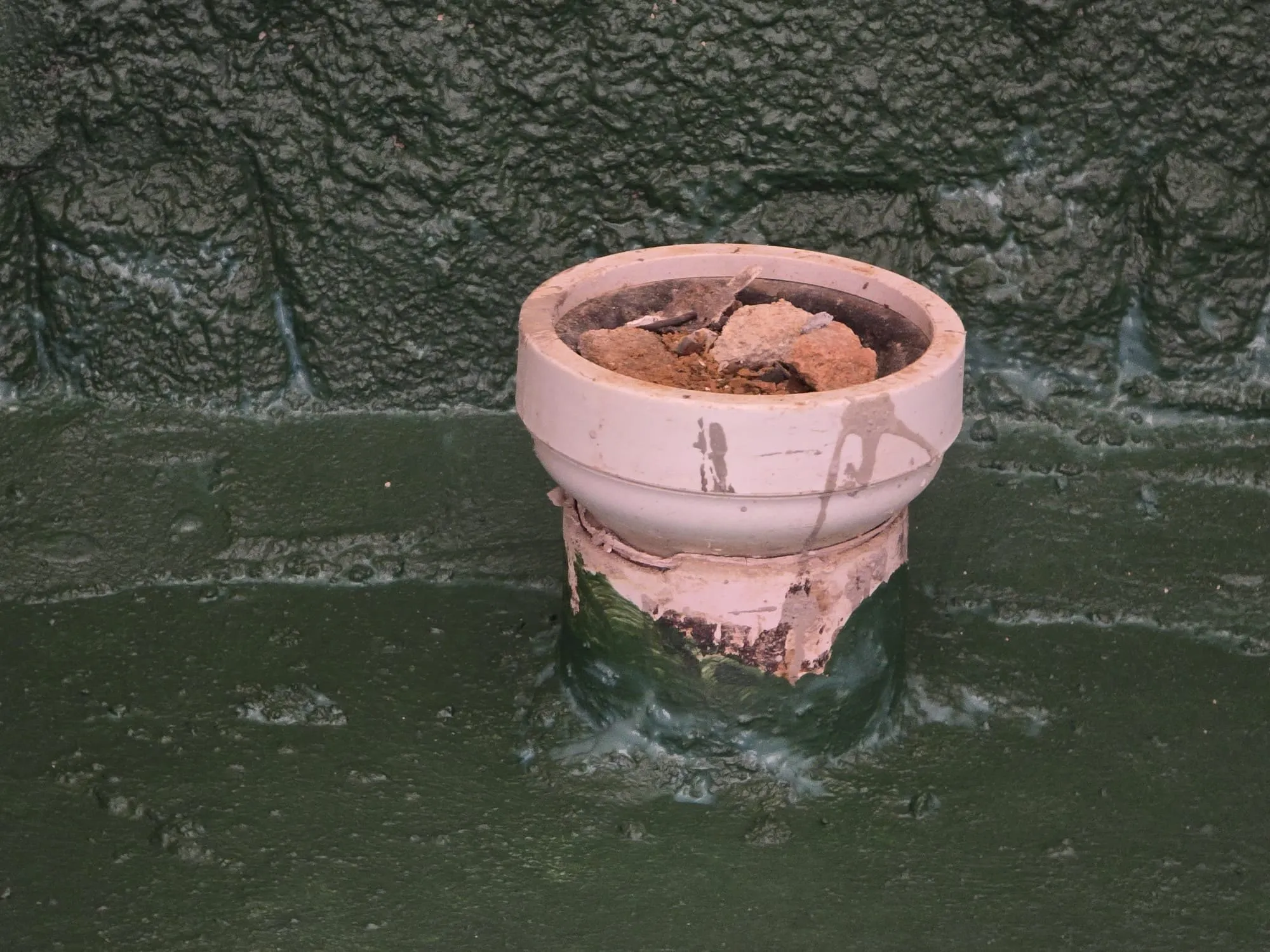
A stain spreads on the bathroom ceiling, then a drip, then a bubble in the paint. It is the most common waterproofing failure in Singapore, and the first question is never technical. It is: who pays? The answer depends on what you live in, and in every case the repair happens somewhere you do not own: the toilet above you. This guide sets out the rules for an HDB flat, a condominium and a landed house, what the repair actually is, what it costs, and what to do this week.
Start from where the water comes from
Water on a ceiling has come through the floor slab above it. In a bathroom stack, the toilet upstairs sits directly over yours, and the membrane beneath its tiles has failed at one of five places: the floor trap, a pipe penetration, the wall–floor junction, the door threshold or the shower wall. The wet-area guide goes through each. The point for now is simpler: nothing applied to your ceiling fixes it. Sealing, painting or boxing the ceiling hides the stain and keeps the water in the concrete.
HDB flats: the floor slab is shared
Under the HDB lease the upper and lower floor flat owners are jointly responsible for the party structure between them, the floor slab. So the leak is not simply the upstairs owner’s problem, and it is not simply yours: it is a shared repair.
To keep that repair affordable and quick, HDB runs the Goodwill Repair Assistance scheme for leaks caused by wear and tear in the slab between flats. As HDB has described it in its own letters to the press, HDB co-pays 50% of the repair cost, the remaining 50% is shared equally between the upper and lower floor owners, and once both owners agree to take up the scheme HDB arranges a contractor to carry out the work in both units: typically a new waterproofing membrane on the floor of the upper flat, and skim coat, sealer and paint on the ceiling of the lower one. The scheme covers the repair of the slab, not damage to fixtures such as cabinets, shower screens or lighting. HDB’s published letters have also described a cap on each owner’s share per repair location; the figure and the eligibility conditions are HDB’s to state, so read HDB’s current page before you rely on a number.
If the upper-floor owner will not engage, report the leak to HDB, which contacts the owner directly. Disputes between neighbours that stay unresolved have a mediation route, and HDB’s process, not a contractor’s description of it, is the one to follow. Keep dated photographs of the stain and any drip: they show when the leak began and whether it follows showers, the WC or is constant.
The technical work does not change with who pays. The upstairs toilet floor is opened, the cause is found, the membrane is reinstated, flood-tested and re-tiled.
Condominiums: the law presumes the unit above
In a private non-landed estate the Building Maintenance and Strata Management Act sets the starting point: a leak into a lower unit is presumed to come from the unit above unless the upper-floor owner proves otherwise. The two owners are expected to investigate the cause jointly, and the management corporation is brought in where the source may be common property, a riser, a rooftop tank or the roof itself, which the corporation maintains rather than either owner.
Most cases settle once the cause is found, because the presumption makes the upstairs owner’s interest clear. Where they do not, either owner can apply to the Strata Titles Board, which offers mediation and hearings for a filing fee. As with HDB, dated photographs and a written record of when the leak appears are what the case rests on.
Landed houses: your own upper floor
There is no neighbour. The bathroom, balcony or roof terrace above the stain is yours, and so is the repair. The failure points are identical, and the landed-home guide covers the surfaces that sit over rooms: the bathrooms inside, the balconies, the roof terrace and the car porch.
What the repair is
Two honest routes, and the assessment decides which:
- The membrane is sound and a crack or joint is letting water through. PU injection grouting seals the crack from below or above. It is quick and relatively cheap, and it is the right fix only when the film beneath the tiles is still doing its job.
- The membrane has failed at a detail. The tiles in the toilet above come up, the failed area or the whole floor is prepared, cracks are reinstated with a non-sag repair such as PatchBond TX80, and the membrane is reinstated. For a toilet or bathroom that is SealForce WB20: a one-part, water-based membrane rolled on in two coats at 0.4 mm wet film, worked into the trap, around the pipes and up the walls, flood-tested 24 hours after the final coat and only then re-tiled.
A no-hack coating applied over the tiles from above sits between the two: it can stop grout weeping, and it buys months where the membrane has failed at a trap or a pipe. It cannot rebuild the detail.
What it costs
Singapore guides published in 2026 give these ranges; the waterproofing cost guide lists the sources.
| Repair | Published range, S$ |
|---|---|
| PU injection grouting | 300 – 1,200 |
| No-hack coating from above | 700 – 2,500 |
| Injection plus targeted waterproofing | 1,000 – 2,200 |
| Typical HDB ceiling leak fixed at the source | 600 – 1,800 |
| Hack, treat, re-membrane and repaint | 2,500 – 6,000+ |
Add roughly 15 to 25% for rope access, urgent call-outs or condominium coordination. In an HDB flat the owners’ shares fall under HDB’s scheme; in a condominium the presumption usually puts the cost with the unit above.
What to do this week
- Photograph the stain and any drip, with the date, and note whether it follows showers, the WC, washing, or rain.
- Speak to the owner above; most leaks are resolved by two owners who both want it fixed.
- In an HDB flat, report it to HDB and ask about the Goodwill Repair Assistance scheme. In a condominium, inform the management corporation.
- Get the toilet above assessed with a flood test before anyone quotes for hacking or for a sealer.
- Send the photographs to Rayson. We will specify the membrane, send the technical data sheet and, where you need one, introduce an applicator in the Rayson network who assesses the toilet, flood-tests it, issues the quotation and carries out the repair under its own workmanship warranty.
The hub page for waterproofing in Singapore sets wet areas beside roofs, decks and tanks; the toilet and bathroom waterproofing page shows the repair step by step.