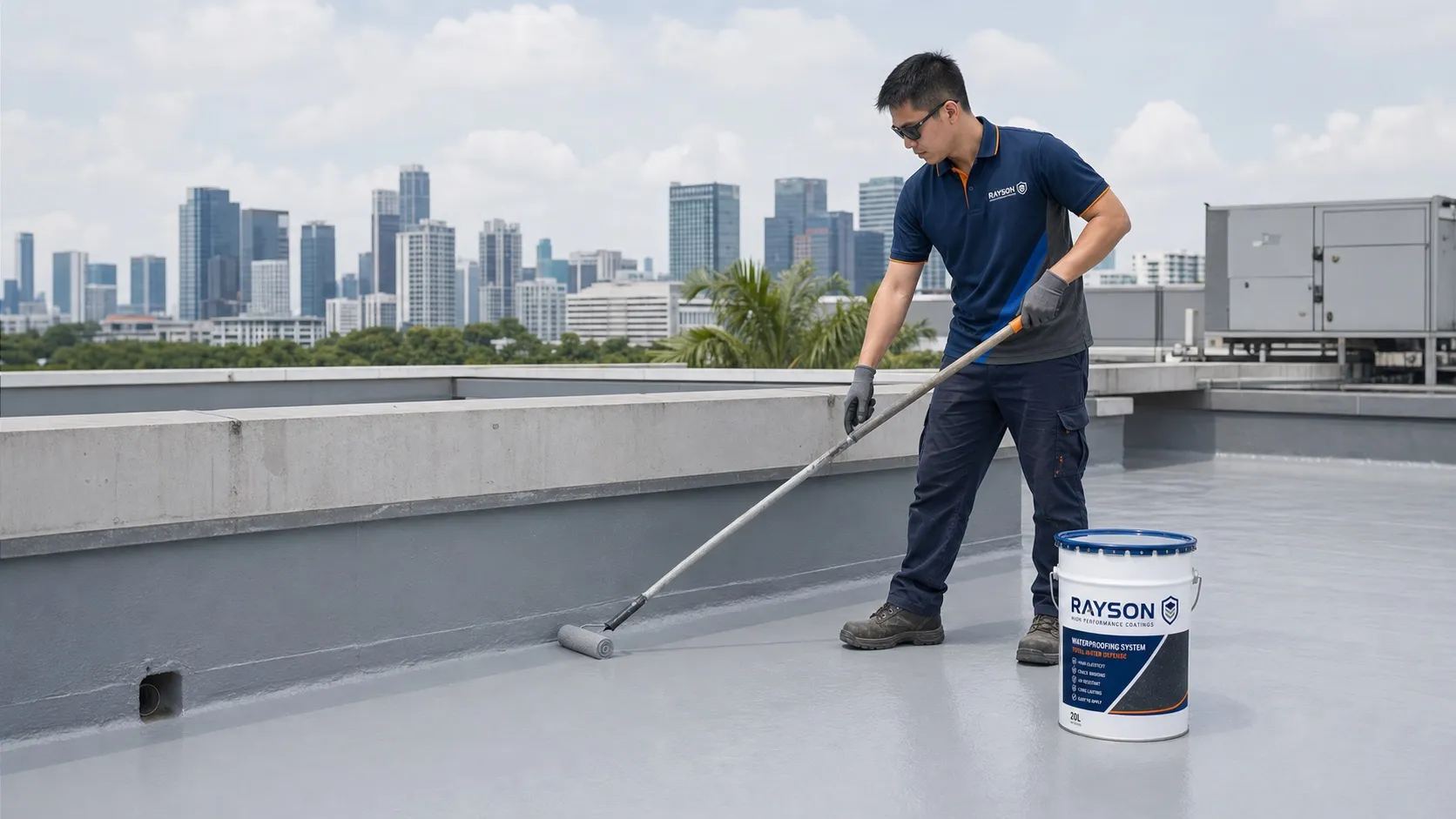
A roof that was waterproofed and leaks again is rarely a product failure. It is almost always one of eight things that were true of the roof before the membrane went on — or true of the day it was applied. Each one leaves a visible signal, has a physical cause, and has a fix aimed at that cause rather than at the coating. This guide sets them out in the order an applicator looks for them, because the order matters: the first two account for most of the roofs we see.
1. Ponding — the roof holds water
Signal. Tide-marks, dark patches, silt, algae and moss in the same places after every rain. Standing water hours after the sky clears.
Cause. The falls do not carry water to the outlets. Sometimes the slab was cast flat; sometimes deflection or a later screed created low spots; sometimes the outlet is higher than the field around it. Standing water keeps the film wet, cool and stressed, ages every membrane chemistry, and pushes water into the smallest pinhole or lap.
Fix. Correct the falls — with a falls screed or by relocating or adding outlets — before any membrane goes on. A system that tolerates prolonged ponding, such as SealForce RC40, gives a margin of resilience on a roof that occasionally holds water after a storm; it does not make a permanent pond acceptable. Coating over ponding delays the same leak.
2. Upstands and terminations — the membrane stops short
Signal. Leaks along a parapet line, at a plinth under plant, or at the junction between roof and wall, often appearing inside as a stain running down from the ceiling edge.
Cause. Where the membrane turns up a parapet, a kerb or a plinth it has to climb above the water line and terminate — into a chase, under a flashing, or against a sealed edge. Terminations that stop too low, are not reinforced at the change of plane, or are left with an open top edge let water in behind the membrane, where it travels along the slab and appears somewhere else.
Fix. Detail the upstands first and the field second. Reinforce the internal corner, carry the membrane to the specified height above the finished level, and terminate it into a chase or under a counter-flashing that sheds water. On a roof with many plinths and kerbs, a seamless liquid system that follows every change of plane without a lap is the reason the roof pages recommend one.
3. Outlets and drains — water finds the way down
Signal. A leak directly below a roof outlet, or a persistent damp patch around a downpipe inside the building.
Cause. The outlet is where the membrane has to turn down and bond to a pipe, a clamping ring or a cast-iron body — a different material, a different movement, a different temperature. It is also where debris collects and water sits deepest. A membrane that was feathered to the outlet rather than dressed into it, or an outlet with a cracked body or missing clamp, is a leak waiting for the next storm.
Fix. Treat every outlet as a detail: clean, prime, reinforce, dress the membrane into the outlet body and clamp it. Check that the outlet sits at the lowest point of its catchment. Keep it clear — a blocked outlet turns the roof around it into a pond, which is failure number one.
4. Blistering — the film lifted off the slab
Signal. Domed bubbles in the membrane, soft underfoot, sometimes with water inside when cut. Often worst where the roof holds water or in the areas coated last in the day.
Cause. Two mechanisms, and the assessment distinguishes them. Moisture from below: the film was applied over a slab that was too wet, and vapour pushed up under it as the surface warmed. Solvent from within: a solvent-borne layer was applied too thick, skinning over before the solvent could escape. RC40’s published limits — substrate moisture below 4%, and each unreinforced layer kept under 1 kg/m² — exist to prevent exactly these two.
Fix. Cut out the blisters back to sound, bonded film; dry the substrate and confirm it with a meter; correct the cause — moisture or thickness; feather, prime and reinstate the area with the same system. If the substrate is saturated across the roof, local repair chases the problem and the roof is a strip-and-replace.
5. UV chalking and surface cracking — the wrong chemistry in the sun
Signal. A powdery, faded surface that comes off on a finger. Fine crazing that deepens into cracks. Colour that has gone from white or grey to yellow or brown.
Cause. Aromatic polyurethanes, epoxies and many general-purpose coatings are not stable under permanent UV. The surface degrades, the film thins, elasticity drops, and the cracks that follow let water in. This is the most common failure on roofs that were coated with a floor or general-purpose product because it was to hand.
Fix. An aliphatic chemistry for exposed roofs — RC40 is an aliphatic polyurea formulated to hold colour, gloss and elasticity under UV, with a high-reflectance white grade for cool roofs — or a UV-stable topcoat over an aromatic base. A chalked surface that is otherwise bonded can sometimes be cleaned, primed and overcoated; one that has cracked through needs the cracked film removed first.
6. Moving cracks — a joint that was never designed
Signal. A crack that reappears through the membrane in the same line, opens in the cool of the morning and closes in the afternoon heat, often running between columns or along a construction joint.
Cause. The slab moves with temperature and load. A crack that opens and closes is a movement joint the structure made for itself, and no membrane painted across it will hold — the film is stretched past its limit at a line a few millimetres wide.
Fix. Distinguish static from moving. A static shrinkage crack is cut, cleaned and filled — a non-sag epoxy such as PatchBond TX80 bonds on vertical and mat-damp concrete — and then coated over. A moving crack is treated as a joint: a bond-breaker over the crack, a reinforced flexible strip, and the field membrane carried over that, so the movement is spread across a band rather than concentrated on a line.
7. Overcoating a dead membrane — sealing the problem in
Signal. A recent coating that is lifting in sheets, with the old membrane coming away underneath it; leaks that started soon after the “repair”.
Cause. A new liquid coat was applied over an existing membrane that was already debonded, waterlogged or chemically incompatible. The new film bonded to the old membrane, not to the roof, and when the old membrane let go, so did everything on top of it. Water trapped beneath had nowhere to go.
Fix. Assess before overcoating. A sound, well-bonded, compatible membrane can be prepared, primed and overcoated — RC40 is formulated for recoating sound bitumen, PVC/TPO and PU-foam. Failed, debonded or waterlogged areas are removed and reinstated; a membrane holding water underneath is stripped, not covered. The roof guide sets out the assessment that decides which case you have.
The eighth cause: the weather on the day
Not a defect in the roof — a defect in the programme. A film applied onto a surface that was still damp from the last storm, or below dew point in the early morning, or rained on before it could resist early rain, fails in one of the ways above without any of the roof conditions being wrong. For RC40 the published rules are substrate moisture below 4%, relative humidity below 85%, the surface at least 3 °C above dew point, and no rain expected during application or until the film resists it — about three hours. In Singapore that means working to the weather, not the calendar, and an applicator who walks off the roof when the conditions say so.
What to send us
Wide photographs of the whole roof and close-ups of every stain, blister, crack and outlet; where water stands after rain; what is on the roof now and when it went on; and where the leak appears inside. Rayson will review the likely cause, specify the system, and — where you need one — introduce an applicator in the Rayson network who diagnoses the roof, quotes the repair and carries it out under its own workmanship warranty. The roof waterproofing page covers the systems; the membrane types guide covers the alternatives.