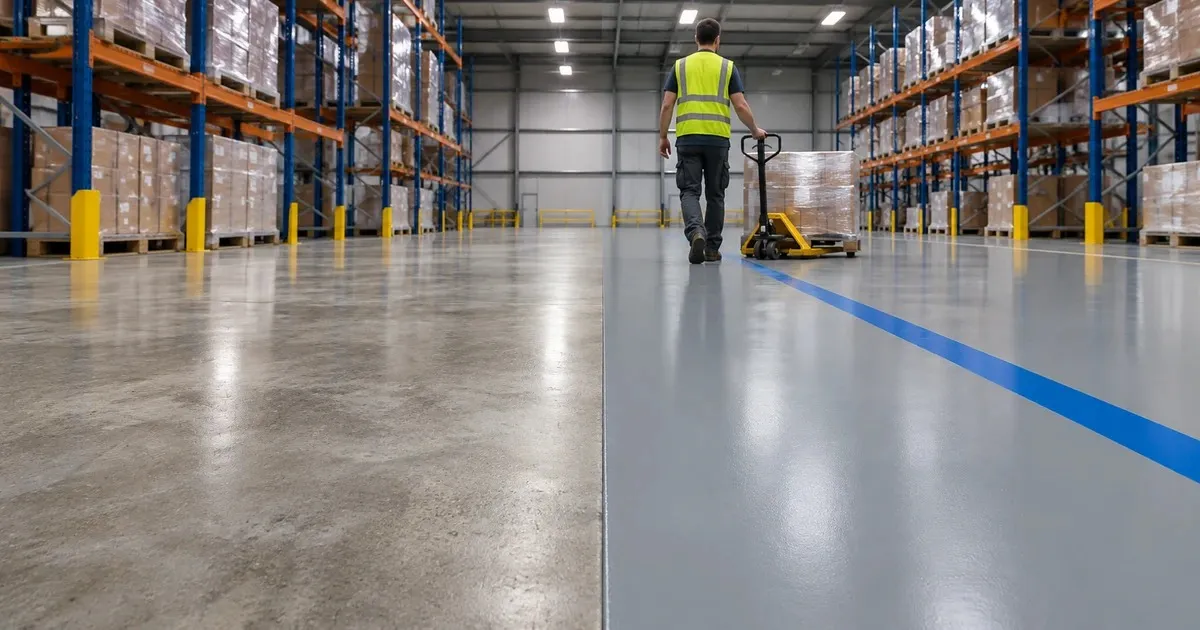
Both a concrete hardener and an epoxy coating stop a floor dusting. They do it in different ways, and the difference decides which one fits your floor.
The short answer
- Hardener: the slab is sound, the problem is dust and stains, and the floor can stay the colour of concrete.
- Epoxy: the floor needs colour, line marking, a thicker wearing layer or resistance to specific chemicals.
Side by side
| Concrete hardener | Epoxy floor coating | |
|---|---|---|
| What it leaves | A hardened surface with a thin, clear film | A coloured resin layer on top of the slab |
| Rayson product | TopShield CH460-S | FloorGuard EP310 (roller) or EP320 (self-levelling), over PrimeBond EP110 |
| Material | About 0.35 kg/m², three coats | More, by system; see each data sheet |
| Colour and marking | Clear only | Colours, zones and line marking |
| Levels a rough floor | No | Self-levelling epoxy does |
| Existing floors | Yes, new and old concrete | Yes, on prepared sound concrete |
| Foot traffic | 12 hours after the last coat | By product; see the data sheet |
| Watch for | Does not bridge cracks; can be slippery when wet | More preparation and a longer shutdown |
Choose a hardener when
- The concrete is firm and flat enough to use as it is.
- Dust on stock, racking or machines is the main complaint.
- The area cannot close for long. Coats go on 4 to 24 hours apart.
- A concrete look is acceptable.
TopShield CH460-S penetrates and binds the surface, then builds a thin hard film. Because it forms its own wear surface, the result depends less on the quality of the slab than a conventional silicate hardener does. The full system and its limits are on the concrete floor hardener page.
Choose epoxy when
- Aisles, walkways and zones must be coloured or marked.
- The surface is worn or rough and needs a new wearing layer.
- The floor meets oils, solvents or process chemicals that call for a tested system.
- The floor must look uniform, with repairs hidden.
The systems and formats are on the epoxy flooring page, and prices by system are in the epoxy flooring price guide.
Use both, by zone
One building rarely needs one answer. A typical warehouse split:
- Racking and storage bays: clear hardened concrete.
- Main forklift aisles and turning areas: self-levelling epoxy.
- Walkways and safety zones: coloured epoxy or line marking.
- Wash bays and wet process areas: PU-cement screed.
Zoning puts the heavier system only where the traffic needs it. The method is set out in choosing a warehouse floor coating by traffic class.
What neither does
- Neither fixes a damp slab. Both need dry concrete. For the hardener, that means a moisture content below 8%.
- Neither replaces repairs. Cracks, potholes and broken joint edges are repaired first.
- Neither is right for hot wash-down. That is a PU-cement screed.
Getting it assessed
Send photos, the area and what runs on the floor. Rayson recommends the job to an applicator in its network, who quotes and contracts it with you directly. TopShield CH460-S is new in the Rayson range in November 2026, so ask about availability and a trial area.