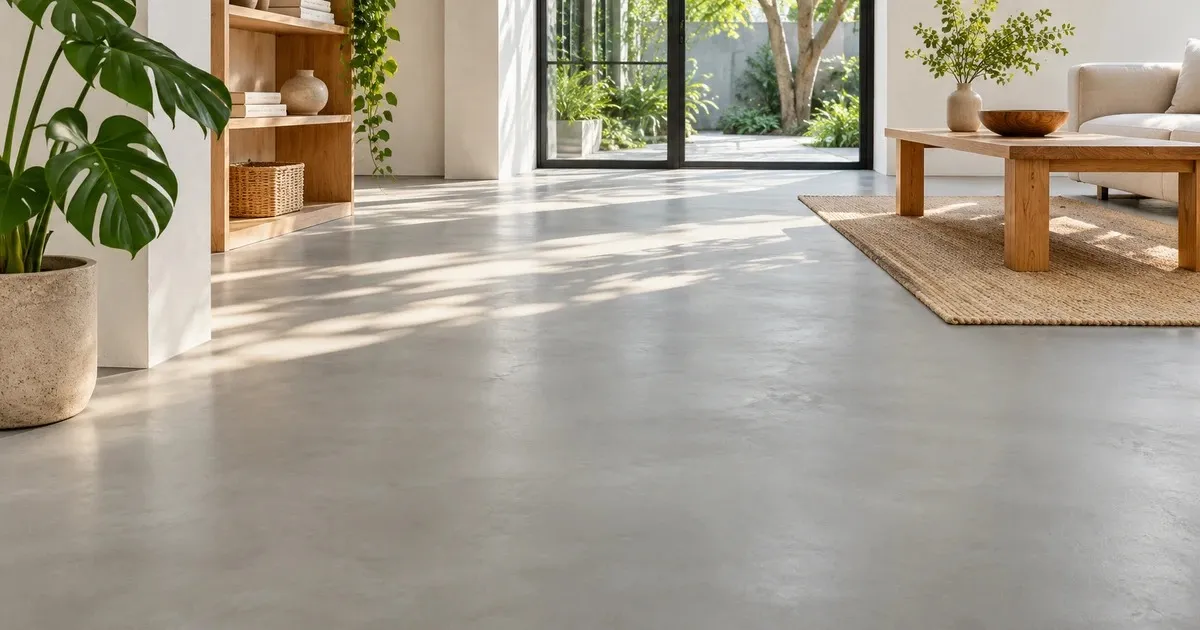
A cement screed floor gives a shop, café, office or home a raw, industrial look. Left bare, it also sheds dust, shows every mark and soaks up spills. Sealing it keeps the look and makes the floor usable.
Before you seal: three checks
- Is the screed sound? Tap it and walk it. Hollow, loose or crumbling areas are cut out and repaired. A sealer does not hold a weak screed together.
- Is it dry? A new screed must cure and dry before any coat goes on. For the Rayson system the moisture content must be below 8%. A sealer over damp screed can blister or turn cloudy.
- Are the cracks stable? Fine shrinkage cracks are normal in screed. Fill them first, and expect them to remain visible under a clear coat. A crack that keeps widening needs to be investigated, not sealed over.
Prepare the surface
Grind or sand the screed to remove laitance, paint spots, old sealer and dirt, then vacuum thoroughly. A sealer bonds to what it touches, so anything loose left on the floor ends up under the coat.
Four kinds of clear sealer
| Sealer | What it is | Fits | Watch for |
|---|---|---|---|
| Penetrating sealer or densifier | Soaks in; leaves no film | Dust control where the look must not change | Limited protection against stains |
| Acrylic sealer | One-part film | Light foot traffic, small budgets | The softest film; needs re-coating under regular use |
| Polyurethane clear coat | Two-part aliphatic film | Floors in sunlight | Needs its own primer |
| Ceramic-hybrid clear coat | Two-part inorganic–organic film, about 50 µm per coat | A hard, stain-resistant finish indoors | Thin film; no UV data published yet |
The Rayson clear system
For an indoor screed floor that must resist stains and wear:
- Grind, repair and vacuum the floor.
- Prime with one coat of PrimeBond CH145-S at about 0.15 kg/m². It consolidates weak or dusty screed.
- After at least 4 hours, apply two coats of TopShield CH465-S at 0.10 kg/m² each, at least 4 hours apart.
That is about 0.35 kg/m² of material in total. The floor takes foot traffic after 12 hours and reaches full hardness after 72 hours at 20 °C. The clear, coloured and over-epoxy systems are compared on the concrete floor sealer page.
What to expect
- The look changes. A clear coat can deepen the grey. Ask for a sample area on your own floor before the whole room is done.
- Marks underneath stay. Stains, patches and trowel marks show through.
- Smooth means slippery when wet. No slip rating is published for this coat. Keep it to dry areas, or ask about an anti-slip finish.
- Sunlight matters. Rayson has not published UV or weathering data for the ceramic-hybrid coat. For a shopfront or balcony in direct sun, use the polyurethane clear coat TopShield PU425-S.
Who does the work
Send photos of the floor, its area and how the room is used. Rayson recommends the job to an applicator in its network, who quotes and contracts it with you directly. In an HDB flat the applicator must be on the HDB Directory of Renovation Contractors. The ceramic-hybrid products are new in the Rayson range in November 2026, so ask about availability and a sample area.