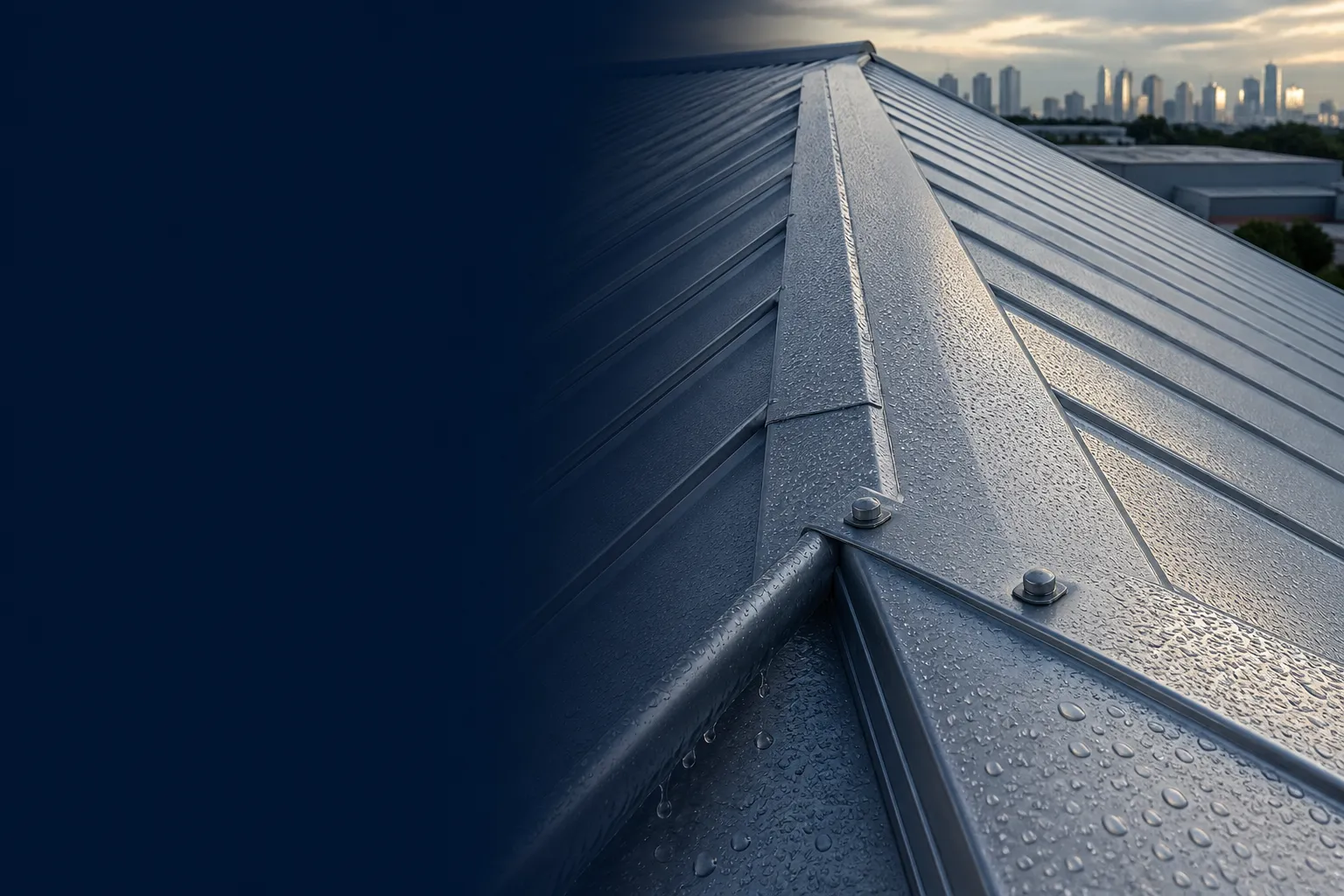
A roof that takes solar panels stops being a roof you can reach. Under the array, the membrane can no longer be inspected, repaired or recoated without lifting the panels, and on a Singapore factory or warehouse the panels usually stay for a decade or two. This guide is for owners, facility managers and the consultants who advise them before a solar contract is signed.
How long the panels stay
JTC’s SolarRoof programme lets JTC lessees put solar on an RC flat or metal roof of 800 m² or more at no upfront cost: the solar vendor finances, designs, builds, owns, operates and maintains the system. Under rooftop licensing the contract runs 8 to 20 years; under solar leasing it is based on 20 years (JTC SolarRoof infokit, version 2, rates as of January 2024). JTC cut the minimum SolarRoof contract from 15 years to as short as 8 in July 2022.
Singapore passed 2 GWp of installed solar capacity in 2025 and has raised its target to 3 GWp by 2030, with rooftops making up more than 80% of installed capacity (Energy Market Authority, March 2026). More factory roofs will carry panels, for longer.
What it costs to do it later
If panels have to come off before the contract ends, charges apply. JTC’s 2024 infokit lists removal at S$9.01 to S$462.77 per m² of panels, depending on the years left in the contract, and relocation at S$75.00 to S$334.47 per m². Those are JTC’s reference rates, subject to the contract with the vendor; they are not waterproofing prices, and the roof repair comes on top. At the end of a lease, JTC’s voluntary solar deployment terms (February 2023) require the panels and their supporting equipment to be removed six months before lease expiry so the premises can be reinstated, which puts the roof under the array back in the lessee’s hands.
The cheapest time to waterproof is before the first bracket is fixed.
Check the roof against the contract length
The question is not whether the roof leaks today. It is whether its waterproofing will last as long as the solar contract. An applicator surveys:
- Metal roofs: side and end laps, fastener heads and washers, rust at cut edges and laps, skylights and flashings, and whether any sheet has rusted through. A sheet that has lost its section is replaced; a coating does not restore it.
- RC roofs: falls and ponding, cracks and whether they move, outlets and upstands, plinths, and the existing membrane’s adhesion and trapped moisture. Details follow SS 637:2018, the Singapore code of practice for waterproofing reinforced-concrete buildings.
- Gutters and outlets on either: outlet size, blocked sumps, split joints and missing overflows. An array sheds rain in sheets onto the same gutters.
If the existing waterproofing would need renewing during the contract, renew it now.
Which membrane goes under the array
A solar roof is walked on: cleaning crews, inverter and string checks, cable runs. That rules out membranes that are not made for foot traffic.
Rayson SealForce RC40 is a two-component, cold-applied aliphatic polyurea: walkable, UV-stable, resistant to ponding water and elastic from −35 °C to +80 °C. It goes on in two layers at 1 to 1.2 kg/m² in total over the primer matched to the roof (on metal, the anti-corrosion primer specified for the sheet), with fabric reinforcement at laps, gutters and details. It resists early rain about 3 hours after application, takes the next layer after about 18 hours at 23 °C and hardens fully in about 7 days. A 1,000 m² roof takes 1,000 to 1,200 kg, or 48 to 58 sets of 21 kg rounded up, on plan area before profile and wastage. In white it is a reflective finish.
Rayson SealForce AC10, the one-part acrylic, suits metal roofs that drain freely and are not walked on. Under an array it belongs only where walkway pads carry all the foot traffic, and never where water ponds. Neither membrane needs hot works, so production below keeps running.
The mounting points decide it
Every solar installation crosses the membrane somewhere. How it crosses decides the detail:
- Standing-seam metal roofs: clamps grip the seams and leave the sheet unpierced. The membrane’s work is the laps, fasteners and gutters around them; agree with the installer which goes on first, and touch up any coating a clamp disturbs.
- Trapezoidal or corrugated sheet: brackets are screwed through the sheet, so every bracket is a hole. The membrane goes on first, the installer fixes the brackets through it with sealing washers, and the applicator returns to wrap each bracket base in a fabric-reinforced RC40 collar.
- RC roofs with ballasted frames: a protection pad goes under every block so it does not grind the membrane, and the blocks stay off the lines the water drains along.
- RC roofs with anchored frames: each anchor is detailed like a pipe penetration, ideally on a plinth above the membrane line rather than in the open field; cracks and spalls around the plinths are reinstated first with PatchBond TX80.
- Cables: through upstands in sleeves, not through the field, with cable trays on supports that stand on pads.
Keep the water moving
Frames, ballast, cable trays and walkways must not dam the falls or crowd the outlets. Leaves and dust collect under panels, and the shaded roof dries more slowly after rain, so gutters and outlets must stay reachable for cleaning through the whole contract. Leave walkway strips along the gutters and to every outlet.
Who warrants what
Three parties touch the roof, so agree in writing who answers for each part before work starts. Rayson’s quotation carries the workmanship warranty, including the bracket collars the applicator formed. Rayson warrants its SealForce polyurea roof membranes against manufacturing defects for five years from the date of supply, provided they are stored and applied to the technical data sheet. The solar vendor warrants its own fixings and penetrations. Photograph every bracket before and after detailing, so that a leak at a bracket years later can be traced to the right party.
What to send for a quote
A drone shot or the roof plan, the solar layout and mounting type, the contract period, the roof type and area, the leak history, whether production continues below, and the planned installation date. Rayson replies within one working day, arranges a survey by an applicator from its network, quotes the repairs, details and membrane as separate lines, and phases the work around production. The industrial roof waterproofing page sets out the systems and the programme in full.